
Bitcoin-Backed Credit and Financial Inclusion in Africa: Disrupting Emerging Markets Infrastructure
Sub-Saharan Africa has emerged as a hotbed for BitcoinBTC-- adoption and financial innovation, driven by systemic challenges such as inflation, limited banking access, and the need for cost-effective cross-border solutions. Between July 2024 and June 2025, the region recorded over $205 billion in crypto transactions, a 52% year-on-year increase, positioning it as the third-fastest-growing market globally. Nigeria, the region's largest market, accounted for nearly $92 billion in on-chain value, with Bitcoin representing 89% of crypto purchases-a testament to its role as both a store of value and a hedge against currency devaluation according to analysis. This surge is not merely speculative; it reflects a structural shift in how African economies are redefining financial inclusion through decentralized technology.
Bitcoin as a Catalyst for Infrastructure Development
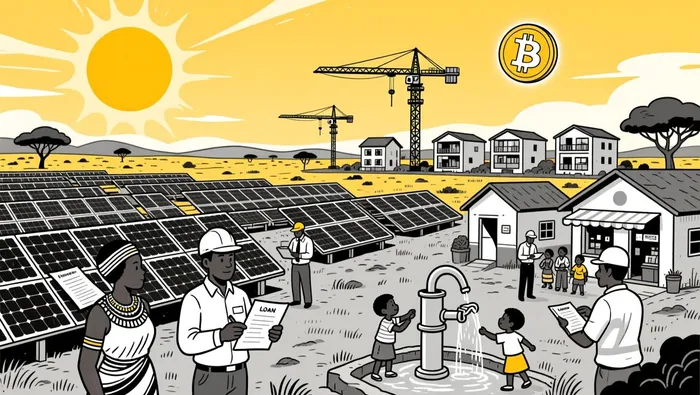
Bitcoin-backed credit programs are now playing a pivotal role in addressing infrastructure gaps, particularly in clean energy and social infrastructure. Platforms like SALT Lending and Africa BitCorp are leveraging Bitcoin as collateral to unlock capital for individuals and businesses, bypassing traditional banking barriers. For instance, SALT Lending offers crypto-backed loans with annual percentage rates (APRs) ranging from 9.95% to 14.45%, depending on loan-to-value (LTV) ratios and term lengths. These terms are competitive with traditional lending in regions where access to credit is constrained by bureaucratic inefficiencies or lack of collateral.
In Q3 2025, Kenya led African infrastructure funding with 57% of total capital directed toward clean energy projects. This aligns with broader trends: Bitcoin-backed credit is enabling MSMEs to secure funding for operations and expansion. For example, Kenyan fintech Pezesha facilitated over 3,751 loans by converting USD stablecoins into local currency, while Mozambique's Empowa used crypto to crowdsource real estate development. These initiatives highlight how decentralized finance (DeFi) is expanding access to capital in underserved markets.
Regulatory Evolution and Institutional Adoption
The regulatory landscape is also shifting to accommodate this disruption. Kenya's regulatory sandboxes, established to test blockchain-based innovations, and South Africa's integration of crypto trading into mainstream banking platforms signal a maturing ecosystem. South Africa's Absa Bank has developed crypto-related services, reflecting institutional confidence in digital assets. Meanwhile, Nigeria's economic challenges-such as its March 2025 currency devaluation-have accelerated Bitcoin adoption, with stablecoins like USDTUSDT-- and USDCUSDC-- facilitating 43% of the region's crypto transaction volume.
Measurable Impact on Financial Inclusion
The Global Findex 2025 reports that Sub-Saharan Africa's account ownership rate has risen from 34% to 58% between 2014 and 2024, driven by mobile money and digital payments. Bitcoin-backed credit platforms are amplifying this trend. For example, JUMO's AI-driven lending tools have enabled millions of entrepreneurs to access credit, while the Africa Finance Corporation (AFC) has contributed to $50 billion in GDP growth and 7 million jobs through infrastructure projects.
However, regulatory uncertainty, particularly in countries like Morocco, and financial literacy gaps hinder widespread adoption. Yet, the continent's startup ecosystem is resilient: fintech and cleantech raised $289 million in January 2025, a 240% increase from January 2024.
Investment Implications
For investors, Bitcoin-backed credit in Africa represents a dual opportunity: capitalizing on a $205 billion market while addressing systemic financial exclusion. The region's unbanked population-over 64 million in Nigeria alone presents a vast untapped market. Platforms like SALT Lending and Africa BitCorp are not only democratizing access to capital but also fostering economic resilience. As AI-driven tools enhance credit assessments and fraud detection, the scalability of these models will likely accelerate.
Yet, risks remain. Regulatory shifts, volatility in crypto markets, and infrastructure bottlenecks could disrupt momentum. Investors must balance these risks against the potential for long-term impact, particularly in sectors like clean energy and MSMEs, where Bitcoin-backed credit is already catalyzing growth.
Conclusion
Africa's financial infrastructure is undergoing a profound transformation. Bitcoin-backed credit is not merely a technological innovation-it is a tool for economic empowerment, enabling job creation, and redefining financial inclusion in a decentralized era. As the continent's regulatory frameworks evolve and adoption deepens, the intersection of crypto and infrastructure will likely become a cornerstone of emerging markets growth. For investors, the time to engage is now.







Comentarios
Aún no hay comentarios