
Bitcoin's Ascent: Can Institutional Adoption and Asset Displacement Close the $30 Trillion Gap with Gold?
The $30 Trillion Divide: Gold's Dominance and Bitcoin's Ambition
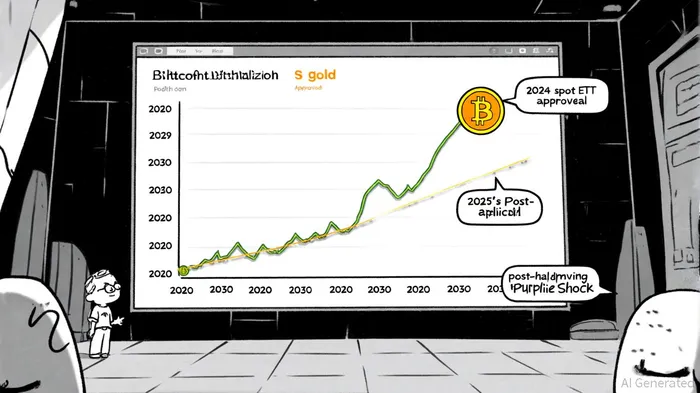
Gold's market capitalization has surged to $30 trillion in 2025, dwarfing Bitcoin's $2.1–$2.5 trillion valuation, according to a Mooloo analysis. This 10.5–14.5x gap reflects gold's entrenched role as a millennia-old store of value, bolstered by central bank purchases (1,045 tonnes in 2024, per the Mooloo analysis) and geopolitical tailwinds. Meanwhile, BitcoinBTC--, despite its 2025 price peak of $116,592, remains a niche asset. Yet, the narrative is shifting: Bitcoin's institutional adoption has exploded, with global ETPs and companies acquiring 944,330 BTC in October 2025 alone-surpassing 2024's total, according to a Bitcoin Magazine report.
Institutional Adoption: The New Gold Rush
Institutional demand for Bitcoin has reached unprecedented levels. As of September 2025, tracked entities hold 3.8 million BTC ($435 billion), with MicroStrategy (640,031 BTC) and Marathon Digital leading the charge, the Bitcoin Magazine report notes. The River Business Report 2025 notes that corporations now control 6.2% of Bitcoin's supply (1.3 million BTC), a 21x increase since 2020. Regulatory clarity (e.g., EU's MiCA and U.S. SEC compliance frameworks, as outlined in a Chainup blog post) and institutional-grade custody solutions have normalized Bitcoin as a treasury asset. For instance, the River Business Report finds that 75% of corporate Bitcoin buyers allocate 10% of annual net income to BTC, signaling a strategic shift toward decentralized value storage.
Asset Displacement: From Gold to Bitcoin
Bitcoin's rise has begun to displace gold in institutional portfolios. BlackRock's IBIT ETF attracted $6.96 billion in 2025 inflows, outpacing the SPDR Gold Trust's $6.5 billion, per a CoinEdition analysis. By July 2025, that CoinEdition analysis reports Bitcoin ETFs captured 70% of gold ETF inflows, totaling $50 billion. This trend reflects Bitcoin's unique value proposition: a decentralized, programmable alternative to gold's physicality. While gold rose 16% year-to-date in 2025, Bitcoin fell 6%, the Bitcoin Magazine report observed, yet institutional allocations persist due to Bitcoin's low correlation with equities (spiking to 1.0 during market stress, according to the Mooloo analysis) and its role as a hedge against fiat devaluation.
Macroeconomic Tailwinds: Inflation, Rates, and Geopolitics
The 2025 macroeconomic environment favors both assets. With the Federal Reserve poised to cut rates, non-yielding assets like gold and Bitcoin gain appeal, the Mooloo analysis suggests. U.S. debt levels and trade tensions further drive demand for hard assets. However, Bitcoin's post-halving supply shock (reduced block rewards) and exchange outflows suggest structural support for its price, a dynamic noted in the Mooloo piece. Gold, meanwhile, benefits from central bank accumulation and its zero-volatility profile (12% vs. Bitcoin's 50+%^1).
Long-Term Implications: Can Bitcoin Close the Gap?
For Bitcoin to surpass gold's $30 trillion market cap, it would need to achieve a price of ~$150,000–$200,000, the Mooloo analysis estimates, assuming current supply dynamics. While this seems ambitious, structural factors could accelerate the process:
1. Supply Constraints: Institutional holdings lock up 3.8 million BTC, the Bitcoin Magazine report highlights, reducing circulating supply.
2. Portfolio Diversification: BlackRockBLK-- recommends 1–2% Bitcoin allocation, while Ray Dalio advocates gold for preservation; the Mooloo analysis suggests a blended strategy (1–2% Bitcoin + 5–7% gold) may dominate.
3. Regulatory Maturity: MiCA and SEC frameworks, as discussed in the Chainup blog post, will likely spur further institutional inflows.
Conclusion: A Tale of Two Stores of Value
Gold's dominance as a safe-haven asset is unlikely to wane, but Bitcoin's institutional adoption and asset displacement trends signal a paradigm shift. While the $30 trillion gap remains vast, Bitcoin's 2025 trajectory-driven by ETFs, corporate treasuries, and regulatory clarity-suggests it could narrow significantly by 2030. Investors must weigh gold's stability against Bitcoin's innovation, recognizing that both assets serve distinct roles in a diversified portfolio.





Comentarios
Aún no hay comentarios