
Bitcoin's $90K Support Amid $125M January Options Expiry: Strategic Hedging and Market Volatility
Bitcoin's price action near the $90,000 level has become a focal point for institutional investors and derivative market participants as the $125 million January 2026 options expiry looms. This critical juncture is shaped by a confluence of factors: heavy options positioning, gamma-driven hedging flows, and evolving macroeconomic dynamics. Understanding these mechanics is essential for navigating the volatility and strategic opportunities ahead.
Derivative Mechanics and Gamma Dynamics
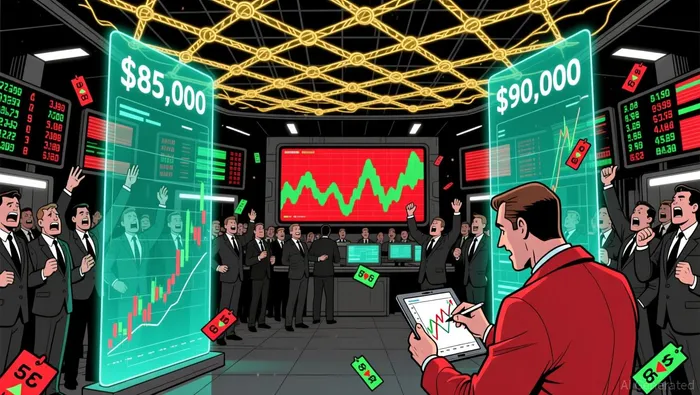
The $90,000 level is not just a psychological barrier but a structural fulcrum in Bitcoin's derivative ecosystem. According to a Coindesk report, Bitcoin's open interest on Deribit stands at $27 billion, with a put-call ratio of 0.38, signaling a strong upside bias toward the mid-$90,000s. This imbalance reflects institutional bullishness, but it also creates a fragile equilibrium. Dealer hedging behavior further complicates the picture: heavy put gamma near $85,000 acts as a floor, while call gamma near $90,000 caps rallies. This dual-sided gamma exposure means even minor price deviations could trigger sharp, mechanical responses from market makers.
As the January expiry approaches, clustered strike prices amplify the risk of short-term dislocations. A MEXC report highlights that concentrated hedging flows around these strikes could lead to large intra-day moves and short squeezes. For example, a $300 million gamma expiry in late December 2025 created a "gamma trap", mechanically suppressing price movement and forcing BitcoinBTC-- into a tight range. Such events underscore the importance of gamma management for institutions seeking to avoid forced liquidations or unintended directional bets.
Institutional Hedging Strategies
Institutional players are deploying a mix of options strategies to navigate this volatile environment. Zero-cost collars are gaining traction as a way to hedge downside risk without capping upside potential. For instance, a fund holding Bitcoin near $90,000 might buy a put at $85,000 to protect against a breakdown, while selling a call at $95,000 to offset the cost of the put. This strategy aligns with the current gamma landscape, where the $85,000 floor and $90,000 cap create a natural range.
Risk reversals are another tool. By buying out-of-the-money calls and selling puts, institutions can express bullish bias while reducing net premium outlays. This approach is particularly effective in a high-gamma environment, where market makers are forced to delta-hedge aggressively, amplifying price swings. However, as noted by on-chain analyst InvestadorBTC, a shift to "short gamma" if the $85,000 floor breaks could force dealers to sell $122 million per 1% decline, increasing the likelihood of sharp corrections.
Macroeconomic and Institutional Tailwinds
Beyond derivatives, broader macroeconomic trends are reshaping Bitcoin's trajectory. Bitcoin's correlation with the Nasdaq has risen to 0.52 from 0.23 in 2024, reflecting its growing role as a high-beta tech proxy rather than an independent macro hedge. This shift is driven by institutional adoption, including ETF inflows and corporate treasury purchases, which are creating deeper, institutional-grade infrastructure for Bitcoin.
Regulatory developments like the CLARITY Act and GENIUS stablecoin law are further cementing Bitcoin's institutional legitimacy. As one analyst puts it, 2026 marks the beginning of an "institutional era" where Bitcoin's path is tied more closely to equity risk, liquidity conditions, and portfolio rebalancing than to the halving clock alone. This transition reduces reliance on cyclical narratives and shifts focus to fundamentals like funding flows and derivative positioning.
Conclusion: A High-Plateau Consolidation
While the $125 million January expiry introduces near-term volatility, the broader picture suggests Bitcoin is in a high-plateau consolidation phase rather than a bear market decline. Long-term holders have quietly returned to accumulation, and the record $28.5 billion options expiry in late December 2025, though painful for short-term traders, reinforced this trend. Institutions are adapting by leveraging derivative tools to manage risk while capitalizing on Bitcoin's evolving role in diversified portfolios.
As the market navigates this inflection point, the interplay between gamma-driven mechanics, clustered strikes, and macroeconomic tailwinds will define Bitcoin's next chapter. For investors, the key lies in balancing strategic hedging with a long-term perspective, recognizing that volatility is not a threat but a feature of Bitcoin's maturing ecosystem.







Comentarios
Aún no hay comentarios