
Is Bitcoin's $87,000 Rally a Sustainable Rebound or a Dead-Cat Bounce?
Market Sentiment: A Fragile Optimism
Bitcoin's Q4 2025 performance has been marked by a sharp decline in investor confidence. According to a report by Coinotag, the cryptocurrency experienced a 15.13% net loss in the quarter, the weakest since 2018, with November alone accounting for 74% of this drawdown. Short-term holders (STHs) are particularly vulnerable, with nearly 99% in unrealized losses and 592k BTC at risk of liquidation. Institutional outflows have further exacerbated the bearish momentum, with over $3 billion in ETF withdrawals in November alone, signaling a lack of conviction in current price levels.
The Fear & Greed Index, a widely tracked sentiment metric, has plummeted into "extreme fear" territory-a condition historically associated with deeper corrections before stabilization. This suggests that retail and institutional investors are prioritizing risk management over speculative bets. While some analysts argue that Bitcoin's long-term structural thesis remains intact, the immediate outlook is dominated by caution. notes, "greed-driven recoveries appear unlikely without renewed institutional inflows or a shift in macroeconomic sentiment".
Technical Indicators: A Bearish Structure
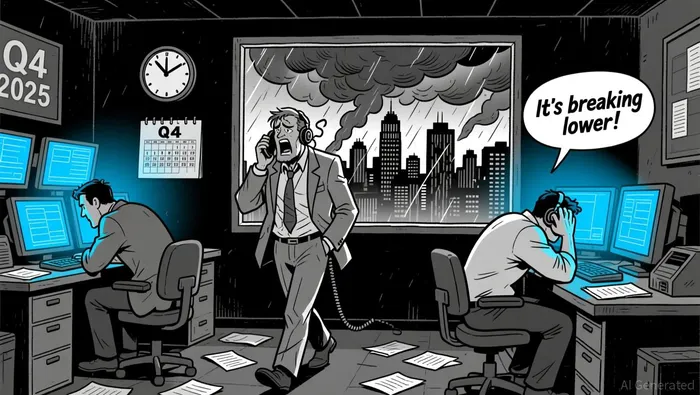 Bitcoin's technical chart paints a mixed but ultimately bearish picture. The asset has formed four successive lower lows since peaking at $126,000 in early October, failing to hold key support levels. The Relative Strength Index (RSI) has shown divergence, with the indicator failing to rise alongside Bitcoin's earlier October gains-a classic sign of weakening momentum.
Hyunsu Jung of Hyperion DeFi highlights that this technical weakness, combined with macroeconomic headwinds, points to further downside. Vasily Girya of GIS Mining adds that the $87,000 level is a critical short-term threshold: if BitcoinBTC-- settles below this level before U.S. stock trading opens, it could signal the start of a prolonged stagnation period, often referred to as a "crypto winter". A rapid recovery to $93,000 would be needed to stabilize confidence, but such a move appears unlikely without a catalyst.
Macroeconomic Catalysts: Interest Rates, AI Fatigue, and Geopolitical Risks
Bitcoin's price action in late 2025 is inextricably linked to broader macroeconomic trends. Falling interest rates, for instance, have reduced the net interest income of financial institutions like Urbo Bankas, which saw a 5% revenue growth to EUR 17.6 million despite declining profitability. This aligns with broader trends where lower rates disincentivize capital allocation to high-risk assets like crypto, as noted by Alex Thorn of Galaxy Digital.
The AI trade, a key driver of Bitcoin's earlier rally, is also showing signs of exhaustion. Institutional investors are shifting capital from crypto to equities, with the S&P 500 outperforming Bitcoin by a significant margin in 2025. Meanwhile, geopolitical tensions-such as the U.S.-China trade war and the Russia-Ukraine conflict-have triggered massive crypto liquidations. For example, missile and drone attacks in late November 2025 caused $3.5 billion in liquidations, deepening the selloff.
Regulatory developments, including the U.S. GENIUS Act and the pending CLARITY Act, add another layer of uncertainty. These measures could introduce more transparency but may also reduce crypto's appeal as an unregulated asset, further dampening investor appetite.
Conclusion: A Dead-Cat Bounce or a Precursor to Recovery?
Bitcoin's $87,000 rally appears to be a dead-cat bounce-a temporary rebound in a broader downtrend. The confluence of bearish sentiment, technical weaknesses, and macroeconomic headwinds suggests that the current price level is fragile. Institutional outflows, extreme fear metrics, and geopolitical risks all point to a continuation of downward pressure.
However, long-term investors may see value in Bitcoin's current price range. notes, reduced prices could create a "value zone" for bargain hunters. That said, a sustainable recovery will require a catalyst: either a shift in macroeconomic sentiment (e.g., Fed rate cuts) or renewed institutional demand. Until then, the market remains in a risk-off phase, with Bitcoin likely to test critical support levels in the coming months.







Comentarios
Aún no hay comentarios