
Bitcoin's Recent $83,000 Breakdown: A Strategic Buying Opportunity or a Bear Market Warning?
Macroeconomic Catalysts: The Perfect Storm
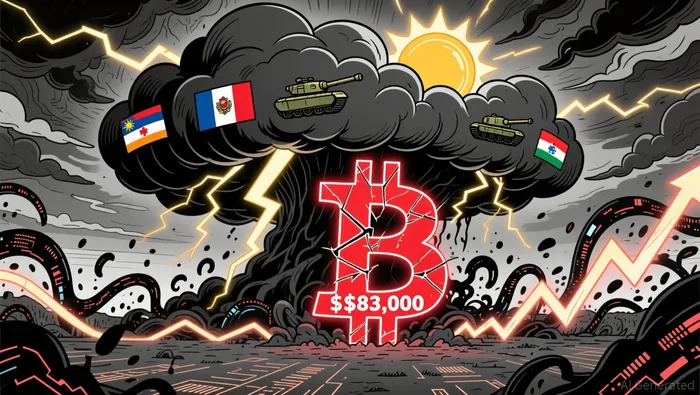
Bitcoin's $83,000 breakdown was not a standalone event but the culmination of a perfect storm of macroeconomic and geopolitical factors. The U.S. Federal Reserve's dovish pivot in 2025-marked by two 50-basis-point rate cuts in September and October-initially fueled a rally to a record $126,296. However, this optimism was short-lived. Internal disagreements within the Federal Open Market Committee and hawkish rhetoric from key officials eroded market confidence, slashing the probability of a December rate cut to 67.9% by October 2025.
Simultaneously, geopolitical tensions-particularly the U.S.-China trade war-intensified. Tariff hikes on Chinese imports triggered a 18% sell-off in BitcoinBTC-- over just a few days, as investors shifted capital to safe-haven assets. This dynamic highlights Bitcoin's evolving role as a liquidity barometer rather than a pure inflation hedge. While the asset historically correlated with inflation data, its 2025 price action was more closely tied to Fed policy and global risk sentiment.
Fund flows further exacerbated the downturn. By October 2025, Bitcoin ETFs recorded $1.38 billion in outflows over three weeks, reflecting waning retail and institutional confidence. Meanwhile, long-term holders dumped a record 84,806 BTC units, signaling a shift in cycle dynamics.
Technical Indicators: Bearish Control and Key Levels
From a technical perspective, Bitcoin's breakdown below $83,000 has handed bears the reins. The SuperTrend indicator on the weekly chart flipped to a sell signal, historically preceding average drawdowns of 61%. The Relative Strength Index (RSI) remains subdued at 38, and the MACD histogram is deeply negative, confirming bearish momentum (https://www.investing.com/analysis/bitcoin-sharp-correction-signals-latecycle-stress-amid-tight-liquidity-200670387).
Price action is now confined to a narrowing channel, with $96,000 as immediate resistance and $83,000–$84,000 as critical support. A breakdown below $83,000 could target $69,000–$72,000, with the "Trump Bottom" range of $90,000–$110,000 serving as a potential intermediate floor. Volatility metrics also suggest heightened risk: Bitcoin's 30-day implied volatility spiked to 85% in late October, mirroring the VIX index's spike during the same period.
Strategic Entry Points: Buy the Dip or Wait for Clarity?
The question of whether to "buy the dip" hinges on risk-adjusted entry points. Historically, Bitcoin's multi-cycle structure has featured 25–40% corrections before late-cycle rallies. The current decline aligns with this pattern, with parallels to 2016 and 2020 setups. However, the bearish case is strengthened by the fact that over 95% of Bitcoin's 21 million supply has already been mined, reducing the "scarcity premium" that often drives late-cycle euphoria.
Institutional behavior offers a mixed signal. While Bitcoin ETFs are hemorrhaging capital, on-chain accumulation addresses are buying aggressively. El Salvador and MicroStrategy, for instance, added 8,178 BTC at an average price of $102,200, signaling long-term conviction. This divergence suggests that while retail investors are fleeing, institutional players view the dip as a strategic entry point.
The Path Forward: Macro Liquidity and Policy Uncertainty
Bitcoin's near-term trajectory will likely depend on two factors: macro liquidity and regulatory clarity. If the Fed's dovish pivot accelerates-say, with a surprise rate cut in early 2026-Bitcoin could rebound toward $120,000–$150,000 by year-end. Conversely, persistent fund outflows and a hawkish Fed could push prices into the $40,000–$60,000 range, testing the resilience of long-term holders.
Geopolitical risks remain a wildcard. A de-escalation in U.S.-China tensions or a breakthrough in Middle East peace talks could reignite risk appetite, while renewed hostilities would likely drive capital back to safe havens . Meanwhile, the Trump administration's pro-crypto agenda-led by a potential "crypto tsar" and a more business-friendly SEC-could provide a regulatory tailwind if enacted .
Conclusion: A Calculated Bet in a High-Volatility Environment
Bitcoin's $83,000 breakdown is neither a clear buy signal nor an unambiguous bear market warning. Instead, it represents a high-risk, high-reward inflection point. For risk-tolerant investors, the current price offers a historically discounted entry, particularly if macro liquidity improves or institutional buying accelerates. However, those prioritizing capital preservation should wait for a retest of the $83,000–$84,000 support zone and a confirmation of a bottom via on-chain metrics like the realized loss margin (-16%) and fund flow trends (https://www.investing.com/analysis/bitcoin-sharp-correction-signals-latecycle-stress-amid-tight-liquidity-200670387).
In the end, Bitcoin's next move will be dictated by the same forces that have always shaped its journey: macroeconomic policy, geopolitical stability, and the ever-present tension between fear and greed.






Comentarios
Aún no hay comentarios