
Bitcoin's 70% Surge and the Rise of 145,100 Bitcoin Millionaires: A Strategic Inflection Point for Institutional Crypto Exposure?
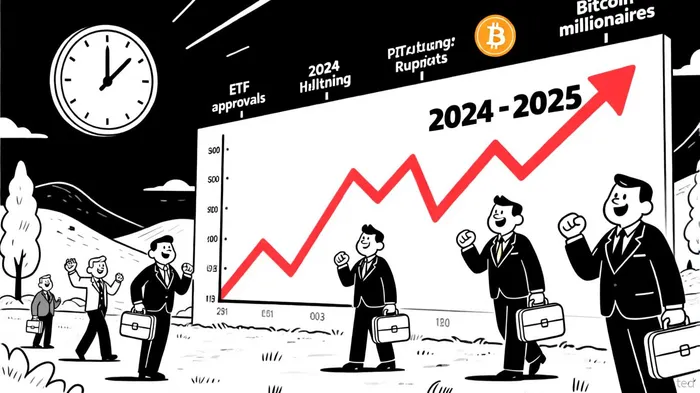
Bitcoin's 70% price surge in 2025 is not merely a market anomaly—it is a seismic shift in the global financial landscape, driven by a confluence of macroeconomic tailwinds, regulatory clarity, and institutional adoption. As the cryptocurrency's price has surged past $98,000 and approached $120,000 in late 2025, it has created 145,100 Bitcoin millionaires, a 70% year-on-year increase, according to the Henley & Partners Crypto Wealth Report 2025[1]. This surge marks a strategic inflection point for institutional investors, who are now grappling with the question: Is Bitcoin's post-regulatory era the gateway to long-term wealth creation, or a speculative bubble waiting to burst?
The Drivers of the 70% Surge: A Perfect Storm of Catalysts
Bitcoin's rally is underpinned by four key factors:
Institutional Adoption and ETF Inflows:
The approval of spot BitcoinBTC-- ETFs in early 2025 catalyzed a flood of capital into the asset. By mid-2025, ETFs like BlackRock's iShares Bitcoin Trust (IBIT) had attracted $50 billion in net inflows, directly increasing demand for BTC[2]. This institutional-grade infrastructure has transformed Bitcoin from a speculative asset into a legitimate portfolio staple, with corporations like StrategyMSTR-- Inc. accumulating 159,107 BTCBTC-- in Q2 2025 alone[2].Regulatory Clarity and Geopolitical Tailwinds:
The U.S. government's establishment of the Strategic Digital Asset Reserve and the passage of the GENIUS Act have reduced headline risk, making Bitcoin more palatable to institutional allocators[3]. These developments align with a broader global trend of regulatory normalization, as seen in the EU's MiCA framework and Japan's expanded crypto licensing regime.Macroeconomic Conditions:
A weakening U.S. dollar (DXY index down 12% year-to-date) and the Federal Reserve's anticipated rate cuts have bolstered Bitcoin's appeal as a hedge against currency debasement[4]. With real interest rates near zero, traditional fixed-income assets have lost luster, pushing capital into risk-on assets like Bitcoin.Post-Halving Dynamics:
The 2024 halving reduced Bitcoin's supply by 50%, tightening its scarcity and triggering a “wealth effect” as long-term holders (HODLers) accumulated more BTC. On-chain metrics, including a 13% decline in exchange-held supply over six months, further reinforce price resilience[5].
The Rise of 145,100 Bitcoin Millionaires: A New Financial Elite
The surge in Bitcoin millionaires is not just a function of price—it reflects a structural shift in how wealth is created and stored. According to Henley & Partners, the number of individuals holding $1 million+ in Bitcoin has grown to 145,100, with 26,758 new millionaires added in the first half of 2025 alone[6]. This growth is part of a broader trend: the global crypto millionaire count now stands at 241,700, up 40% from 2024[6].
The methodology behind these figures is robust. Henley & Partners' analysis combines blockchain analytics (tracking wallet balances) with market data to estimate wealth thresholds. For example, at $115,000 per BTC, a wallet holding 9 BTC would qualify as a “millionaire.” This approach highlights Bitcoin's role as a base currency for wealth accumulation, akin to gold but with programmable properties[7].
Institutional Exposure: A Strategic Inflection Point
The rise of Bitcoin millionaires signals a critical juncture for institutional investors. Historically, institutional adoption has followed a predictable pattern: early skepticism → regulatory clarity → capital inflows → price discovery. Today, we are witnessing the final phase.
ETFs as a Gateway:
Spot Bitcoin ETFs have democratized access to Bitcoin, enabling traditional investors to allocate capital without navigating custody risks. With $2.5 billion in inflows over two weeks in late 2025[1], these products are reshaping institutional portfolios.Corporate Balance Sheets:
Public companies now hold 159,107 BTC collectively, with firms like MicroStrategy and Tesla leading the charge[2]. This trend mirrors the 2008 financial crisis, when corporations began hoarding gold as a hedge—only this time, the asset is Bitcoin.Geopolitical Diversification:
The U.S. Strategic Digital Asset Reserve's plan to accumulate 1 million BTC over five years[5] underscores Bitcoin's role as a geopolitical tool. Institutions are now viewing Bitcoin not just as an asset class but as a strategic reserve to hedge against fiat instability.
Long-Term Wealth Creation: Beyond the 70% Surge
While the 2025 rally is impressive, the long-term potential of Bitcoin lies in its store-of-value properties and network effects.
Historical Precedent:
Post-halving cycles have historically delivered outsized returns. The 2020 halving preceded a 684% rally, and the 2024 event has already set the stage for a 150–400% return in 2025[8]. With Bitcoin's market cap now at $1.2 trillion (40% of the crypto market), its role as a “digital gold” is cementing.Future Projections:
Expert panels predict Bitcoin could reach $250,000 by late 2025 and $1 million by 2035[9]. These forecasts assume continued institutional adoption, a weakening dollar, and the maturation of Bitcoin's ecosystem (e.g., layer-2 scaling solutions).Institutional Infrastructure:
The rise of custodial services, derivatives markets, and Bitcoin ETFs has created a self-reinforcing cycle of demand. As more institutions allocate capital, Bitcoin's liquidity and price stability improve, attracting further inflows.
Risks and Considerations: Navigating the Volatility
No investment thesis is complete without addressing risks. While Bitcoin's fundamentals are bullish, three challenges remain:
Regulatory Whiplash:
Despite the GENIUS Act, regulatory uncertainty persists. A sudden crackdown in key markets (e.g., the U.S. or China) could trigger a sell-off.Macroeconomic Shocks:
A U.S. recession or inflation spike could reverse the current risk-on sentiment, causing Bitcoin to underperform.Competition from Altcoins:
Ethereum's upgrades and the rise of AI-native tokens could siphon capital from Bitcoin. However, Bitcoin's first-mover advantage and scarcity remain unmatched.
Conclusion: Timing the Inflection Point
Bitcoin's 70% surge and the creation of 145,100 millionaires represent more than a market rally—they signal a paradigm shift in how wealth is created and stored. For institutional investors, the question is no longer if to allocate to Bitcoin, but how much.
The post-regulatory era has lowered barriers to entry, while macroeconomic conditions (rate cuts, dollar weakness) and institutional infrastructure (ETFs, custody) have created a fertile ground for long-term wealth creation. As Bitcoin's market cap grows to rival gold and treasuries, its role as a global reserve asset will only solidify.
For those who missed the 2021 peak, 2025 offers a second chance—a chance to ride the next leg of a multi-decade trend. The question is whether the market will treat Bitcoin as a speculative asset or a foundational pillar of the 21st-century financial system.





Comentarios
Aún no hay comentarios