
Bitcoin's 6-Year Low in Reserves and Its Implications for Institutional Adoption
On-Chain Metrics as Leading Indicators of Market Sentiment
Bitcoin's exchange reserves have plummeted to a six-year low of 2.8 million BTCBTC-- as of October 2025, signaling a structural shift in market dynamics, according to a CoinCentral analysis. This decline reflects a broader trend of holders-particularly institutional actors-reducing exposure to trading platforms in favor of cold storage and corporate treasuries. Such behavior is historically correlated with bullish price cycles, as lower exchange liquidity often precedes upward price pressure, the CoinCentral analysis notes.
The on-chain data reveals a stark divergence between institutional and retail activity. Institutional investors, including whales and corporate entities, now control 16.57 million BTC, a 507,700 BTC increase over the past year, the CoinCentral analysis reports. These entities are acquiring BitcoinBTC-- at an average daily inflow of 1,460 BTC, with a strong positive correlation (+0.86) to BTC's price movements. In contrast, retail investors-defined as wallets holding less than 1 BTC-have seen a year-on-year decline of 54,500 BTC, with daily outflows averaging 220 BTC. This imbalance underscores a transition from retail-driven volatility to institution-led stability.
Institutional Adoption: A New Era of Capital Reallocation
The surge in institutional accumulation is amplified by the launch of U.S. spot Bitcoin ETFs, which have absorbed over 1.29 million BTC since 2024, as detailed in CoinGecko's 2025 report. These products have created a regulated on-ramp for traditional investors, enabling institutions to allocate capital to Bitcoin without navigating custody complexities. For example, BlackRock's IBIT alone has attracted $54.4 billion in cumulative net inflows by Q3 2025, a figure highlighted in CoinGecko's 2025 report. This institutional-grade infrastructure has also reduced Bitcoin's volatility, as large-scale OTC transactions now dominate accumulation activity, as shown in a 2025 market breakdown.
Corporate adoption further reinforces this trend. Over 344 companies now hold 3.88 million BTC, surpassing the current exchange supply, according to the CoinCentral analysis. MicroStrategy and TetherUSDT-- alone added 91,781 BTC to their treasuries in Q1 2025, per CoinGecko's 2025 report. The growing correlation between Bitcoin and equities (0.76) and its inverse relationship with Fed rates (-0.65) position it as a compelling hedge against macroeconomic uncertainty, as noted by the CoinCentral analysis. Sovereign wealth funds and pension funds are increasingly viewing Bitcoin as a diversification tool, particularly in a low-interest-rate environment, a trend emphasized in the 2025 market breakdown.
Strategic Entry Points for Long-Term Investors
The confluence of declining exchange reserves and institutional buying creates a compelling case for long-term investors. With only 2.8 million BTC on exchanges-less than the 3.88 million BTC held by corporations-Bitcoin's liquidity is increasingly concentrated in long-term holders, the CoinCentral analysis highlights. This dynamic reduces immediate sell pressure and aligns with historical patterns where tight exchange supply precedes price surges.
Moreover, the imbalance between institutional demand and new supply is striking. Bitwise data cited in the 2025 market breakdown shows that institutional demand absorbed 690,000 BTC in August 2025, compared to a mere 109,000 BTC in new mining supply. This 6.3x oversupply suggests that institutions are actively building positions, potentially setting the stage for a future breakout. Analysts like Standard Chartered have projected Bitcoin reaching $200,000 by year-end, a projection referenced in CoinGecko's 2025 report and attributed to the "structural bull foundation" created by institutional inflows.
Conclusion
Bitcoin's 6-year low in exchange reserves is not merely a technical statistic-it is a leading indicator of a paradigm shift in market structure. The on-chain metrics paint a clear picture: institutions are locking up Bitcoin as a strategic asset, while retail selling pressure wanes. For long-term investors, this represents a strategic entry point, as the asset's role as a store of value and inflation hedge is increasingly validated by both capital flows and macroeconomic trends. As the U.S. regulatory landscape continues to normalize Bitcoin's inclusion in institutional portfolios, the next phase of adoption may be less about price discovery and more about capital reallocation.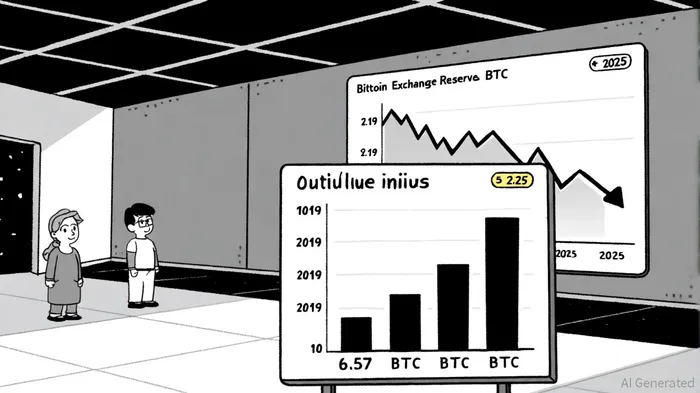





Comentarios
Aún no hay comentarios