
Is Bitcoin's 59% Spike in Buying Pressure a Breakout Catalyst or a False Dawn?
Bitcoin's November 2025 price action has sparked intense debate among investors and analysts. A 59% surge in buying pressure metrics initially fueled optimism, but this was swiftly followed by a 21% correction, leaving the market to grapple with whether the rally was a genuine breakout or a misleading signal. To assess this, we must dissect on-chain behavior, institutional/retail sentiment alignment, and macroeconomic dynamics.
On-Chain Metrics: Mixed Signals of Resilience and Weakness
On-chain data reveals a nuanced picture. The MVRV (Market Value to Realized Value) ratio has fallen to 1.61, indicating Bitcoin is trading below its realized value-a potential sign of a mid-term bottom. Meanwhile, the NUPL (Net Unrealized Profit/Loss) metric shows short-term holders facing losses, while long-term holders remain cautiously positioned according to on-chain analysis. Crucially, long-term investors added 375,000 BTC to wallets over 30 days, signaling growing confidence in Bitcoin's fundamentals.
However, these positives are offset by red flags. Long-term holders sold 800,000 BTC in November alone, exacerbating downward pressure. Blockchain revenues and decentralized exchange (DEX) volumes also plummeted, reflecting reduced user activity and liquidity. The Active Addresses indicator dropped sharply, suggesting waning retail demand.
Institutional and Retail Sentiment: A Fractured Landscape
Institutional behavior has been a double-edged sword. U.S. spot Bitcoin ETFs recorded $4.3 billion in net redemptions in November, driven by shifting macroeconomic expectations and risk-off sentiment. ETF outflows, particularly on November 20, accelerated the price decline. Yet, by late November, the tide began to shift: ETFs saw their first combined net inflow since late October, hinting at stabilization.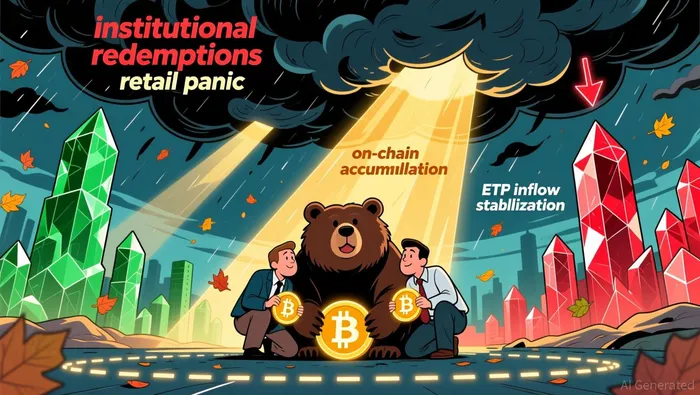 Retail sentiment, meanwhile, remained deeply bearish. The Crypto Fear & Greed Index stayed in the "fear" category, with the RSI dropping to 32, signaling oversold conditions. U.S. trading hours accounted for 85% of November's losses, underscoring retail panic. However, the RSI and MACD indicators suggest selling pressure may be exhausting, raising questions about whether the market is nearing a turning point.
Macroeconomic Integration: Bitcoin's New Normal
Bitcoin's correlation with traditional assets has deepened. Its 46% alignment with the Nasdaq 100 during selloffs highlights its role as a high-beta proxy for broader market risks. Similarly, Bitcoin's inverse correlation with gold underscored its integration into defensive capital rotation. This alignment, while reflecting Bitcoin's growing institutional adoption, also exposes it to macroeconomic headwinds.
The Federal Reserve's policy uncertainty-delayed economic data and conflicting signals about rate cuts-compounded volatility. Bitcoin's liquidity crisis, with market makers pulling back and order books drying up, further amplified its sensitivity to macro trends according to blockchain analysis.
Is This a Breakout or a False Dawn?
The 59% buying pressure spike appears to be a false dawn in the short term. While on-chain accumulation by long-term holders and ETF inflow stabilization suggest potential support, the broader context remains bearish. Institutional outflows, macroeconomic fragility, and retail fear dominate the landscape. The MVRV ratio's drop to 1.61 and NUPL's mixed signals indicate a possible floor, but these metrics alone cannot counteract the self-reinforcing sell-off dynamics observed in November.
For BitcoinBTC-- to transition from a false dawn to a genuine breakout, three conditions must align:
1. Sustained ETF inflows to rebuild institutional confidence.
2. A shift in Fed policy expectations toward rate cuts, reducing Bitcoin's correlation with risk-off assets.
3. On-chain accumulation by long-term holders to outweigh short-term selling pressure.
Until these factors materialize, the 59% spike remains a cautionary tale of market fragility. The coming months will test whether Bitcoin's on-chain resilience can overcome its newfound entanglement with traditional finance.






Comentarios
Aún no hay comentarios