
Bitcoin's 50% Drawdown Paradox: Navigating Institutional Adoption and Market Psychology in 2025
The Historical Pattern of 50% Drawdowns
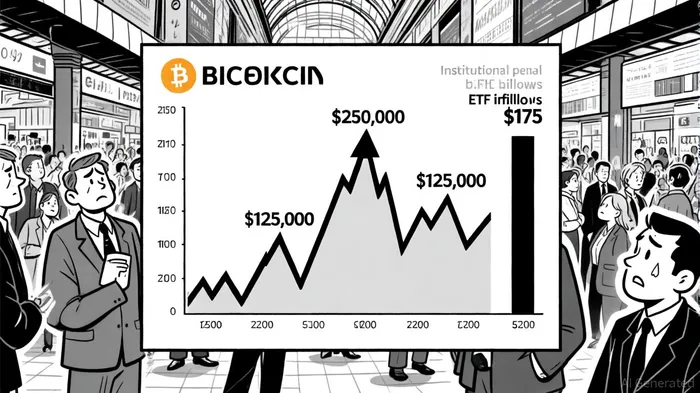
Bitcoin's history is marked by sharp corrections, even during bull cycles. Tom Lee, chairman of BitMine, has repeatedly warned that a 50% price drop remains a plausible scenario in 2025. For instance, a 20% decline in the S&P 500 could translate to a 40% drop in Bitcoin prices due to its amplified correlation with traditional markets. Historical precedents, such as Bitcoin's 50% fall from $69,000 in 2021 to $35,000 in 2022, underscore this pattern. If Bitcoin peaks at $200,000–$250,000 by year-end 2025, a 50% drawdown would bring it back to $100,000–$125,000, levels last seen in late 2024.
Institutional Adoption: A Double-Edged Sword
Institutional adoption has undeniably deepened Bitcoin's market infrastructure. According to CME Group insights, Q3 2025 saw record-breaking crypto derivatives volume-$900 billion in futures and options-with EthereumETH-- and Bitcoin derivatives growing by 355% and 17% year-over-year, respectively. The rise of large open interest holders (LOIH) to 1,014 by mid-September 2025 also signals broader participation. However, this growth has not eliminated volatility. For example, a 100% tariff on Chinese technology exports in October 2025 triggered a 14% Bitcoin price drop, illustrating how geopolitical events can override institutional confidence, as reported by Analytics Insight.
Risk Management in a Volatile Market
Institutions are deploying sophisticated tools to manage crypto exposure, but Bitcoin's volatility complicates these efforts. U.S. BTC and ETH spot ETFs now hold $115 billion in assets under management (AUM), yet they remain subject to sharp corrections, as noted in Digital Finance Briefing. The 30-fold surge in crypto dealmaking under the Trump administration-reaching $10 billion in Q3 2025-has introduced new players like FalconX and CoinbaseCOIN--, but it has also amplified speculative trading, according to a Coinotag report. As Tom Lee cautions, leveraged positions and stop-loss orders often exacerbate downward momentum during drawdowns.
The Psychology of Fear and Speculation
Bitcoin's price swings are deeply tied to market psychology. Geopolitical tensions, such as U.S.-China trade disputes, have historically triggered panic selling. Conversely, diplomatic optimism-like Trump's anticipated meeting with Xi Jinping-has led to short-term rallies. This emotional pendulum between fear and greed creates a feedback loop where institutional inflows coexist with retail-driven speculation. For example, SolanaSOL-- (SOL) and XRPXRP-- derivatives saw open interest surge to $2.1 billion and $1.4 billion, respectively, as altcoin speculation intensified, per the CME GroupCME-- insights.
Conclusion: Balancing Optimism with Caution
Bitcoin's institutional adoption is reshaping the financial landscape, but it has not eliminated the risks inherent to its speculative nature. While ETFs and regulated products provide a veneer of stability, the market remains susceptible to 50% drawdowns driven by macroeconomic shifts, geopolitical events, and psychological triggers. Investors must approach Bitcoin with a dual lens: leveraging institutional tools for risk mitigation while acknowledging the asset's enduring volatility. As Tom Lee aptly puts it, Bitcoin may be entering a "longer cycle," but the path to $1 million will likely be paved with both milestones and minefields.





Comentarios
Aún no hay comentarios