
Bitcoin's $5.7B STH Exchange Inflows: Profit-Taking or Institutional Adoption?
Bitcoin's recent $5.7 billion in Short-Term Holder (STH) exchange inflows have sparked debate among investors: Are these movements a sign of profit-taking by speculative traders or a structural shift toward institutional adoption? The answer lies in dissecting on-chain flow dynamics, ETF activity, and macroeconomic trends.
On-Chain Metrics: Profit-Taking or Accumulation?
On-chain data reveals a nuanced picture. According to Coin Metrics' Q3 wrap-up (https://coinmetrics.substack.com/p/state-of-the-network-issue-331), Bitcoin's MVRV Z-score (a measure of realized profit/loss) stood at 2.0 in Q3 2025, indicating the market remains below historical euphoria peaks but still in a profitable state for most holders. This suggests that while some STHs are realizing gains-particularly as BitcoinBTC-- approached resistance levels-large-scale panic selling is absent.
Exchange outflows have also surged, with over 4.52k BTC withdrawn on August 5, 2025, signaling accumulation behavior typical of early bull markets. However, these outflows do not necessarily equate to profit-taking. As noted in Sentora's analysis (https://sentora.com/research/articles/bitcoin-on-chain-analysis-correlations-on-chain-profit-and-large-holders), STHs are increasingly moving BTC to cold storage or ETF custody, reducing immediate liquidity and mitigating downward pressure - a trend highlighted by Analytics Insight (https://www.analyticsinsight.net/cryptocurrency-analytics-insight/5-major-changes-bitcoin-etfs-have-caused-in-the-market). This trend aligns with institutional adoption, where long-term holders prioritize security and regulated exposure over speculative trading.
ETF Flows: A Structural Shift in Institutional Demand
The most compelling evidence for institutional adoption lies in Bitcoin ETF performance. U.S. spot Bitcoin ETFs recorded $7.8 billion in net inflows during Q3 2025, with BlackRock's IBIT alone amassing $87.7 billion in assets under management (AUM) by August, according to Yahoo Finance (https://finance.yahoo.com/news/bitcoin-etfs-suffer-258m-outflow-152626116.html). These figures dwarf earlier volatility, such as the $5.3 billion outflow in Q2 2025, which TradingNews attributed to profit-taking and quarter-end rebalancing (https://www.tradingnews.com/news/bitcoin-etf-post-903m-usd-outlows-as-btc-usd-stabilizes-at-111k-usd-blackrock-ibit-gains).
Institutional confidence is further underscored by regulatory tailwinds. The SEC's approval of in-kind creation/redemption mechanisms for crypto ETPs in mid-2025 reduced operational friction, enabling smoother ETF flows and lower slippage, as StocksToday reported (https://www.stockstoday.com/bitcoins-september-showdown-institutional-momentum-versus-seasonal-pressure/). This innovation, coupled with the Clarity Act's passage, has normalized Bitcoin as a macro-asset, attracting corporate treasuries (e.g., MicroStrategy's $470M BTC purchase in July 2025) and traditional asset managers, per InvestingHaven (https://investinghaven.com/crypto-blockchain/coins/bitcoin/bitcoin-performance-so-far-in-2025/).
Market Dynamics: Profit-Taking vs. Institutional Resilience
While September's inflows reflect robust institutional demand, short-term profit-taking cannot be ignored. Long-term holders (LTHs) realized 3.4 million BTC in profits post-FOMC in September, according to blockchain.news (https://blockchain.news/flashnews/bitcoin-btc-on-chain-alert-3-4m-btc-lth-profit-taking-etf-inflows-slow). This activity coincided with a temporary slowdown in ETF inflows, raising concerns about distribution. However, the market rebounded swiftly, with ETFs absorbing $429 million in inflows on September 30 alone, as Dzilla reported (https://dzilla.com/bitcoin-bull-case-in-q4-from-116k-breach-to-160-200k-dreams-on-chain-forces-institutional-flows-in-2025/).
The key distinction lies in the destination of these inflows. Unlike historical patterns where STHs funneled BTC into exchanges for immediate selling, 2025's flows are increasingly directed toward ETFs. For instance, Fidelity's FBTC led September inflows with $298.7 million, while BlackRock's IBIT saw $72.9 million in a single day, per blockchain.news (https://blockchain.news/flashnews/us-bitcoin-etf-daily-flows-hit-518m-on-sept-29-2025-fbtc-leads-ibit-sees-outflow-as-btc-demand-concentrates). This shift indicates that institutions are prioritizing regulated, diversified exposure over direct exchange trading, reducing the risk of sudden liquidity crunches.
Macro Tailwinds and Seasonal Challenges
Bitcoin's September volatility-historically a weak period-has been tempered by macroeconomic factors. The U.S. Federal Reserve's rate-cut cycle, initiated in mid-2025, has boosted risk appetite, with ETFs benefiting from a $111,875 price floor supported by institutional buying, according to The Financial Analyst (https://thefinancialanalyst.net/2025/09/06/bitcoin-etf-inflows-spark-market-shifts-and-sustainability-questions/). However, a hawkish surprise could trigger leveraged liquidations, as Equiti noted when ETFs bled $903 million in a single week in August (https://www.equiti.com/sc-en/news/crypto-hub/will-bitcoin-2025-finally-escape-the-red-september-curse/).
Conclusion: A Tipping Point for Institutional Adoption
The $5.7B STH inflows in 2025 are best interpreted as a dual phenomenon: short-term profit-taking coexists with a broader institutional shift. While on-chain metrics confirm some distribution, the dominance of ETF-driven inflows-backed by regulatory clarity, corporate adoption, and macroeconomic tailwinds-points to a structural reorientation of Bitcoin's role in global finance.
For investors, the takeaway is clear: Bitcoin's market is maturing. The days of unregulated speculative frenzies are fading, replaced by a framework where institutional demand and regulated products anchor price discovery. As ETFs continue to absorb supply and reduce exchange liquidity, the next phase of Bitcoin's bull run may hinge less on retail sentiment and more on institutional conviction.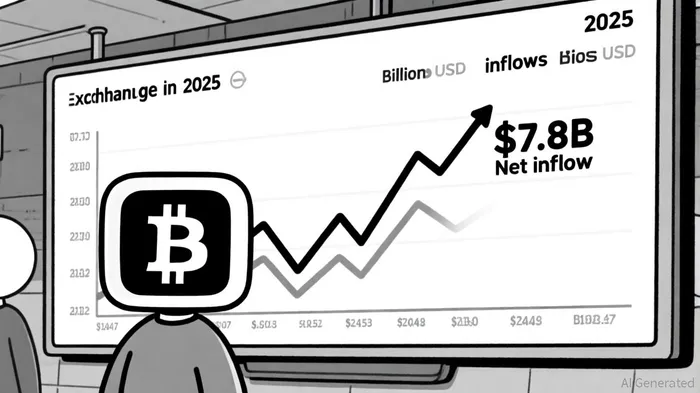






Comentarios
Aún no hay comentarios