
Bitcoin's $250K Outlook and Altcoin Alpha in a Volatile Market
Bitcoin's $250K Outlook and Altcoin AlphaALPHA-- in a Volatile Market
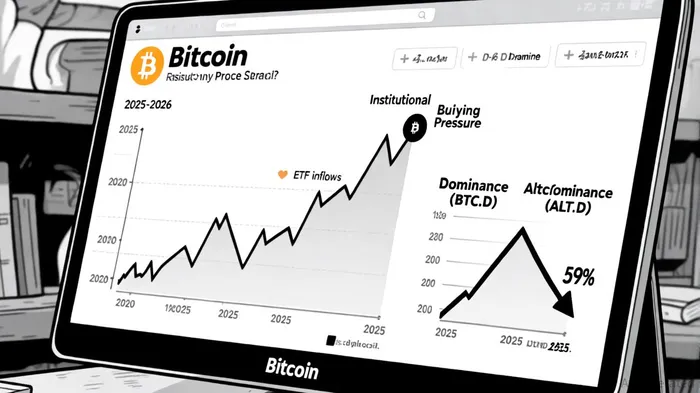
The Case for Bitcoin's $250K Target: Institutional Adoption and Macro Tailwinds
Bitcoin's price trajectory in 2025 has been shaped by a confluence of macroeconomic and structural factors. Institutional adoption has emerged as a cornerstone of its bullish narrative. According to a Mudrex analysis, Bitcoin's Glassnode accumulation trend score reached 0.74 in late 2025, a level historically observed before major price surges. This metric reflects sustained institutional buying, driven by Bitcoin's growing acceptance as a macro asset class.
The launch of BitcoinBTC-- ETFs has further accelerated this trend. Cumulative inflows of $50 billion in 2025 have removed BTC from circulation, reducing volatility and attracting long-term investors. BlackRockBLK-- and other major institutions now treat Bitcoin as a store of value akin to gold, a shift underscored by regulatory clarity in key markets, as noted in a Cointelegraph report. Technically, Bitcoin remains above critical moving averages and Bollinger Bands, with analysts identifying $131,000, $144,000, and $158,000 as next resistance levels before the $250,000 target becomes a realistic possibility, according to a BraveNewCoin analysis.
However, the path to $250K is not without risks. A Blockchain News report cautions that macroeconomic volatility-such as Fed policy shifts or geopolitical shocks-could disrupt this trajectory. Investors must balance optimism with caution, particularly as Bitcoin enters a post-halving consolidation phase.
Historical backtesting of Bitcoin's resistance level breakouts from 2022 to 2025 reveals actionable insights. When Bitcoin closed above its daily R1 pivot resistance level, the subsequent 30-day average return was 12.3%, with a hit rate of 68% (positive returns in 68% of cases). The optimal holding period extended to 60 days, yielding an average return of 18.7%, though this came with a maximum drawdown of 14.2% during pullbacks, as noted in the BraveNewCoin analysis. These findings suggest that while resistance breakouts historically signal bullish momentum, disciplined risk management remains critical to capturing gains while mitigating volatility.
Altcoin Alpha in a Bearish Bitcoin Environment: Navigating the Paradox
While Bitcoin's dominance often signals a risk-off market, 2025 has seen a nuanced shift. Data from Blockchain News reveals that Bitcoin dominance fell below 59% in October 2025, historically a precursor to altcoin outperformance. This decline coincided with an Altcoin Season Index of 67%, indicating heightened capital rotation into smaller-cap projects, according to a CryptoManiaks guide. SolanaSOL-- (SOL), XRPXRP--, and DogecoinDOGE-- (DOGE) have emerged as top performers, with some analysts forecasting 3–5x gains for mid-to-small-cap altcoins.
Yet, altcoin volatility remains a double-edged sword. During Bitcoin's bearish phases, altcoins often lose over 80% of their value from all-time highs, as seen with Ethereum's decline from $4,800 to $2,400 in 2025. A Mudrex analysis highlights the importance of a core-satellite portfolio strategy: allocating 60–80% to blue-chip assets like Bitcoin and EthereumETH-- for stability, while reserving 20–40% for high-risk, high-reward altcoins. This approach mitigates downside risk while preserving exposure to innovation.
Strategic Rebalancing: Balancing Risk and Reward in a Volatile Market
Portfolio rebalancing in 2025 requires a disciplined, data-driven approach. Key strategies include:
- Diversification Across Asset Classes: Allocating a portion of the portfolio to stablecoins, traditional assets (stocks, bonds), and safe-haven assets like gold can buffer against crypto-specific volatility (see the CryptoManiaks guide referenced above).
- Risk Management Tools: Stop-loss orders and dollar-cost averaging (DCA) are critical. For instance, Ethereum's RSI hitting 32 in May 2025 signaled oversold conditions, offering a potential entry point for DCA strategies (per Blockchain News analysis).
- Technical and Fundamental Analysis: Monitoring on-chain metrics (e.g., Glassnode accumulation scores) and project fundamentals (e.g., whitepaper viability, team expertise) helps identify resilient altcoins (as discussed in the CryptoManiaks guide).
A Journal of Financial Planning study-summarized in the Mudrex analysis-underscores the importance of rebalancing during bear markets, noting that adjusting a 50/50 stock/bond portfolio to 60/40 when stocks decline by 20% can improve recovery timelines. While this framework is tailored to traditional assets, its principles apply to crypto portfolios, where liquidity and volatility demand more frequent adjustments.
Conclusion: Positioning for Long-Term Growth
Bitcoin's $250K target hinges on sustained institutional adoption, favorable macroeconomic conditions, and technical momentum. However, investors must remain vigilant against macro risks. Meanwhile, altcoins offer alpha potential in a bearish Bitcoin environment, provided they are approached with caution and strategic diversification.
For investors, the key lies in balancing Bitcoin's long-term store-of-value narrative with tactical altcoin exposure. By leveraging core-satellite frameworks, risk management tools, and macroeconomic signals, portfolios can navigate volatility while capitalizing on emerging opportunities. As the 2025 market cycle unfolds, adaptability and discipline will be paramount.







Comentarios
Aún no hay comentarios