
Bitcoin's $250,000 Outlook: Kiyosaki's Bold Bet Amid Volatility and Systemic Risk
Kiyosaki's Rationale: "Fake Money" and the Case for Real Assets
Kiyosaki's bullish stance on Bitcoin is less about speculative hype and more about systemic distrust in fiat currencies. He argues that the Federal Reserve's "fake money" policies-zero-interest rates, quantitative easing, and debt monetization-have eroded the value of traditional assets while creating a "wealth gap" between the financially educated and the rest. "Money is a game," Kiyosaki asserts, and those who understand the rules are positioning for a future where decentralized assets like Bitcoin and gold act as hedges against currency devaluation, as reported by Cointelegraph.
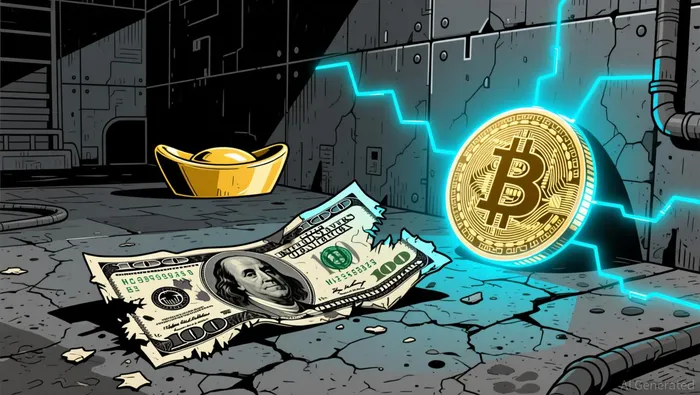
His $250,000 Bitcoin target is paired with an equally staggering $27,000 gold price projection by 2026. This dual bet reflects a broader strategy: accumulating "real money" assets that retain value during economic downturns. For Kiyosaki, Bitcoin is notNOT-- just a speculative play-it's a digital counterpart to gold, offering scarcity, portability, and resistance to central control, as reported by Cointelegraph.
Bitcoin's Dual Role: Risk Amplifier or Decoupling Hedge?
The October 2025 flash crash, where Bitcoin plummeted over $20,000 in a single day, underscores the asset's paradoxical nature. According to a Financial Content report, the crash wiped out $19.36 billion in crypto liquidations within 24 hours, revealing Bitcoin's susceptibility to macroeconomic triggers like trade tensions and regulatory uncertainty. Yet, in calmer markets, Bitcoin has shown a unique ability to decouple from traditional assets. Academic research highlights that Bitcoin's correlation with the S&P 500, gold, and U.S. Treasuries fluctuates wildly depending on market regimes, offering a "dynamic hedge" that static models fail to capture, as detailed in a ScienceDirect study.
This duality creates both risk and opportunity. During crises, Bitcoin can amplify systemic stress by attracting panic selling. But in tranquil periods, its decentralized nature allows it to act as a portfolio diversifier-a role that grows more compelling as central banks lose credibility.
Contrarian Investing: Navigating Volatility with Discipline
For contrarian investors, volatility is not a barrier but a feature. The October 2025 crash, while painful, was framed by some as a "necessary reset" to purge overleveraged positions and irrational exuberance. "This is a healthy flush for the ecosystem," one crypto influencer noted in the aftermath, emphasizing that long-term holders view such events as buying opportunities, as reported by Financial Content.
Kiyosaki's philosophy aligns with this mindset. He stresses emotional discipline, warning that fear of short-term losses often blinds investors to long-term gains, as noted in BeInCrypto. His strategy-buying during dips and holding through cycles-mirrors the tactics of value investors like Warren Buffett, albeit applied to a digital asset with far greater volatility.
Systemic Risks and the Road Ahead
Despite its potential, Bitcoin's role in traditional finance remains contentious. The October crash exposed vulnerabilities in risk management frameworks, with institutional outflows from Bitcoin ETFs reaching nearly $800 million as panic set in, as reported by Financial Content. Regulators, too, are grappling with how to integrate decentralized assets into existing systems without stifling innovation.
Yet, as the ScienceDirect study notes, Bitcoin's foundational technology-blockchain-offers a blueprint for a more resilient financial system. Its integration into traditional markets, while still nascent, suggests a maturing asset class that could coexist with gold as a secondary safe haven.
Conclusion: A High-Stakes Bet on the Future
Kiyosaki's $250,000 Bitcoin target is as much a commentary on the state of global finance as it is a price prediction. In a world where central banks print money and governments default on debt, decentralized assets offer an alternative-a digital "escape hatch" for those who distrust the status quo.
But this path is fraught with risks. Bitcoin's volatility, regulatory uncertainty, and systemic amplification during crises demand a disciplined, long-term approach. For contrarian investors, however, these challenges are not deterrents-they're opportunities to bet against the crowd and reap rewards when the tide turns.
As the Fed's "fake money" experiment continues and macroeconomic instability deepens, the question is no longer if Bitcoin will reach $250,000, but who will be positioned to capitalize when it does.






Comentarios
Aún no hay comentarios