
Bitcoin’s 2025 Spam Wars: Ideological Fragmentation and the Risk-Reward Tradeoff for Long-Term Value
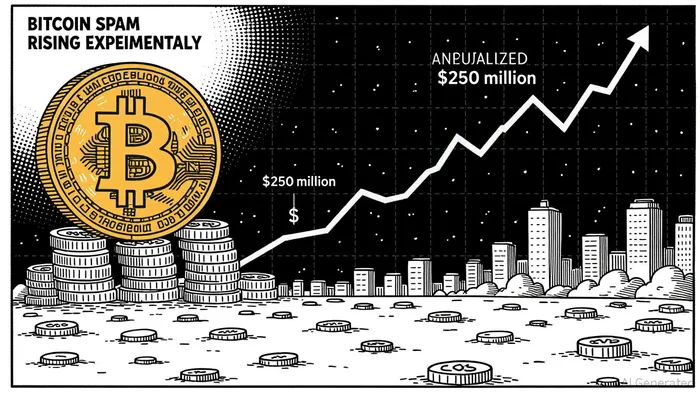
Bitcoin’s 2025 Spam Wars have ignited a fierce ideological battle over the network’s core identity. At stake is whether BitcoinBTC-- remains a streamlined, censorship-resistant store of value or evolves into a decentralized data layer. This conflict, driven by JPEG spam and arbitrary data inscriptions, has exposed deep fractures in the community, with implications for Bitcoin’s long-term utility and investment appeal.
The Spam Dilemma: Data vs. Money
According to a report by Mitrade, Bitcoin’s network processed over 100 million JPEG inscriptions by August 2025, up from 88 million in May, with annualized fees from these activities reaching $250 million [1]. This surge, enabled by the removal of the 83-byte spam filter, has sparked debates about network congestion and transaction costs. Adam Back, founder of Blockstream, warns that non-monetary data—such as images, videos, and documents—threatens Bitcoin’s efficiency as a peer-to-peer electronic cash system [1].
Bitcoin Core’s proposal to expand the arbitrary data limit to 2 MB per block (via version 30, slated for October 2025) has further polarized stakeholders. Proponents argue that this change unlocks new use cases, such as on-chain NFTs and decentralized communication. Critics, however, fear it could enable illegal content (e.g., child pornography) and regulatory scrutiny, undermining Bitcoin’s censorship-resistant ethos [2].
Ideological Fragmentation: The Cost of Innovation
The Spam Wars echo the earlier Blocksize Wars, but with a modern twist: Ordinals and meta-token protocols are redefining what Bitcoin can be. While these innovations attract developers and creatives, they risk alienating traditionalists who view Bitcoin as a monetary system. As stated by Bitcoin Knots developers, lifting the OP_RETURN limit could lead to “abuse and the loss of Bitcoin’s core principles” [2].
This fragmentation extends to governance. Miners, who control transaction prioritization, face limited economic incentives to curb spam. Despite collecting $250 million annually from JPEG-related fees, this represents just 0.1% of miner profits after costs [1]. Without aligning spam reduction with economic incentives, Back argues, the network risks becoming a “playground for data hoarders” [4].
Risk-Reward Tradeoff: Store of Value vs. Data Utility
For investors, the 2025 Spam Wars present a critical risk-reward analysis. Risks include:
1. Network Congestion: Increased data inscriptions could raise transaction fees, pricing out small users and deterring adoption [1].
2. Regulatory Backlash: If spam includes illegal content, governments may impose stricter compliance measures, eroding Bitcoin’s censorship-resistant appeal [2].
3. Ideological Drift: A shift toward data-centric use cases could dilute Bitcoin’s identity as digital gold, creating uncertainty for institutional investors [3].
Conversely, rewards include:
1. Innovation Incentives: Data inscriptions and Ordinals could attract new users, diversifying Bitcoin’s utility beyond payments [2].
2. Censorship Resistance: By enabling decentralized communication (e.g., Ethereum’s Input Data Messages [2]), Bitcoin could become a tool for free speech in censored environments.
3. Fee Market Resilience: Higher fees from data transactions might offset declining block subsidies, bolstering long-term security [3].
Broader Implications: Spam as a Weapon of Censorship
The 2025 Spam Wars extend beyond the blockchain. On social media platforms like X (formerly Twitter), coordinated bot swarms have weaponized algorithmic manipulation to suppress content visibility [3]. While these tactics don’t directly impact Bitcoin, they highlight a broader trend: digital platforms are increasingly battlegrounds for ideological control. Bitcoin’s ability to resist such manipulation—by enabling censorship-resistant communication—could become a key differentiator [2].
Conclusion: Balancing Innovation and Core Principles
Bitcoin’s long-term value hinges on its ability to balance innovation with its foundational principles. The 2025 Spam Wars underscore a critical juncture: Will the community prioritize scalability and monetary utility, or embrace data-centric experimentation? For investors, the risk-reward tradeoff lies in Bitcoin’s adaptability. If the network can evolve without compromising its censorship-resistant core, it may emerge stronger. However, if ideological fragmentation leads to governance paralysis or regulatory crackdowns, Bitcoin’s store-of-value proposition could face existential challenges.
As the dust settles on the 2025 Spam Wars, one truth remains: Bitcoin’s future is not just about code—it’s about the values its community chooses to defend.
Source:
[1] Adam Back calls for new Bitcoin rules to curb spam and ... [https://www.mitrade.com/insights/news/live-news/article-3-1099181-20250905]
[2] Bitcoin blockchain can become home to child pornography? [https://crypto.news/bitcoin-blockchain-become-home-to-child-pornography/]
[3] Bitcoin's long-term security budget problem [https://www.tradingview.com/news/cointelegraph:9647892bc094b:0-bitcoin-s-long-term-security-budget-problem-impending-crisis-or-fud/]
[4] Adam Back Sounds Alarm: JPEG Spam Threatens Bitcoin ... [https://www.btcc.com/en-US/square/CryptotimesIO/908941]






Comentarios
Aún no hay comentarios