
Bitcoin's 2025 Resilience: ETF-Driven Market Structure Shifts and the Institutional Takeover
Bitcoin's 2025 narrative is defined by two forces: institutional adoption and ETF-driven market structure shifts. These forces have notNOT-- only reshaped Bitcoin's liquidity and volatility profile but also signaled a tectonic shift in how the asset is perceived by traditional finance. By October 2025, the cryptocurrency's price resilience-despite volatile swings-has been underpinned by a surge in institutional demand, regulatory clarity, and structural innovations like spot BitcoinBTC-- ETFs.
The ETF Revolution: Liquidity, Order Book Depth, and Institutional Flow
The approval of U.S. spot Bitcoin ETFs in early 2024 marked a watershed moment. By August 2025, these ETFs collectively held 1.296 million BTC-6.5% of the total supply-with BlackRock's iShares Bitcoin Trust (IBIT) dominating the market with $87.7 billion in assets under management [1]. This institutional-grade infrastructure has transformed Bitcoin's market dynamics:
- Liquidity and Price Discovery: ETFs have shifted trading activity to U.S. exchanges during equity market hours, aligning Bitcoin's price discovery with traditional financial systems. ETF shares now trade at high volumes, compressing bid-ask spreads and reducing slippage for large investors [1].
- Order Book Resilience: Institutional orders are clustered at key psychological levels (e.g., $98,026.2 and $99,115.38), creating deep liquidity pools that stabilize price during volatility [4]. This contrasts with the fragmented retail order flow of pre-ETF eras.
- Fee Competition and Accessibility: ETF providers slashed fees to 0.15–0.25%, far below older products like Grayscale's GBTC (1.5%), democratizing access for institutional and retail investors alike [1].
The result? Bitcoin's volatility has dropped from an average of 65% annualized pre-ETF to 45% post-ETF [4], making it a viable addition to diversified portfolios.
Institutional Adoption: A 7.4x Surge in Demand
Institutional demand in 2025 has been nothing short of explosive. By October 8, 2025, global ETPs and publicly traded companies had acquired 944,330 BTC-surpassing the total purchased in all of 2024 and representing 7.4 times the new supply mined in 2025 [3]. This accumulation is driven by:
- Corporate Treasuries: Over 338 tracked entities, including 265 public and private companies, now hold Bitcoin. MicroStrategy alone added 4,200 BTC (~$470M) in July 2025 [2].
- Sovereign Reserves: Countries like Bhutan (13,000 BTCBTC--, 28% of GDP) and El Salvador (6,003 BTC) have added Bitcoin to their reserves, while U.S. states like Texas and Arizona established strategic Bitcoin reserves [3].
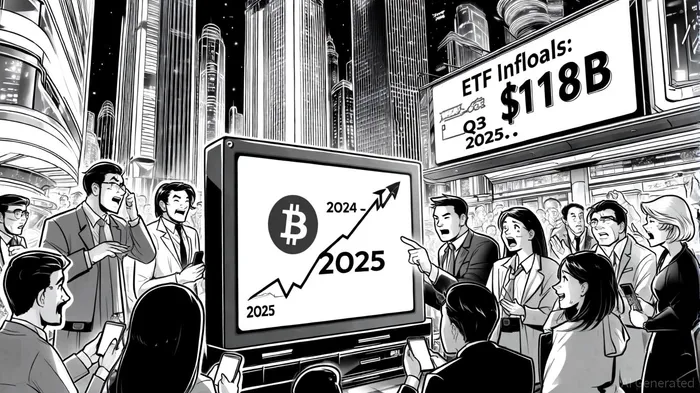
- ETF Inflows: Q3 2025 saw $118 billion in ETF inflows, directly correlating with Bitcoin's price surge to record highs [4].
This institutional buying is not speculative-it's strategic. Businesses now allocate 10% of net income to Bitcoin on average, with 75% of corporate clients having fewer than 50 employees [3]. Small businesses are leading the charge, signaling a broad-based adoption wave.
Volatility and Liquidation Risks: The September 2025 Correction
Despite institutional tailwinds, Bitcoin faced a liquidity crunch in September 2025. Derivatives data revealed $220 billion in open interest, with perpetual futures volumes 8–10x higher than spot trading [1]. When Bitcoin dipped below $124,000 to $112,000, $1.7 billion in leveraged long positions were liquidated [4]. Analysts warned that a drop to $104,500 could trigger $10 billion in long liquidations, while a rally above $124,000 could wipe out $5.5 billion in short positions [1].
However, the market's resilience shone through. A short squeeze in October liquidated $330 million in short positions, propelling Bitcoin back toward $120,000 [2]. This rebound was fueled by:
- Dovish Fed Policy: A 25-basis-point rate cut in September 2025 injected liquidity into risk assets.
- Whale Accumulation: Large BTC holders added to their positions during the dip, signaling long-term conviction [2].
The Future: ETFs as a Gateway to Mainstream Finance
Bitcoin ETFs are no longer a novelty-they're a bridge. By Q3 2025, ETFs had attracted $58 billion in institutional capital, with BlackRock's IBIT capturing 89% market share [4]. This infrastructure has normalized Bitcoin as a 1–2% allocation in institutional portfolios, hedging against inflation and macroeconomic risks [1].
Looking ahead, the implications are profound:
- Market Cap Expansion: With ETF inflows acting as a durable demand channel, Bitcoin's market cap could surpass gold's by 2029 [3].
- Regulatory Tailwinds: The SEC's market-friendly stance under new leadership has reduced institutional uncertainty, fostering innovation in tokenized assets and stablecoins [1].
- Global Adoption: European and Asian institutions are now exploring Bitcoin via international feeder funds, signaling a global institutional adoption wave [1].
Conclusion: A New Era of Resilience
Bitcoin's 2025 journey underscores a fundamental truth: institutional adoption and ETF-driven liquidity are reshaping the asset's trajectory. While volatility remains, the structural shifts in order book depth, fee competition, and regulatory clarity have created a resilient market. As institutions continue to allocate billions and ETFs normalize Bitcoin's role in traditional portfolios, the cryptocurrency is no longer a speculative bet-it's a cornerstone of modern finance.





Comentarios
Aún no hay comentarios