
Bitcoin's 2025 Price Trajectory: Institutional Adoption and Macroeconomic Tailwinds Drive a New Era
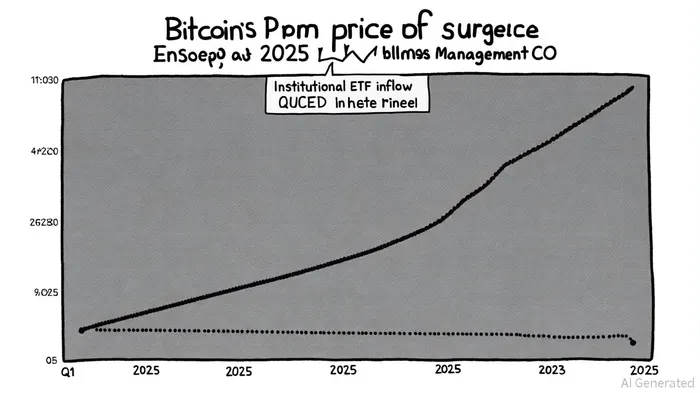
Bitcoin's 2025 price trajectory has been nothing short of revolutionary, driven by a confluence of institutional adoption and macroeconomic tailwinds. The cryptocurrency's journey from a speculative asset to a cornerstone of institutional portfolios has been catalyzed by regulatory clarity, technological infrastructure, and a reimagining of its role in global finance. By September 2025, Bitcoin's price has surged to historic levels, with analysts and investors alike recalibrating their expectations for the digital asset's future.
Institutional Adoption: The New Paradigm
The institutionalization of BitcoinBTC-- in 2025 has been a watershed moment. According to a report by Pinnacle Digest, institutional investors now allocate roughly 59% of their portfolios to include at least 10% in Bitcoin and other digital assets[4]. This shift is underpinned by the introduction of spot Bitcoin ETFs, which have democratized access to the asset for large-scale investors. By April 2025, these ETFs had amassed over $65 billion in assets under management (AUM) globally, with BlackRock's iShares Bitcoin Trust (IBIT) alone accounting for $18 billion in Q1 2025[4].
The U.S. government's March 2025 executive order establishing a “Strategic Bitcoin Reserve” further normalized Bitcoin's integration into traditional finance[5]. This move, coupled with the approval of spot ETFs in early 2024, has spurred 43% of private equity firms to actively invest in digital assets or blockchain projects[3]. Sovereign wealth funds (SWFs) have also entered the fray, diversifying reserves with Bitcoin as a hedge against geopolitical instability and monetary expansion[4].
Corporate treasuries are now a significant force in Bitcoin's adoption. Over 180 corporations, including MicroStrategy (now StrategyMSTR-- Inc.), have allocated portions of their reserves to Bitcoin, with the latter holding 632,457 BTC valued at $71 billion by mid-2025[3]. Institutional-grade custody solutions have lowered barriers to entry, making Bitcoin a prudent treasury strategy. As a result, ETFs now control 6% of Bitcoin's total supply[3], reshaping the asset's market structure.
Macroeconomic Tailwinds: A Perfect Storm
Bitcoin's price surge in 2025 is not solely a function of institutional demand but also a response to macroeconomic dynamics. The U.S. Federal Reserve's policy shift, signaled by Chair Jerome Powell at Jackson Hole in August 2025, has created a tailwind for Bitcoin as investors anticipate rate cuts[4]. Bitcoin's price behavior in Q3 2025 showed a stronger reaction to U.S. employment data than inflation figures, reflecting its growing integration into traditional financial markets[4].
The asset's role as a hedge against fiat debasement has also gained traction. With U.S. federal debt reaching $36.2 trillion[3], Bitcoin's inclusion in 401(k) accounts and its adoption by SWFs underscore its appeal as a store of value. On-chain metrics, such as increased holdings by mid-tier investors and robust hash rates, further signal institutional confidence[5].
Price Trends and Volatility: A New Normal
Bitcoin's price trajectory in 2025 has been marked by unprecedented stability. By mid-August 2025, the asset reached all-time highs above $124,000, with a market capitalization exceeding $4.11 trillion[1]. This surge was fueled by ETF inflows, which surpassed $118 billion by August 2025[1]. Notably, Bitcoin's volatility has plummeted by 75% compared to pre-ETF levels, with average daily volatility dropping from 4.2% to 1.8%[1]. This reduction is attributed to increased liquidity and long-term buying by institutional players[3].
Looking Ahead: A $200,000+ Future?
Analysts project Bitcoin's price could reach $200,000 to $210,000 within 12 to 18 months, driven by sustained institutional demand and improved market stability[4]. Long-term models suggest a compound annual growth rate of 28.3%, with Bitcoin potentially hitting $1.3 million by 2035[5]. Institutional investors are expected to allocate between 1% and 5% of their portfolios to Bitcoin, solidifying its status as a macro-asset[5].





Comentarios
Aún no hay comentarios