
Bitcoin's 2025 Price Correction: Macro Pressures and Sentiment Shifts Reshape the Narrative
Bitcoin's 2025 price correction has sparked a reevaluation of its role in global finance, with macroeconomic pressures and shifting investor sentiment driving a 32% decline from its October peak to below $86,000 by late November according to analysis. This downturn, fueled by Federal Reserve policy uncertainty, stubborn inflation, and evolving market dynamics, has exposed cracks in Bitcoin's narrative as a reliable inflation hedge. At the same time, diverging behaviors between institutional and retail investors-alongside structural on-chain fragility-highlight a market at a crossroads.
Macroeconomic Pressures: The Fed's Tightrope and Inflation's Resilience
The Federal Reserve's pivot from dovish to hawkish signals in late 2025 has been a primary driver of Bitcoin's volatility. Despite a 25-basis-point rate cut in December, the market's muted response-Bitcoin rose only 8%-underscored a loss of confidence in its traditional safe-haven appeal according to market data. Analysts argue that the Fed's reluctance to aggressively cut rates, coupled with inflation persisting above 2%, has created a "risk-off" environment where Bitcoin's high-beta characteristics dominate over its perceived store-of-value role as research shows.
Compounding this, the U.S. government's growing debt and deficits have eroded trust in the dollar as a stable reserve asset according to Grayscale research. While this theoretically positions BitcoinBTC-- as an alternative, its recent performance has contradicted that narrative. For instance, Bitcoin's correlation with equities-particularly AI-driven tech stocks-has surged, with its average correlation to the S&P 500 and NASDAQ 100 rising to 0.5 and 0.52, respectively, in 2025 according to Reuters analysis.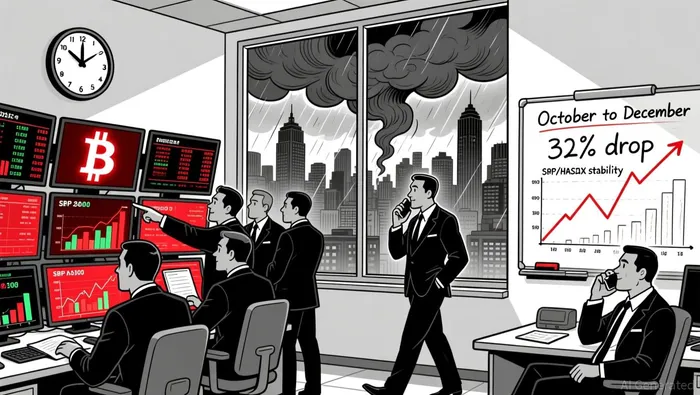 This alignment with risk-on assets has diluted its appeal as a hedge, especially as investors increasingly treat it like a speculative tech stock rather than a macroeconomic safeguard as data indicates.
Investor Sentiment: Institutional Calm vs. Retail Panic
The October 2025 selloff revealed stark contrasts between institutional and retail investor behavior. Institutional players, buoyed by regulatory clarity (e.g., the GENIUS Act) and improved digital asset infrastructure according to SSGA analysis, maintained long-term positions and even added to holdings via U.S.-listed spot Bitcoin ETFs according to Aurpay data. In contrast, leveraged retail traders exacerbated the decline by unwinding positions, triggering cascading liquidations according to Morningstar analysis. By December, on-chain data confirmed retail investors were in an "Extreme Fear" state per the Crypto Fear & Greed Index, while institutional flows turned positive according to Aurpay analysis.
This divergence reflects broader shifts in market psychology. While institutional confidence remains rooted in Bitcoin's growing adoption as a strategic asset, retail sentiment has been swayed by macroeconomic and geopolitical events-such as U.S. tariff threats-amplifying short-term volatility according to Morningstar analysis. Meanwhile, ETF flows have turned negative, signaling reduced institutional appetite and heightened sensitivity to macroeconomic conditions according to Glassnode data.
Structural Weaknesses and the Path Forward
Bitcoin's on-chain metrics paint a picture of a market under strain. Rising unrealized losses and profit-taking by long-term holders indicate structural fragility according to Glassnode analysis. Exchange balances have also swelled, suggesting increased selling pressure as investors liquidate holdings according to Forbes reporting. These factors, combined with a thinning demand buffer from ETFs, raise concerns about Bitcoin's ability to withstand further macroeconomic shocks.
Looking ahead, Bitcoin's trajectory in 2026 may hinge on global monetary easing and risk appetite. A Fed pivot toward aggressive rate cuts could reignite bullish sentiment, but this depends on inflation cooling-a scenario complicated by a resilient labor market and net revisions to non-farm payrolls hitting pandemic-era highs according to Bitwise analysis. For now, the market appears to be in a cyclical reset, with investors recalibrating expectations for Bitcoin's role in portfolios according to Morningstar analysis.
Conclusion: A New Equilibrium?
Bitcoin's 2025 correction has forced a reckoning with its macroeconomic and sentiment-driven challenges. While institutional demand remains a stabilizing force, the asset's evolving identity-as both a speculative play and a potential hedge-remains unresolved. For investors, the key takeaway is clear: Bitcoin's future performance will depend not only on its intrinsic properties but also on the interplay of global monetary policy and the maturation of investor sentiment. In this new landscape, diversification and a nuanced understanding of Bitcoin's dual nature will be critical.







Comentarios
Aún no hay comentarios