
Bitcoin's 2025 Halving and the Path to $200K: A Macroeconomic and Supply-Driven Analysis
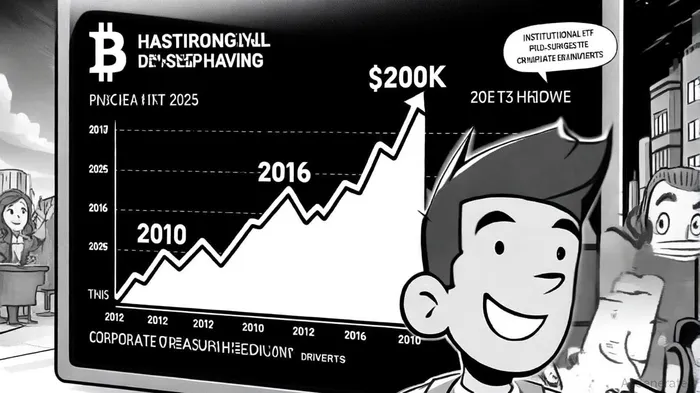
The BitcoinBTC-- halving of April 2024, which reduced blockXYZ-- rewards from 6.25 to 3.125 BTC, has set the stage for a new era of scarcity-driven value creation. While historical patterns suggest a bullish trajectory, the 2025 price action has been uniquely shaped by macroeconomic tailwinds and institutional adoption. This analysis explores how the interplay of supply constraints, institutional demand, and global liquidity dynamics could propel Bitcoin toward $200,000 by year-end.
Supply Constraints: The Structural Foundation
Bitcoin's halving event is a programmable scarcity mechanism, reducing new supply by 50% every four years. By April 2024, the annual issuance had dropped to 900,000 BTC, a 50% decline from pre-halving levels[1]. This structural deflationary pressure historically correlates with price surges: the 2020 halving preceded a 540% rally to $63,850[2], while the 2016 halving drove a 294% increase[3]. However, the 2024 halving initially saw Bitcoin stabilize around $60,000, suggesting that traditional supply-side dynamics alone are insufficient to explain current price action.
Institutional Demand: A New Paradigm
The approval of U.S. spot Bitcoin ETFs in January 2024 marked a watershed moment. By September 2025, these ETFs had attracted over $54.8 billion in net inflows, with BlackRock's IBIT alone securing $14 billion in assets[4]. This institutional adoption has created a demand-supply imbalance: ETFs and corporate treasuries now absorb approximately 1.98 million BTC in holdings, reducing circulating supply and amplifying scarcity[5]. For example, MicroStrategy's “digital treasury” model—where Bitcoin replaces traditional reserves—has been replicated by firms like TeslaTSLA-- and CoinbaseCOIN--, with corporate holdings expanding by 20% in Q2 2025[6].
Ethereum's institutional adoption further underscores this trend. Post-approval in July 2024, EthereumETH-- ETFs accumulated $9.9 billion in assets, representing 3.35% of the network's market cap[4]. This diversification of institutional interest into altcoins signals a maturing market, where Bitcoin's dominance is complemented by broader crypto adoption.
Macroeconomic Catalysts: Liquidity and Policy Shifts
Global liquidity expansion and central bank policies are amplifying Bitcoin's appeal. As of Q3 2025, Bitcoin ETFs represent 6% of the total Bitcoin market cap[4], a figure that could rise with anticipated Solana and XRPXRP-- ETF approvals. Analysts like Andre Dragosch argue that macroeconomic factors—such as inflation hedging and interest rate dynamics—now outweigh historical halving volatility[7]. For instance, Bitcoin's inclusion in 401(k) plans and the passage of the GENIUS Act (which clarifies crypto tax treatment) have normalized its role as a macroeconomic asset[5].
Central banks' potential easing cycles also play a role. With global liquidity expanding and real interest rates trending downward, Bitcoin's fixed supply becomes a counterbalance to fiat devaluation. Standard Chartered analysts note that sustained ETF inflows and corporate demand could drive Bitcoin to $200,000 by year-end, assuming macroeconomic stability[8].
The Path to $200K: Quantifying the Catalysts
To assess Bitcoin's potential, consider the following metrics:
1. ETF Inflows: $3.8 billion in Q1 2025 inflows[4] suggest continued institutional buying, which could sustain upward momentum.
2. Corporate Holdings: A 20% quarterly increase in corporate treasuries[6] implies Bitcoin is becoming a strategic reserve asset, reducing circulating supply.
3. Historical Multiples: If Bitcoin's price-to-digital-gold ratio (a hypothetical metric comparing Bitcoin's market cap to gold's) aligns with gold's 10x valuation multiple, Bitcoin could reach $1 million by 2030[3].
Risks and Considerations
While the case for $200K is compelling, risks persist. Regulatory shifts, geopolitical instability, or a reversal in macroeconomic trends could dampen demand. Additionally, Bitcoin's price has yet to replicate the post-halving volatility seen in 2020[2], suggesting market maturity may temper short-term swings.
Conclusion
Bitcoin's 2025 halving, combined with institutional adoption and macroeconomic tailwinds, has created a unique confluence of supply-side scarcity and demand-side innovation. As ETFs and corporate treasuries absorb new supply, Bitcoin's role as a macroeconomic asset is cementing. While $200K remains ambitious, the structural forces at play—reduced issuance, institutional demand, and regulatory clarity—make it a plausible outcome. Investors should monitor ETF inflows, corporate buying patterns, and central bank policies as key indicators of Bitcoin's next phase.





Comentarios
Aún no hay comentarios