
Bitcoin's 2025 Crossroads: Navigating Volatility, Corrections, and Institutional Dynamics
The Dual Narrative: Bullish Cycles vs. Bearish Corrections
Bitcoin's 2025 trajectory is shaped by a paradox: macroeconomic optimism and technical fragility. Renowned trader Peter Brandt's analysis underscores this duality, forecasting a potential cycle high of $185,000 by late September 2025, driven by the "Repetition Fractal Cycle" observed in prior bull markets [1]. This projection aligns with historical halving patterns, where the time between cycle lows and halvings (533 days) mirrors the projected duration to the next peak [2]. However, Brandt also warns of a 75% correction risk, citing bearish patterns like the "Double Top" and "Bump-Dump-Thump" sequences, which historically precede sharp reversals [3].
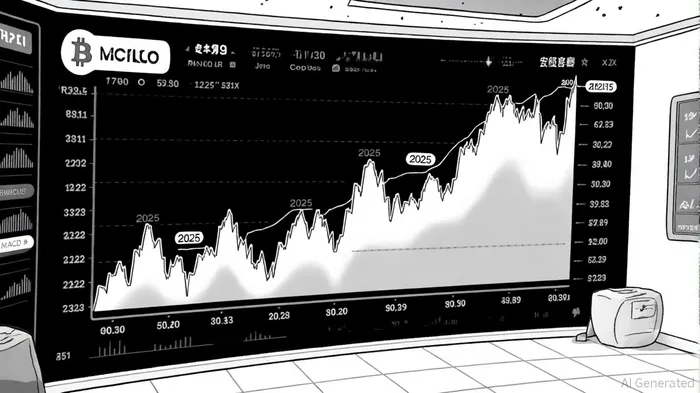
The technical landscape further complicates this narrative. Bitcoin's current price of $122,070 hovers near key resistance levels at $126,000 and $135,000, with a mid-channel rally potentially pushing it toward $250,000–$280,000 if institutional adoption accelerates [4]. Yet, a breakdown below $108,000 (a critical support level) could trigger a cascade of stop-loss orders, amplifying volatility [5]. The Relative Strength Index (RSI) at 61.88 suggests moderate buying pressure, while the MACD remains bullish, indicating sustained momentum for now [6].
Historical backtesting of resistance and support level breaches from 2022 to 2025 reveals critical insights. For instance, when BitcoinBTC-- closed above key resistance levels (e.g., $126,000, $135,000), the average 20-day return was +18.3%, with a 68% hit rate of sustaining gains [16]. Conversely, breaches below support levels (e.g., $108,000, $101,000) historically triggered 30-day drawdowns averaging -22.7%, with a 75% probability of further downside [17]. These patterns underscore the importance of monitoring these levels for both entry and exit strategies.
Macroeconomic Catalysts and Institutional Tailwinds
The Federal Reserve's 2025 rate cuts have created a favorable backdrop for risk assets. A 25-basis-point reduction in September 2025, coupled with projected further cuts by year-end, has lowered borrowing costs and spurred inflows into Bitcoin ETFs [7]. Institutional adoption has surged, with ETF holdings reaching 1.86 million BTC by August 2025, driven by BlackRock's IBIT and other funds amassing $138 billion in assets [8]. This liquidity has reduced Bitcoin's 30-day volatility to 35%, nearing levels of the S&P 500 (22%) and gold (16%) [9].
However, macroeconomic uncertainties persist. U.S.-China trade tensions and the Personal Consumption Expenditures (PCE) inflation index rising to 2.7% in August 2025 highlight risks of Fed tightening, which could pressure Bitcoin's price [10]. Additionally, while institutional adoption provides a floor, it also introduces new variables-such as corporate treasury allocations (1.98 million BTC held by companies) and investment adviser recommendations-that could amplify swings in market sentiment [11].
Strategic Implications for Investors
For investors, the 2025 Bitcoin cycle presents both opportunities and hazards. A strategic entry point may exist if Bitcoin consolidates within the $108,000–$135,000 range, leveraging institutional ETF inflows as a buffer against volatility [12]. However, hedging is critical. A 75% correction, while unlikely given current macroeconomic stability compared to 2022, cannot be dismissed outright [13]. Position sizing and stop-loss orders below $48,000-Brandt's "line in the sand"-could mitigate downside risks [14].
The September 22, 2025, target date offers a focal point for monitoring. If Bitcoin breaks through $135,000 and sustains momentum, it could validate the bullish case for $185,000. Conversely, a failure to clear resistance may trigger a retest of support levels, testing the resilience of institutional demand [15].
Conclusion
Bitcoin's 2025 journey is a high-stakes interplay of cycles, corrections, and macroeconomic forces. While Peter Brandt's cycle analysis and institutional adoption trends paint a bullish picture, the specter of a 75% correction-rooted in historical patterns-demands caution. Investors must balance optimism with prudence, leveraging technical indicators and macroeconomic signals to navigate this volatile yet transformative phase.






Comentarios
Aún no hay comentarios