
Bitcoin's 2025 Correction: Bear Market or Pre-2026 Rally Setup?
The cryptocurrency market in 2025 has been a study in contradictions. Bitcoin's 36% decline from its annual peak-a move eerily mirroring the 2022 bear market with a 98% correlation-has sparked debates about whether this is the end of a prolonged downturn or the prelude to a 2026 rebound according to analysis. At the heart of this analysis lies a critical question: Is the current correction a bear market in its own right, or a market cycle inversion driven by ETF-driven demand and macroeconomic forces that could set the stage for a $150,000–$250,000 rally next year?
Market Cycle Inversion: ETF Outflows and Institutional Divergence
Bitcoin's 2025 trajectory has been shaped by a paradox. While the price has plummeted, institutional demand-particularly through ETFs-has shown resilience. In late 2025, Bitcoin ETFs recorded $226 million in net inflows, yet November alone saw record-setting outflows of $3.55 billion, the largest since the ETFs' inception in early 2024 according to data. This divergence between price action and capital flows suggests a market inversion: retail panic selling is being offset, at least temporarily, by institutional positioning.
The outflows, however, have exacerbated the selloff. The $1 trillion wipeout in total crypto market capitalization reflects a broader flight to liquidity, driven by macroeconomic uncertainty. Yet technical indicators hint at a potential bottoming process. The weekly RSI has reached levels consistent with historical bear market troughs, while derivatives platforms like Deribit show 85% of open interest concentrated in Bitcoin, signaling lingering demand for the asset.
The 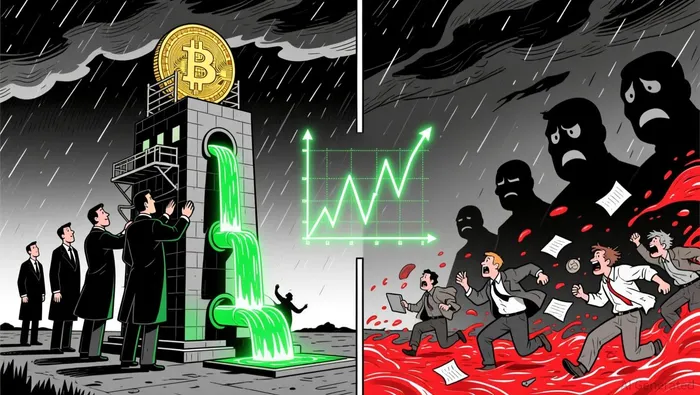 suggests an evolving landscape. The divergence between price and capital flow patterns is not just a statistical anomaly—it is a sign of market maturation. While the broader crypto market continues to contract, Bitcoin's institutional footprint remains resilient, with ETFs and derivatives platforms acting as stabilizers. This dynamic indicates a structural shift in how institutional investors approach the crypto space, using derivatives to hedge against retail volatility.
Dominance Shifts: A Fragmented Market or a New Paradigm?
Bitcoin's market dominance has defied historical patterns. During the 30% correction in late 2025, its dominance dropped instead of rising-a stark contrast to prior corrections where BitcoinBTC-- typically consolidated market share. This divergence suggests that altcoins, not Bitcoin, absorbed the brunt of the selloff. Analysts attribute this to macroeconomic factors: Trump's tariff announcements and AI valuation concerns created a risk-off environment where altcoins-often more speculative-were hit harder.
Yet this fragmentation may not be a bearish signal. Bitcoin's dominance had previously surged to 65% in 2025, driven by declining altcoin performance and institutional adoption in derivatives and ETFs. The current drop in dominance could indicate a consolidation phase, where investors are rebalancing portfolios rather than abandoning crypto entirely.
The 2026 Rebound: Macro Liquidity and Institutional Adoption
The case for a 2026 rebound hinges on two pillars: macroeconomic liquidity and institutional adoption. First, expectations of Federal Reserve rate cuts remain a wildcard. If the Fed begins easing in early 2026, risk-on sentiment could return, with Bitcoin-historically a hedge against inflation and monetary expansion-positioned to benefit. Second, the record $732 billion in capital inflows from 2022 to 2025 suggests that institutional demand is not a fleeting trend. Even amid the crash, Bitcoin's derivatives market remains robust, with 80% of Deribit's volume tied to the asset.
A $150,000–$250,000 rebound by 2026 would require a confluence of factors: a Fed pivot, renewed AI-driven risk appetite, and a stabilization of ETF flows. While the path is uncertain, the interplay of ETF-driven demand and macroeconomic cycles creates a scenario where Bitcoin's 2025 correction could act as a catalyst for a multi-year bull run.
Conclusion
Bitcoin's 2025 correction is neither a straightforward bear market nor a simple bear trap. It is a market cycle inversion, driven by ETF outflows, dominance shifts, and macroeconomic uncertainty. For investors, the key lies in distinguishing between short-term pain and long-term potential. If history is any guide, the current turmoil may be laying the groundwork for a 2026 rebound fueled by institutional adoption and macro liquidity-a scenario where Bitcoin's price could reclaim-and surpass-its 2024 highs.






Comentarios
Aún no hay comentarios