
Bitcoin's $175K Target: A Convergence of Macroeconomic Catalysts and On-Chain Momentum
Bitcoin's $175K Target: A Convergence of Macroeconomic Catalysts and On-Chain Momentum
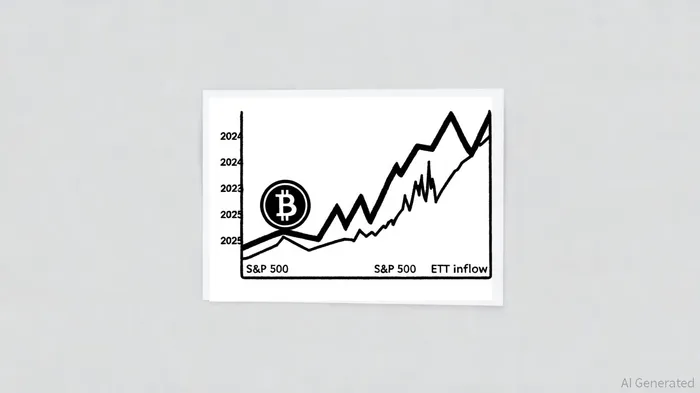
The cryptocurrency market has long been a barometer for macroeconomic shifts, and Bitcoin's recent ascent to record highs underscores its growing role as a hedge against traditional financial uncertainties. As of September 2025, BitcoinBTC-- trades near $115,000, but analysts and institutional investors are increasingly eyeing a $175,000 target. This potential surge is not merely speculative-it is underpinned by a confluence of macroeconomic catalysts and robust on-chain momentum metrics.
Macroeconomic Catalysts: Dovish Policy and Institutional Adoption
The U.S. Federal Reserve's dovish pivot in 2024–2025 has been a cornerstone of Bitcoin's bullish narrative. A 0.25% rate cut in September 2025, with further reductions anticipated in October and December, has created a low-interest-rate environment that favors risk-on assets, according to a FinancialContent deep dive. This monetary easing, coupled with a U.S. inflation rate of 2.9% in August 2025 (projected to rise to 3% in Q4), reinforces Bitcoin's appeal as a store of value amid currency devaluation concerns, according to the same FinancialContent deep dive.
Institutional adoption has further amplified this dynamic. The approval of spot Bitcoin ETFs in early 2024 injected over $58.44 billion in net inflows by October 2025, with cumulative inflows surpassing $14.2 billion in early October alone, according to the FinancialContent deep dive. These ETFs have not only stabilized Bitcoin's volatility but also normalized its inclusion in institutional portfolios. Over 1 million BTC is now held by publicly listed companies, signaling a paradigm shift in how Bitcoin is perceived as a long-term treasury asset, according to a Fortune piece.
Deutsche Bank analysts have even speculated that central banks may soon add Bitcoin to their reserves, citing its declining volatility and growing similarity to gold, as the FinancialContent deep dive notes. While Bitcoin lacks the physical backing of gold, its performance in 2024–2025-reaching record highs and outperforming traditional assets by +119%-has made it an attractive diversification tool, as the Fortune piece observes.
On-Chain Momentum: Network Strengthening and Miner Activity
Bitcoin's on-chain metrics paint a picture of a maturing network. The Network Value to Transactions (NVT) ratio, a critical valuation tool, has surged to levels near the historical "overbought" threshold. As of September 2025, the NVT Golden Cross-a derivative metric tracking short-term versus long-term trends-reached 1.98, approaching the 2.2 level that has historically coincided with local price tops, according to a Cointelegraph analysis. This suggests that Bitcoin's market value is increasingly justified by its transaction volume, which hit 619,514 daily transactions in September 2025-a 9.08% increase from the prior day, per YCharts data.
Miner activity also reflects a strengthening network. Bitcoin's hashrate crossed 1 Zettahash in April 2025 and reached an all-time high of 1.085 Zettahashes in August 2025, the FinancialContent deep dive reports. This surge is driven by institutional investments in mining infrastructure, particularly in the U.S., where companies are adapting to energy and regulatory shifts under the Trump administration. The U.S. now accounts for 37.8% of the global hashrate, with emerging markets like Paraguay and Oman gaining traction due to government-backed energy subsidies, as noted in the Fortune piece.
Historical Correlation: NVT and Fibonacci Levels
Historically, Bitcoin's price surges have aligned with NVT ratio patterns. During the 2017 and 2021 bull cycles, the NVT ratio signaled overvaluation before corrections occurred, per YCharts data. However, in 2025, the ratio's trajectory suggests a different dynamic: a strengthening network with growing utility. The FinancialContent deep dive cites the CoinGecko Bitcoin Report 2025, noting that active Bitcoin addresses reached 944,000 in August 2025, a metric that has historically preceded major price movements.
Analysts have also linked Bitcoin's price to Fibonacci extensions. The 1.618 level, which corresponds to approximately $173,646 in 2025, aligns with the $175K target, per the Cointelegraph analysis. This is further supported by exponential decay fit analysis and post-halving supply scarcity, which have historically driven Bitcoin to multi-year highs, according to the Cointelegraph analysis.
The Path to $175K: Risks and Realities
While the case for $175K is compelling, risks remain. Bitcoin's lack of physical backing, regulatory uncertainties, and environmental concerns-such as its 20% electricity consumption in Kazakhstan-could dampen adoption, as the Fortune piece warns. However, the growing convergence of Bitcoin with AI and high-performance computing (HPC) infrastructure, as seen in companies like Riot PlatformsRIOT--, suggests a broader technological integration that could mitigate these challenges, according to the Fortune piece.
Conclusion
Bitcoin's potential surge to $175K is not a leap of faith but a synthesis of macroeconomic tailwinds and on-chain fundamentals. Central bank dovishness, institutional adoption, and a strengthening network-evidenced by NVT trends and miner activity-create a compelling case for further appreciation. As the lines between traditional finance and digital assets blurBLUR--, Bitcoin's role as a strategic reserve asset and inflation hedge is likely to solidify, making the $175K target increasingly plausible.





Comentarios
Aún no hay comentarios