
Bitcoin's 17-Year Evolution: A Structural Reset in the Macro Era
Bitcoin is marking a historic milestone. On October 31, 2025, the cryptocurrency celebrated the 17th anniversary of its foundational whitepaper. That document, a nine-page blueprint for a decentralized currency, has birthed an industry now worth nearly $4 trillion. The asset itself has transformed from a niche experiment into a $2 trillion digital asset, with over 350 institutional entities holding a combined 4 million BTC. Yet this anniversary arrives amid a striking anomaly: a historic retreat by the very institutions that helped build this new asset class.
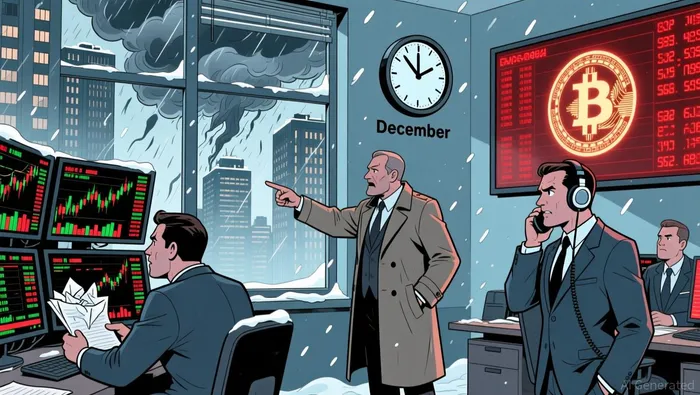
The tension is stark. While Bitcoin's journey is defined by its 17-year evolution from a cypherpunk idea to a strategic reserve asset, its recent performance tells a different story. In the final two months of 2025, the market witnessed its worst two-month stretch on record for spot BitcoinBTC-- ETFs. Investors yanked a combined $4.57 billion from these funds, with outflows of $3.48 billion in November and $1.09 billion in December. This institutional exodus was not a minor correction; it coincided with a 20% slide in bitcoin's price over the same period. Ether ETFs suffered a similar fate, losing over $2 billion.
This sequence frames a potential structural shift. The era of relentless, ETF-driven institutional adoption appears to be giving way to a more complex, macro-driven market. The whitepaper's anniversary serves as a powerful marker of Bitcoin's journey, but the recent outflows suggest a market recalibrating. The capital that once flowed in to capitalize on the narrative is now stepping back, testing the asset's resilience against a backdrop of broader financial conditions. The bottom line is that Bitcoin's path is no longer solely defined by its own cycle. It is now a financial asset whose price is increasingly subject to the same liquidity flows and risk assessments that govern traditional markets. The 17-year experiment is entering a new phase.
The Mechanics of the Reset: From Regulatory Overhang to Seasonal Liquidity
The sharp outflows and price decline at year-end were not a sign of a broken thesis, but the result of a complex interplay between temporary market mechanics and deeper structural concerns. Separating these forces is key to understanding the current setup. The primary driver was a seasonal liquidity crunch, not a fundamental breakdown. As banks scrambled to manage year-end balance sheets, they turned to the Federal Reserve's Standing Repo Facility, borrowing $74.6 billion in a single day. This massive, but temporary, withdrawal of cash from the broader financial system created a headwind for risk assets, including crypto. Analysts correctly characterized this as typical seasonal balance sheet management, not emergency quantitative easing, but it nonetheless tightened near-term conditions.
This seasonal pressure coincided with a significant positive catalyst that had been absent for months. Following the U.S. elections, a major regulatory overhang was lifted, analysts say, which had suppressed Bitcoin's price by an estimated 50% of its potential value. This clarity sparked a surge earlier in the year, but as the regulatory uncertainty dissipated, the momentum faded, leaving the asset vulnerable to the seasonal liquidity drain. The outflows from spot ETFs-$348 million across all 12 Bitcoin funds-reflect a market digesting this post-clarity reality, with institutional optimism tempered by caution.
Technically, the market is now oversold. Bitcoin has returned to "Extreme Fear" territory on the Fear & Greed Index, a condition historically associated with rebounds. This oversold signal, combined with the seasonal liquidity injection, sets up a potential technical floor. The coming weeks will test whether this is a temporary reset or the start of a deeper consolidation. The path forward hinges on whether the seasonal liquidity returns and institutional demand re-engages, or if structural concerns around capital allocation-where money has flowed to AI and precious metals-persist.
The Shifting Cycle: Halving Relevance in a Macro-Driven Market
The traditional 4-year Bitcoin halving cycle is entering a new phase of diminished relevance. The next scheduled halving is set for April 2028, a long-term supply shock event that will cut the block reward from 3.125 to 1.5625 BTC. Yet analysts increasingly argue that this fixed calendar timeline is no longer a reliable predictor of market turns. The market has evolved into a complex system where liquidity, derivatives, and institutional flows now dominate price discovery, overshadowing the direct supply impact of block issuance.
This structural shift is clear. In Bitcoin's early years, halvings created pronounced supply shocks because miner issuance was a major component of daily volume. Today, that dynamic has been smoothed by the arrival of spot ETFs and the dominance of derivatives trading. As one analysis notes, the market is now driven more by liquidity, derivatives, and institutional flows than by changes in block issuance. The predictable nature of the halving schedule also means its impact is often front-run, compressing the traditional "post-halving pump." This evolution is reflected in recent performance patterns, which show a departure from the clean historical cycle.
The result is a market that requires a new analytical framework. For 2026, CryptoQuant's highest-probability scenario is a "twisted range" between $80,000 and $140,000, driven by intermittent ETF flows and persistent macro uncertainty. This range-bound outlook underscores the shift: the market is not being propelled by a single, predictable event but is instead navigating a landscape of conflicting forces. The coming year will be defined by the interplay of Fed policy, geopolitical stability, and the steady, if uneven, drip of institutional capital, rather than the countdown to a halving.
The bottom line is that the halving remains a structural event with long-term significance, but its timing power has eroded. Investors must now look beyond the 4-year cycle to monitor liquidity regimes, macroeconomic signals, and positioning. The 2028 halving will still matter, but its impact will be filtered through a more mature, macro-sensitive market.
Forward Scenarios and Investment Implications
The path forward for crypto is being shaped by a confluence of macro policy and structural adoption catalysts. The most probable near-term scenario, according to CryptoQuant, is a "twisted range" between $80,000 and $140,000, driven by intermittent ETF flows and persistent political uncertainty. This range-bound environment will test the market's new resilience, with a decisive break above $140,000 serving as a key signal that a sustained risk-on shift is underway.
The bullish catalysts are now in motion. First, the anticipated Fed rate cuts are a foundational driver, creating a more supportive monetary environment for risk assets. Second, the potential for 401(k) access to crypto funds represents a massive, underappreciated demand channel, with estimates suggesting just 1% of balances could inject $87 billion. Third, the pending CLARITY Act for bank-crypto integration, expected to be voted on in the Senate this quarter, could unlock traditional finance capital. These policy tailwinds, combined with a strategic US bitcoin reserve that removes seized coins from the market, create a powerful structural backdrop for a 2026 rebound.
Monitoring institutional demand is critical. The recent $355 million in net inflows for US spot bitcoin ETFs, ending a seven-day outflow streak, signals a potential rebound from year-end tax-loss harvesting. A sustained return to positive net flows, particularly if led by major players like BlackRockBLK-- and ArkARK--, would confirm renewed institutional conviction. This flow data is the real-time pulse of demand, offering a clearer signal than price action alone.
The bottom line is one of cautious optimism. The market is navigating a new risk regime, where macro policy and adoption milestones are the primary drivers. While a break above $140,000 would validate a risk-on shift, the more likely near-term path is consolidation within a range. Investors should watch the ETF flow tape for signs of a durable institutional bid and monitor the Fed and Capitol Hill for the policy catalysts that could eventually propel prices toward the upper end of that range.





Comentarios
Aún no hay comentarios