
Bitcoin's 17% Plunge: Decoding Macro Volatility and Whale-Driven Turbulence
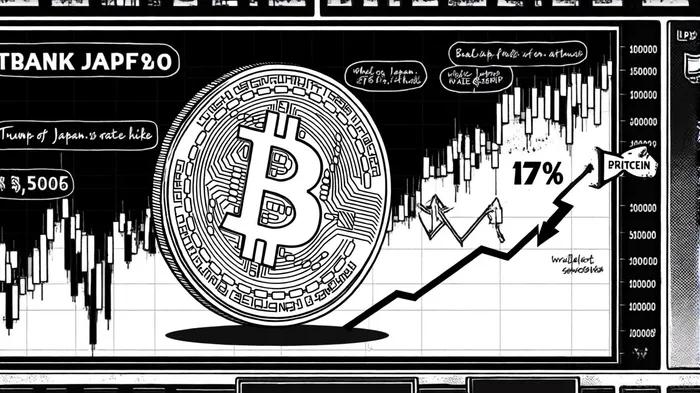
Bitcoin's 17% price collapse in August 2024-its first dip below $50,000 since February-exemplifies the volatile interplay of macroeconomic forces and institutional behavior in crypto markets. While the cryptocurrency has historically weathered storms, this downturn was uniquely shaped by a confluence of global policy shifts, whale-driven liquidity pressures, and speculative short positions.
Macroeconomic Catalysts: Inflation, Tariffs, and Carry Trade Unwinding
The initial trigger emerged from unexpected inflationary data. The U.S. July 2024 Consumer Price Index (CPI), released on August 14, exceeded forecasts, reigniting fears of prolonged Federal Reserve hawkishness, according to a Forbes analysis. Simultaneously, the Bank of Japan's surprise rate hike in early August exacerbated global liquidity strains, triggering a carry trade unwind that saw Japanese investors liquidate overseas holdings, as reported in a CCN analysis. The resulting flight to cash hit crypto markets disproportionately, with Bitcoin's price plummeting 17% within days as the Bank of Japan's policy shift rippled through global capital flows, according to a Cointelegraph report.
Compounding these pressures were U.S. trade policies. President Trump's announcement of 25% tariffs on Canadian and Mexican imports in late July 2024 introduced geopolitical uncertainty, spooking markets, according to an Analytics Insight piece. While BitcoinBTC-- initially decoupled from tariff news in February 2025-surging to $118,000 amid inflationary concerns-October 2025 saw renewed sensitivity as renewed tariff threats sent Bitcoin tumbling below $119,000, a trend later noted in the CCN analysis. Analysts at Glassnode noted that such trade tensions often amplify Bitcoin's volatility, as the asset's perceived role as a macro hedge clashes with its speculative underpinnings; the Forbes analysis echoed similar concerns.
Whale Activity and Short Positions: The Invisible Hand of Institutional Behavior
Beyond macro forces, on-chain data reveals a darker narrative: coordinated whale selling and leveraged short positions. A single Bitcoin whale, holding over $11 billion in BTCBTC--, executed a $600 million short position in late August 2024, leveraging 40x leverage to profit from the downward spiral, as reported by Cointelegraph. This whale had previously closed a $516 million short in March 2025, securing $9.4 million in eight days-a move analysts attribute to strategic timing ahead of Federal Reserve policy announcements, a pattern the Forbes analysis also discussed.
Whale activity intensified as older wallets (inactive for 7–10 years) began moving 3,000 BTC to exchanges, a pattern historically linked to price corrections, according to a Currency Analytics report. By August 5, 2024, over 100,000 BTC had left whale reserves in 30 days-a 2022 bear market echo noted by the CCN piece. Meanwhile, EthereumETH-- faced even sharper declines, losing 20% in two hours as speculative futures positions unraveled, a move Cointelegraph covered.
The interplay between whale selling and macroeconomic uncertainty created a self-fulfilling prophecy. As large holders offloaded assets, liquidity dried up, triggering margin calls and further downward spirals. Over $600 million in leveraged long positions were liquidated during the crash, with retail traders bearing the brunt of the collapse, the Currency Analytics report found.
Liquidity Shifts and ETF Dynamics: A Market in Transition
Liquidity shifts further amplified the crisis. Bitcoin ETFs, once a pillar of institutional confidence, saw $1.2 billion in outflows over two days in August 2024, reflecting waning macroeconomic optimism, per the Currency Analytics report. While spot ETFs maintained $2 billion in daily trading volumes, altcoins faced a 40% capital contraction since December 2024, underscoring Bitcoin's role as the sole remaining safe haven in crypto-a point the Forbes analysis highlighted.
Global regulatory actions-particularly in Japan, Russia, and Nigeria-added to the liquidity crunch, with Cointelegraph noting that tightening capital controls forced investors to prioritize fiat-backed assets over direct crypto holdings. This shift was compounded by the U.S. government's tempered interest in expanding its digital asset reserves, another point covered by Cointelegraph.
Outlook: A Path to Recovery or Deeper Correction?
Despite the gloom, technical indicators suggest a potential rebound. Bitcoin's RSI fell below 30 during the crash, signaling oversold conditions-a pattern that historically precedes consolidation or reversals. A backtest of 145 RSI-oversold events from 2022 to 2025 reveals that average excess returns turned positive after two weeks, peaking at +4.05% around day 18, with a win rate stabilizing near 60% from day 15 onward, a result discussed in the Forbes analysis. However, short-term (≤5 days) returns remain statistically insignificant, suggesting that patience is key for capturing meaningful gains from oversold conditions.
The 30-day Whale Ratio hit a 7-month high of 0.47, indicating that nearly half of BTC inflows to exchanges originated from large holders-a mixed signal of accumulation and distribution, as noted by Currency Analytics.
However, risks persist. If Bitcoin fails to reclaim the $91,000 support level, a deeper correction to $71,000 becomes likely, a scenario flagged by Analytics Insight citing on-chain analytics firm The Block. Meanwhile, Trump's trade policies remain a wild card; while Arthur Hayes of BitMEX argues that global monetary easing will buoy Bitcoin, others caution that retaliatory tariffs could erode its safe-haven appeal, a point raised in the Analytics Insight piece.
Conclusion
Bitcoin's August 2024 crash underscores the fragility of crypto markets in the face of macroeconomic turbulence and institutional behavior. While the asset's long-term fundamentals remain intact-evidenced by projections of $200,000 by 2026-investors must navigate a landscape where whale activity, geopolitical uncertainty, and liquidity shifts can trigger rapid reversals. For now, the market watches closely as the Fed's next moves and Trump's trade agenda determine whether Bitcoin's next chapter is one of resilience or reckoning.






Comentarios
Aún no hay comentarios