
Bitcoin's 13-Year-Dormant Whale Resumes Activity: A Harbinger of Market Sentiment Shifts in 2025?
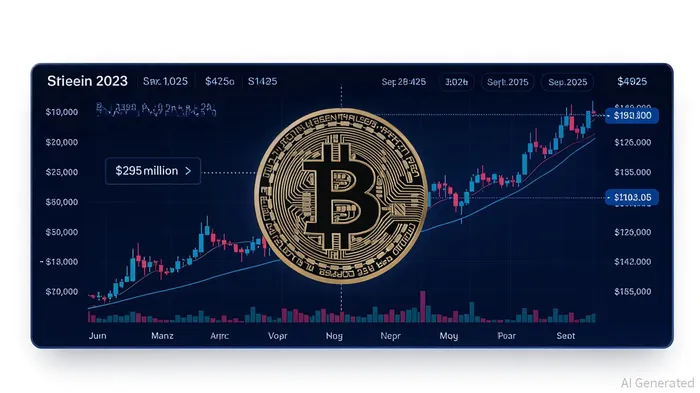
The reactivation of a BitcoinBTC-- wallet dormant since 2013—containing 14,837 BTC—has sent ripples through the crypto market, sparking debates about its implications for Bitcoin's price trajectory in 2025. According to a report by The Cryptonomist, the whale transferred 400 BTC to EthereumETH-- on Hyperliquid, opening a leveraged long position worth $295 million across four wallets with 3x to 10x leverage[1]. This move, occurring amid a broader market correction and Ethereum's outperformance, underscores the complex interplay between dormant on-chain behavior and macroeconomic sentiment.
On-Chain Data: A Window into Investor Behavior
Dormant wallet reactivations are often viewed as barometers of market sentiment. CoinMetrics' 2025 on-chain analysis links such movements to shifts in investor expectations, particularly during periods of volatility[3]. The 2013-era whale's activity aligns with historical patterns where long-dormant addresses trigger sharp price fluctuations. For instance, the transfer of 400 BTC to ETH coincided with Ethereum ETF outflows of $678 million over three sessions, amplifying liquidation risks in derivatives markets[1]. This suggests that whale activity is not isolated but part of a broader rebalancing between BTC and ETH, driven by macroeconomic tailwinds like anticipated Federal Reserve rate cuts[5].
On-chain metrics further contextualize this shift. The Market Value to Realised Value (MVRV) ratio, which compares Bitcoin's market cap to its realized value, has dipped below the 1.5 threshold—a level historically associated with undervaluation[4]. Similarly, the Net Unrealised Profit/Loss (NUPL) indicator shows a growing proportion of addresses in profit, signaling a potential consolidation phase after Bitcoin's peak at $124,000[4]. These metrics suggest that the market may be transitioning from speculative fervor to a more value-driven narrative, with dormant wallet reactivations acting as catalysts.
Strategic Entry Point or Cautionary Signal?
While the whale's leveraged position raises concerns about systemic risk, it also presents a strategic entry opportunity for investors. The shift to Bitcoin dominance—evidenced by the Bitcoin vs Altcoin Season indicator—reflects a flight to safety amid macroeconomic uncertainty[1]. Meanwhile, Ethereum's 48.73% surge in July 2025, driven by the Pectra upgrade and institutional adoption, has created a tug-of-war between BTC and ETH allocations[5]. The whale's move to Ethereum could signal a temporary reallocation of capital, but the persistence of Bitcoin's undervaluation metrics (MVRV, NUPL) suggests that long-term holders may view dips as buying opportunities[4].
However, the leveraged exposure of $295 million introduces volatility. If Bitcoin's $114,000 level breaks, liquidations could accelerate, triggering a cascade effect in derivatives markets[1]. This risk is compounded by thin liquidity in certain leverage tiers, as highlighted by TokenMetrics' analysis of the crypto market's bearish turn[1]. Investors must weigh these risks against the potential for a rebound, particularly if macroeconomic conditions stabilize or Ethereum's outperformance moderates.
Conclusion: Navigating the Crossroads of Sentiment and Structure
The 13-year-dormant whale's reactivation is more than a technical curiosity—it is a microcosm of the broader forces reshaping the crypto market in 2025. By analyzing on-chain patterns and leveraging historical precedents, investors can discern whether this activity signals a strategic entry point or a cautionary warning. While the immediate risks of leveraged positions and ETF outflows are real, the underlying metrics suggest that Bitcoin's fundamentals remain resilient. For those with a long-term horizon, the current correction may offer an opportunity to capitalize on a market recalibrating for the next phase of growth.






Comentarios
Aún no hay comentarios