
Bitcoin's $125K Price Outlook: Navigating Macroeconomic Volatility and Trader Sentiment in a Fractured Labor Market
The U.S. labor market's recent turbulence has cast a long shadow over macroeconomic stability, creating a fertile ground for Bitcoin's price action to diverge from traditional asset correlations. As the September 2025 jobs report revealed a staggering 911,000 downward revisions to prior payroll data-marking the largest adjustment since 2002-the narrative of a resilient labor market has fractured, according to a a CNBC report. This revision, coupled with a mere 50,000 jobs added in September (below the 12-month average of 123,900), underscores a broader cooling trend, according to FactSet projections. Meanwhile, the official unemployment rate (U-3) remains at 4.3%, but the broader U-6 rate, which includes underemployed and discouraged workers, climbed to 8.1% in August, per Trading Economics data. Such divergences highlight the fragility of the labor market and the potential for policy uncertainty-particularly around tariffs-to further dampen hiring momentum, according to a Statistics Canada survey.
Macroeconomic Volatility and Bitcoin's Asymmetric Appeal
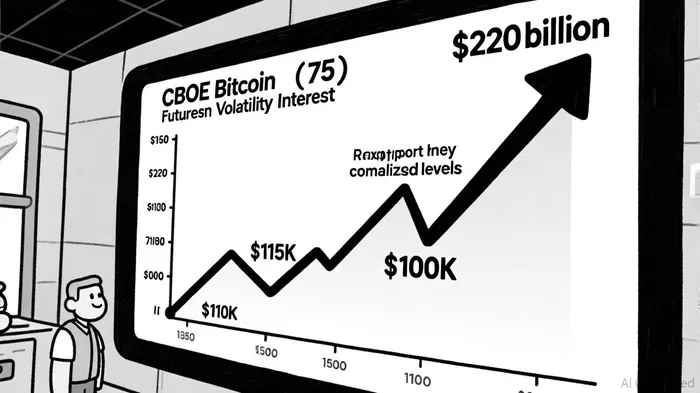
The Federal Reserve's policy calculus is now clouded by these labor market revisions. A weaker-than-expected jobs report could delay rate hikes, potentially boosting risk-on assets like BitcoinBTC--. Historically, Bitcoin has thrived in low-interest-rate environments, as investors seek uncorrelated stores of value. The recent surge in Bitcoin's futures open interest to $220 billion-driven by institutional inflows and speculative positioning-reflects this dynamic, according to a Financial Content article. However, the CBOE Bitcoin Volatility Index (BVOL) spiking to 75 in September 2025 (well above its 52-week average of 50) signals heightened expectations of price swings, as the CNBC report notes. This volatility is not merely speculative; it is a response to macroeconomic uncertainty.
The labor market's fragility is compounded by the federal government shutdown, which delayed the release of official September data. Shadow estimates, such as Carlyle's projection of only 17,000 jobs added in September, suggest a sharper slowdown than the median forecast of 50,000, as noted in the Financial Content article. Such conflicting signals create a "fog of uncertainty" for investors, driving capital into assets perceived as hedges against systemic risk. Bitcoin's role as a "digital gold" is amplified in this context, particularly as institutional adoption-evidenced by $3.87 billion in August ETF inflows-continues to solidify its status as a portfolio staple, as CNBC reported.
Trader Sentiment: Long-Term Optimism vs. Short-Term Caution
Market positioning data reveals a nuanced picture. As of September 1, 2025, Bitcoin's spot positioning has shifted to a heavy long-token stance, with EthereumETH-- remaining neutral, per the CNBC coverage. This suggests a preference for Bitcoin as a core holding amid macroeconomic instability. However, the 25D option put-call skew indicates a defensive posture, with traders hedging against downside risks, as analysts noted. The Fear & Greed Index, at 55, reflects cautious optimism, but analysts warn against complacency, according to Trading Economics.
On-chain metrics add further complexity. The network value to transactions (NVT) ratio has contracted during Bitcoin's rally to $125,000, signaling potential overvaluation, as reported in the Financial Content article. Meanwhile, the hash rate-a proxy for miner confidence-has surged in tandem with price, suggesting sustained network security and participation. Yet, the $193 billion in total crypto trading volume on October 3, 2025, raises concerns about leveraged positions. A correction below key support levels ($105K or $100K) could trigger cascading liquidations, eroding gains and testing the market's resilience, as previously reported by Financial Content.
The $125K Target: Technical and Fundamental Convergence
Bitcoin's price action in late September 2025 has been range-bound between $108K and $125K, with $119K as a central target, according to Statistics Canada. The ability to hold above $115K is critical, as breaking this level could reignite bearish sentiment. Conversely, a sustained close above $125K would validate the thesis of a macro-driven bull run. Technical indicators, such as the Chicago Fed forecast (4.34% for September), suggest limited near-term upside for traditional assets, further tilting the balance in Bitcoin's favor.
However, the path to $125K is not without risks. The U.S. Treasury's 10-year yield, currently at 3.8%, remains a key variable. A spike in yields-driven by inflation fears or fiscal policy shifts-could drain liquidity from risk assets. Additionally, the youth unemployment rate hitting 14.7% (the highest since 2010) signals structural labor market challenges that may persist beyond the current policy cycle, per Statistics Canada. These factors could delay a broader economic recovery, prolonging Bitcoin's role as a safe-haven asset.
Conclusion: A Delicate Balance
Bitcoin's $125K price outlook hinges on the interplay between macroeconomic volatility and trader sentiment. While the labor market's revisions and policy uncertainties create a tailwind for Bitcoin's adoption, the surge in leveraged positions and elevated volatility indices introduce significant downside risks. Investors must navigate this duality with discipline, balancing long-term bullish fundamentals (institutional adoption, ETF inflows) against short-term technical vulnerabilities (overvaluation metrics, leverage-driven corrections).
As the Federal Reserve grapples with a fractured labor market and the crypto market absorbs the implications of a $220 billion open interest surge, Bitcoin's price trajectory will likely remain a barometer of systemic risk. For now, the $125K target represents both a technical milestone and a psychological threshold-a test of whether the market can sustain its current momentum in the face of macroeconomic headwinds.






Comentarios
Aún no hay comentarios