
Is Bitcoin's 122-Day Hold Above $100K the Start of a New Institutional-Driven Crypto Normal?
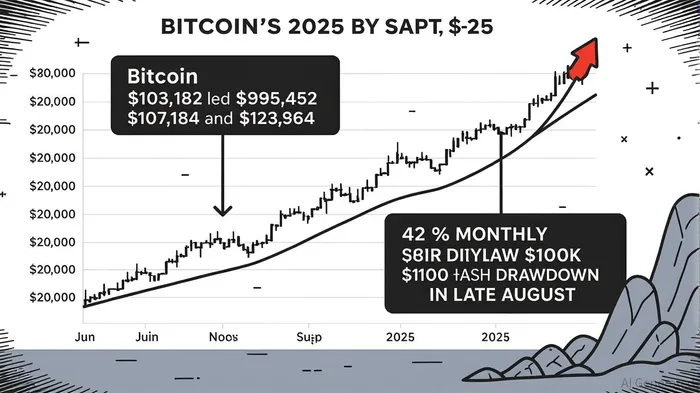
Bitcoin’s 122-day hold above $100,000 is not merely a price milestone—it is a seismic shift in the asset’s institutional identity. For the first time, BitcoinBTC-- has demonstrated the structural resilience and macroeconomic alignment required to sustain institutional-grade participation. This period, marked by a range-bound yet robust performance, reflects a maturing market where traditional finance is no longer a peripheral observer but a core participant.
Institutional Adoption: From Speculation to Strategic Allocation
The institutional narrative in Q3 2025 has been defined by two forces: regulatory clarity and capital reallocation. The U.S. 401(k) executive order, which unlocked $8.9 trillion in retirement assets for Bitcoin exposure [2], and the CLARITY Act’s classification of Bitcoin as a commodity under CFTC oversight [3], have transformed the asset from a speculative bet into a fiduciary-permissible investment. This shift is evident in the $118 billion in inflows to U.S. spot Bitcoin ETFs during the quarter, with BlackRock’s iShares Bitcoin Trust ETF (IBIT) capturing 89% of the market share [1].
Institutional buying has also become a defining feature of Bitcoin’s on-chain activity. From July to August 2025, 28 investment firms added 140,000 BTC to their portfolios, nearing the annual mining output of 164,000 BTC [5]. Year-to-date, institutional investors have accumulated 3.68 million BTC—18% of the circulating supply [2]. This surge is not speculative; it is strategic. Corporate treasuries, including MicroStrategy’s recent purchase of 7,633 BTC [6], now view Bitcoin as a strategic reserve asset, hedging against inflation and diversifying portfolios in a low-yield environment.
Structural Market Dynamics: A New Equilibrium
Bitcoin’s price stability above $100K is underpinned by structural factors that align with traditional finance’s risk frameworks. The global M2 money supply, now exceeding $90 trillion [4], has historically mirrored Bitcoin’s price trends, suggesting that Bitcoin is increasingly functioning as a mirror to monetary expansion. Meanwhile, the Strategic Bitcoin Reserve—a regulatory initiative focused on legitimizing institutional holdings—has reduced operational barriers, enabling broader participation [1].
The market structure itself has evolved. Retail activity, which once drove volatility, has declined by 41% in daily transaction counts from October 2024 to March 2025 [2]. In contrast, institutional volume has surged, with average transaction sizes reflecting large-scale transfers. This shift has created a “large, low-frequency” trading model [1], where Bitcoin’s liquidity is no longer dependent on retail frenzy but on institutional order flow.
Challenges and the Path Forward
Despite these gains, Bitcoin’s institutional adoption is not without friction. Macroeconomic correlations—such as the asset’s retreat below $110K when Fed rate-cut certainty evaporated [1]—highlight the need for volatility management tools. Staking-enabled ETFs, which are expected to launch in late 2025, could address this by offering yield generation alongside price exposure [1].
Geographic diversification will also be critical. While U.S. institutions dominate current flows, emerging markets are beginning to integrate Bitcoin into sovereign wealth strategies. This trend will reduce U.S. market concentration and create more stable dynamics [1].
Conclusion: A New Institutional-Driven Normal
Bitcoin’s 122-day hold above $100K is not an anomaly—it is the beginning of a new institutional-driven normal. The asset has transitioned from a speculative corner of finance to a core component of institutional portfolios, supported by regulatory clarity, infrastructure innovation, and macroeconomic tailwinds. While short-term corrections are inevitable, the structural forces at play suggest that Bitcoin’s floor is now institutional capital, not retail sentiment.
For investors, the lesson is clear: Bitcoin’s next phase will be defined by institutional-grade products, geographic expansion, and a redefinition of risk management. The crypto normal of 2025 is no longer a speculative experiment—it is a structural inevitability.
Source:
[1] What Q3 2025 Taught Us About Institutional Crypto Adoption [https://www.linkedin.com/pulse/what-q3-2025-taught-us-institutional-crypto-adoption-iconominet-mhz9f]
[2] Q3 2025 Bitcoin Valuation Report [https://www.chaincatcher.com/en/article/2199982]
[3] Crypto Safety: September 2025 Outlook Contents Export [https://aurpay.net/aurspace/safe-crypto-investments-2025-q3/]
[4] 25Q3 Bitcoin Valuation Report [https://reports.tiger-research.com/p/tvm-25q3-bitcoin-eng]
[5] What is Driving the Surge in Institutional Bitcoin Buying? [https://www.onesafe.io/blog/institutional-bitcoin-buying-transforming-crypto-landscape]
[6] Corporate Crypto Treasury Surge Accelerates as Bitcoin Hits Fresh Institutional Milestone [https://www.prnewswire.com/news-releases/corporate-crypto-treasury-surge-accelerates-as-bitcoin-hits-fresh-institutional-milestone-302547802.html]





Comentarios
Aún no hay comentarios