
Bitcoin's $122,000 Milestone: The Dawn of a New Asset Class
The cryptocurrency market has reached a historic inflection point. On July 14, 2025, BitcoinBTC-- (BTC) surged to an all-time high of $122,604, solidifying its position as a dominant macro-asset class. This milestone isn't merely a speculative rally—it marks a structural shift in global finance, driven by institutional adoption, regulatory clarity, and macroeconomic tailwinds.
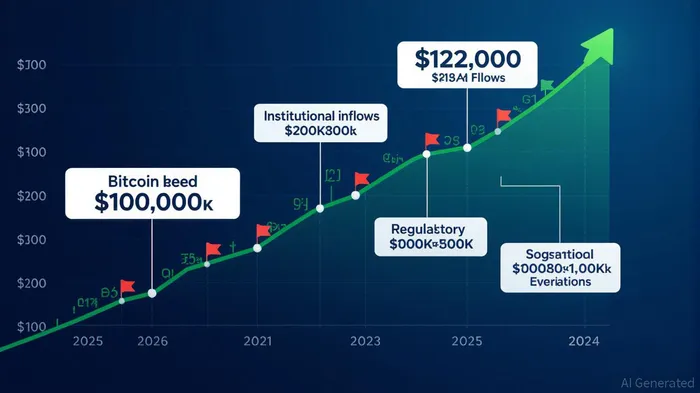
Institutional Adoption: The Engine of Legitimization
Bitcoin's ascent is fueled by institutional capital, not retail speculation. Key drivers include:
BlackRock's iShares Bitcoin Trust (IBIT):
This ETF now holds over 700,000 BTC ($83 billion AUM as of July 2025), tripling its assets in just 200 trading days. . Its rapid adoption contrasts sharply with traditional assets like gold's GLD ETF, which took decades to reach similar scale.Corporate Treasury Reserves:
Firms like MicroStrategyMSTR-- and Strategy (a Bitcoin-focused treasury pioneer) have accumulated 597,000 BTC collectively, using it as a hedge against inflation and fiat volatility. Even state pension funds, such as Wisconsin's $160 million Bitcoin ETF allocation, now treat BTC as a strategic reserve.DeFi Integration:
Bitcoin is no longer a standalone asset. Protocols like Morpho and Aave now enable Bitcoin-backed loans, while platforms like CoinbaseCOIN-- use DeFi infrastructure to offer $300 million+ in BTC-backed lending. This “DeFi mullet” model—fintech front-end, decentralized backend—is attracting institutions seeking yield without complexity.
Regulatory Clarity: The Catalyst for Mainstream Adoption
Regulatory uncertainty has historically been Bitcoin's Achilles' heel. Now, legislative progress is dismantling barriers:
- The CLARITY Act (U.S.) and MiCA (EU) establish frameworks for digital assets, enabling ETF listings and corporate treasury use.
- The GENIUS Act paves the way for private stablecoins, reducing reliance on centralized intermediaries.
- Politically, the U.S. government's stance has shifted: even Senator Elizabeth Warren's concerns about loopholes are tempered by bipartisan momentum toward crypto-friendly policies.
Macroeconomic Drivers: Inflation and the Bitcoin Hedge
Bitcoin's rise isn't disconnected from global economic trends. Here's how macro factors are propelling it forward:
Inflation and Monetary Policy:
Global inflation has cooled to 2.4% as of Q2 2025, but volatility persists. Bitcoin's capped supply of 21 million BTC makes it a natural hedge against fiat debasement. Historical data shows Bitcoin gains 7% per 1% CPI surprise, though Core PCE metrics temper its performance. .Gold vs. Bitcoin:
While gold remains a traditional safe haven, Bitcoin's $2.43 trillion market cap (surpassing Amazon) signals its evolution into a rival macro-asset. Unlike gold, Bitcoin offers programmable scarcity and integration with DeFi yield engines.
On-Chain Metrics: The Technical Case for Continued Growth
Data paints a bullish picture:
- Long-Term Holder NUPL: At 0.69, Bitcoin is far from overheated (0.75 threshold), suggesting sustained demand.
- High-Value Transactions: 89% of on-chain activity now involves transfers exceeding $100,000, signaling institutional dominance.
- Cost Basis Support: A $93,000–$100,000 zone acts as a structural floor, with breaches unlikely without catastrophic macro shocks.
Risks and Considerations
- Volatility: Bitcoin's 20% intra-year swings require risk management. Dollar-cost averaging and ETFs like IBITIBIT-- mitigate this.
- Regulatory Overreach: Overly restrictive policies could stifle adoption, though the current trajectory favors collaboration.
- CBDC Competition: Central bank digital currencies (e.g., China's digital yuan) pose risks, but Bitcoin's decentralization and first-mover advantage remain strengths.
Investment Strategy: Allocate Strategically
Bitcoin's structural shift demands inclusion in modern portfolios. Here's how to capitalize:
- Allocate 1–3% to Bitcoin: Treat it as a strategic beta play, akin to gold or real estate.
- Use ETFs for Accessibility: BlackRock's IBIT and Fidelity's BTC ETFs offer regulated exposure with lower custody risk.
- Dollar-Cost Average: Mitigate volatility by spreading purchases over time.
- Monitor Inflation and Fed Policy: A September 2025 rate cut could propel Bitcoin toward $150,000, while inflation spikes above 3% could trigger corrections.
Conclusion: The New Normal
Bitcoin's $122,000 milestone isn't an end—it's a beginning. The convergence of institutional capital, regulatory frameworks, and macroeconomic demand has positioned Bitcoin as a core asset class. For investors, this is not a bet on hype but on the inevitability of a decentralized, programmable money system. The question isn't whether Bitcoin will endure—it's how quickly portfolios will adapt to this new reality.
The structural shift is here. Embrace it.





Comentarios
Aún no hay comentarios