
Bitcoin's $120K Threshold: Fed Policy and Whale Momentum Converge
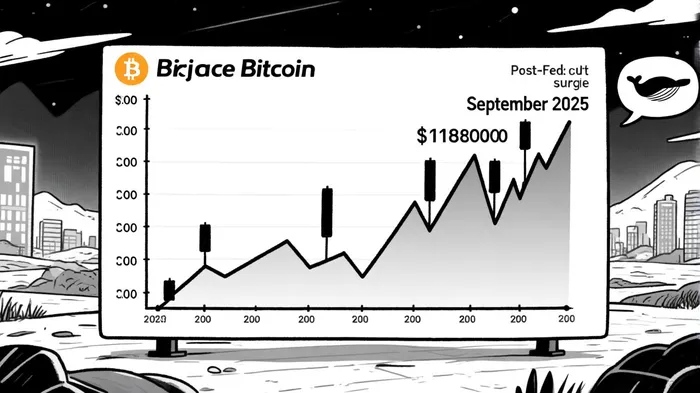
The Federal Reserve's September 17, 2025, rate cut of 25 basis points marked a pivotal shift in monetary policy, signaling the end of a restrictive era and reigniting debates about Bitcoin's price potential. As the U.S. dollar weakened and liquidity expanded, the crypto market faced a critical juncture: Would BitcoinBTC-- capitalize on the dovish pivot to break above $120,000, or would lingering macroeconomic risks temper its ascent?
Fed Policy: A Tailwind for Risk-Assets
The Fed's decision to reduce rates to 4.00%–4.25% injected fresh liquidity into global markets, historically favoring high-beta assets like Bitcoin. Lower interest rates diminish the opportunity cost of holding non-yielding assets, while a weaker dollar amplifies demand for alternative stores of value. According to a report by Forbes, Bitcoin has historically exhibited an inverse correlation with the U.S. dollar, with past rate cuts (e.g., 2024's 0.5% cut) catalyzing multi-month bull runs [1]. However, the market's reaction to the 2025 cut was nuanced. While the initial move saw Bitcoin hover near $116,000, traders remained cautious, awaiting further guidance from Fed Chair Powell's post-meeting comments [2].
The Fed's communication will remain a key variable. A dovish bias—suggesting more rate cuts in 2025—could extend Bitcoin's bullish momentum. Conversely, a hawkish pivot or signals of economic fragility could trigger volatility, as seen during the 2020 emergency rate cuts when Bitcoin initially plummeted before recovering [3].
Whale Activity: The Hidden Engine of Momentum
On-chain data reveals a synchronized buildup of whale-driven momentum ahead of and following the Fed's decision. A Bitcoin whale that had been dormant for 12 years suddenly moved 1,000 BTCBTC-- ($116.88 million) in early September, signaling anticipation of market volatility [4]. This activity coincided with broader trends: over 100,000 BTC ($12.7 billion) exited major wallets in the preceding month, suggesting strategic distribution or long-term positioning [5].
Post-rate cut, whale behavior intensified. EthereumETH-- whales, for instance, executed a $112.34 million purchase of 25,000 ETH, while Bitcoin saw mid-tier addresses (100–1,000 BTC) accumulate steadily, with cold storage allocations rising 18% quarter-on-quarter [6]. These patterns indicate a shift in market psychology: large holders are leveraging macroeconomic catalysts to accumulate during dips, while mid-tier investors lock in gains through long-term storage.
Exchange outflows further underscore bullish sentiment. Binance and CoinbaseCOIN-- reported a 22% decline in BTC deposits since mid-September 2025, tightening supply and reducing near-term selling pressure [7]. This dynamic mirrors historical bull cycles, where reduced exchange balances correlate with price surges as holders “hodl” through volatility.
Technical and Macro Convergence: The Path to $120K
Bitcoin's technical indicators align with the macroeconomic narrative. A breakout above $117,900—a level tied to the 50% Fibonacci retracement and the 100-day EMA—could trigger a cascade of long-term buyers and institutional inflows [8]. Analysts like Man of Bitcoin argue that liquidity injections from Fed easing, combined with whale accumulation, create a “gravitational pull” toward $120K, with order-book depth concentrated between $110,000 and $113,000 acting as a support floor [9].
However, risks persist. A $2.7 billion BTC dump in late August 2025 briefly derailed bullish momentum, highlighting the volatility of whale-driven markets [10]. Additionally, if the Fed signals deeper economic concerns during Powell's press conferences, Bitcoin could face short-term headwinds.
Historical data on Bitcoin's price behavior near resistance levels offers caution. A backtest of daily R1 resistance tests from 2022 to 2025 reveals that a simple buy-and-hold strategy outperformed attempts to time breakouts. For instance, while the win rate improved marginally from 49% on day 1 to 57% by day 30, the average return after testing R1 resistance showed no statistically significant edge over passive holding. This suggests that relying solely on resistance-level triggers may not reliably capture upside potential, reinforcing the need to combine technical signals with macroeconomic context and volume analysis .
Conclusion: A Calculated Bull Case
Bitcoin's potential surge beyond $120K hinges on the interplay of Fed policy and whale behavior. The September rate cut provided a liquidity tailwind, while on-chain data reveals a coordinated buildup of long-term positioning. For investors, the key variables will be:
1. Fed Communication: A consistent dovish tone could extend the bullish narrative.
2. Whale Accumulation: Continued large-holder buying during dips will validate the $120K thesis.
3. Technical Breakouts: A sustained close above $117,200 could unlock institutional demand.
As the market navigates this convergence of macro and on-chain signals, Bitcoin's next move will test the resilience of its bull case—and the depth of its institutional backing.






Comentarios
Aún no hay comentarios