
Bitcoin's $120K Rally and the Role of Whale Accumulation: Institutional Signals and Altcoin Positioning
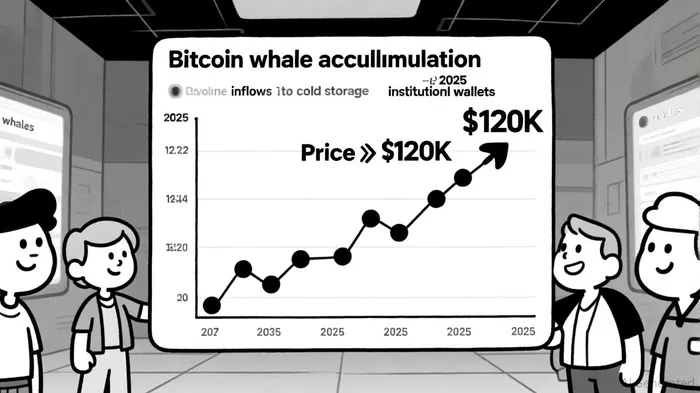
The cryptocurrency market in 2025 is witnessing a seismic shift driven by institutional-grade on-chain signals and strategic whale accumulation. As BitcoinBTC-- consolidates between $110,000 and $115,000, the narrative of a potential $120K rally is gaining traction, fueled by unprecedented institutional activity and altcoin positioning. This analysis deciphers the interplay between whale behavior, regulatory tailwinds, and macroeconomic dynamics to assess the feasibility of this bullish scenario.
Whale Accumulation: A Bullish On-Chain Signal
Bitcoin's whale activity in 2025 has become a focal point for market analysts. On-chain data reveals that large holders—wallets controlling 1,000 BTCBTC-- or more—have accumulated over 120,000 BTC in the past 30 days alone, with total whale holdings now accounting for 67.77% of the circulating supply [1]. This surge is not merely speculative; it reflects a strategic shift toward long-term capital preservation. For instance, over 26,430 BTC flowed into accumulation addresses in early 2025, with a significant portion moving into cold storage and institutional-grade custody [2]. Such movements are historically correlated with price inflection points, as whales reduce exchange-held balances to mitigate short-term volatility risks [3].
The shrinking supply of Bitcoin on exchanges—now at a five-year low—further reinforces this narrative. As whales withdraw BTC from platforms like Binance and Kraken, the market's circulating liquidity tightens, creating upward pressure on price [4]. This trend aligns with historical precedents where whale accumulation preceded major rallies, such as the 2021 $60K breakout.
Institutional Adoption: ETFs and Regulatory Clarity
The approval of U.S. and EU spot Bitcoin ETFs in 2025 has been a game-changer. Regulated capital inflows have surged, with BlackRock's iShares Bitcoin Trust alone holding $86.26 billion in net assets by September 2025 [5]. These ETFs have normalized Bitcoin as a reserve asset, attracting institutional allocations that prioritize security and compliance. For example, corporate entities like MicroStrategy have continued to add BTC to their balance sheets, signaling confidence in its store-of-value proposition [6].
Regulatory frameworks like the U.S. Genius Act for stablecoins and the EU's MiCA have also reduced institutional friction. These policies have enabled tokenized real-world assets (RWAs)—such as U.S. equities and commodities—to enter the crypto ecosystem, diversifying institutional exposure beyond Bitcoin [7]. The result is a maturing market where whales and institutions operate with greater transparency and fewer compliance risks.
Altcoin Positioning: High-Conviction Strategies
While Bitcoin remains the dominant asset, institutional-grade strategies in 2025 are increasingly allocating to altcoins with strong fundamentals. On-chain data reveals aggressive accumulation of tokens like Bitcoin HyperHYPER-- (HYPER), AAVEAAVE--, and UNI, which represent innovations in Layer-2 scaling, DeFi lending, and decentralized exchange governance [8]. For example, EthereumETH-- whales have added 800,000 ETH in a single month, reflecting confidence in the network's deflationary mechanics and staking yields [9].
Institutional investors are also prioritizing projects with tangible use cases. Tokens like Ondo (ONDO), focused on RWA tokenization, and ToncoinTON-- (TON), tied to the Telegram ecosystem, have attracted capital due to their regulatory alignment and scalability [10]. This diversification strategy mirrors traditional asset allocation, where institutions balance blue-chip exposure with high-conviction, risk-adjusted bets.
The Path to $120K: Macro and Micro Drivers
The convergence of whale accumulation, ETF inflows, and altcoin positioning creates a compelling case for a $120K rally. On-chain metrics like Value Days Destroyed (VDD) and shrinking exchange balances indicate that large holders are locking in Bitcoin for long-term gains [11]. Meanwhile, macroeconomic factors—such as the Federal Reserve's dovish pivot and global macroeconomic uncertainty—have driven capital into Bitcoin as a hedge against inflation and currency devaluation [12].
However, risks persist. ETF outflows in August 2025 highlighted the fragility of retail-driven liquidity, while regulatory scrutiny of altcoins remains a wildcard [13]. Investors must monitor whale behavior and on-chain data to gauge market sentiment, as sudden shifts in accumulation patterns could signal a reversal.
Conclusion: Strategic Allocation in a Maturing Market
Bitcoin's $120K rally is not a speculative moonshot but a plausible outcome driven by institutional-grade signals. Whale accumulation, ETF adoption, and altcoin diversification are reshaping the crypto landscape, offering investors a framework to navigate volatility. For high-conviction exposure, prioritizing assets with robust fundamentals—both in Bitcoin and altcoins—while staying attuned to regulatory and macroeconomic shifts will be critical.
As the market evolves, the line between traditional finance and crypto continues to blurBLUR--. Those who recognize the institutional-grade signals embedded in on-chain data will be best positioned to capitalize on the next phase of growth.






Comentarios
Aún no hay comentarios