
Bitcoin's 12-Month Price Outlook: Macro Tailwinds and Institutional Adoption Fuel a Bullish Case
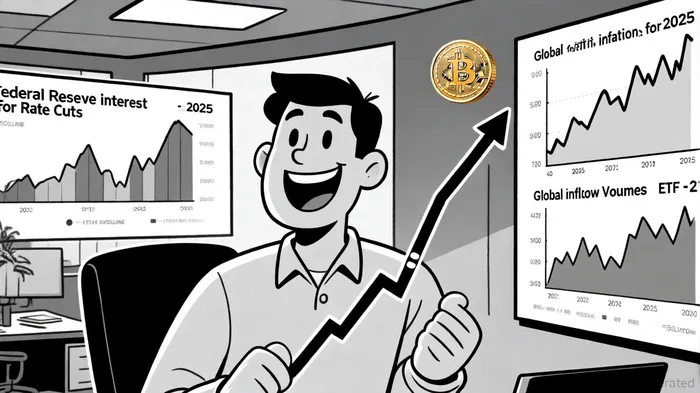
Bitcoin's price trajectory over the next 12 months is poised to be shaped by a unique confluence of macroeconomic tailwinds and institutional adoption. As the U.S. Federal Reserve navigates a delicate balance between inflation control and economic stability, Bitcoin's role as a hedge against fiat devaluation and a store of value is gaining institutional credibility. Meanwhile, regulatory clarity and corporate treasury adoption are amplifying demand, creating a compelling case for further price appreciation.
Macroeconomic Tailwinds: Inflation, Rates, and Dollar Dynamics
The Federal Reserve's aggressive rate-cutting cycle in 2025 has created a favorable environment for BitcoinBTC--. By September 2025, the Fed had reduced the federal funds rate to 4.0%–4.25%, a 50-basis-point cut since November 2024, as it prioritized labor market stability over inflation concerns[4]. These cuts, coupled with a weakening U.S. dollar, have driven investors toward alternative assets. Bitcoin's inverse relationship with the dollar—its price often rises as the greenback weakens—has been amplified by Trump-era tariff policies, which have introduced economic uncertainty and eroded confidence in traditional markets[2].
While inflation remains a mixed signal, with August 2025 CPI at 2.9% year-over-year[5], the Fed's projections suggest a gradual decline to 2.0% by 2027[3]. This controlled inflationary environment, combined with accommodative monetary policy, positions Bitcoin as a strategic hedge against fiat depreciation. Analysts argue that Bitcoin's appeal as an inflation hedge is reinforced by the U.S. national debt surpassing $36.2 trillion, which has prompted investors to seek assets with intrinsic scarcity[2].
Institutional Adoption and Regulatory Clarity
The approval of U.S. spot Bitcoin ETFs in January 2024 marked a watershed moment, enabling institutional and retail investors to access Bitcoin with minimal friction[1]. By mid-2025, ETF inflows had exceeded $50 billion, directly fueling demand and creating upward price pressure[1]. Corporate treasury adoption has further solidified Bitcoin's legitimacy, with firms like MicroStrategy allocating significant portions of their balance sheets to Bitcoin as a strategic hedge[1].
Regulatory developments have also bolstered confidence. The establishment of a U.S. Strategic Digital Asset Reserve and the Genius Act—aimed at streamlining crypto regulations—has reduced uncertainty for institutional players[1]. These measures, combined with global regulatory progress in the EU and other markets, are attracting a new wave of capital to the crypto space[4].
Price Projections and Risks
Analysts project Bitcoin's price could reach $180,000–$250,000 by late 2026, driven by sustained ETF inflows, post-halving scarcity (April 2024), and macroeconomic tailwinds[5]. However, the 12-month outlook hinges on several variables:
1. Continued Fed Rate Cuts: If the Fed maintains its accommodative stance, Bitcoin's demand as a yield-seeking asset will remain robust[4].
2. Global Growth Divergence: Slower global growth (IMF forecasts 3.3% in 2025–2026[1]) may amplify Bitcoin's safe-haven appeal, particularly as trade tensions persist[6].
3. Regulatory Stability: Sudden shifts in policy, such as stricter capital controls, could disrupt inflows[2].
Risks include macroeconomic shocks, geopolitical stability, and potential regulatory tightening. Yet, the current trajectory suggests these factors are unlikely to outweigh the structural tailwinds.
Conclusion
Bitcoin's 12-month price outlook is underpinned by a compelling mix of macroeconomic and institutional drivers. As the Fed's rate cuts and dollar weakness persist, and as institutional adoption accelerates, Bitcoin is well-positioned to outperform traditional assets. While volatility remains inherent, the alignment of monetary policy, regulatory clarity, and supply-side dynamics creates a bullish case for investors willing to navigate the risks.






Comentarios
Aún no hay comentarios