
Bitcoin's 12% Correction Amid a Broader Bull Market: A Technical and Sentiment Deep Dive
Bitcoin's 12% correction in September 2025 has sparked intense debate among investors: is this a healthy consolidation within a broader bull market, or the early stages of a bearish reversal? To answer this, we must dissect technical indicators, sentiment metrics, and on-chain data to assess whether the pullback presents a buying opportunity or a red flag.
Technical Analysis: A Mixed but Manageable Picture
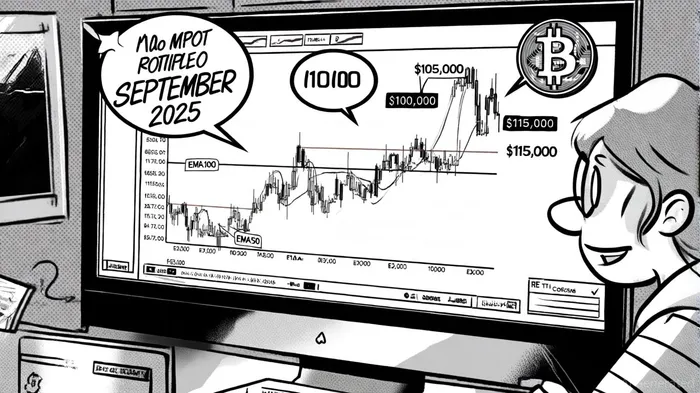
Bitcoin's price as of September 26, 2025, stands at $109,515, consolidating around the $110,000 psychological level. Key support levels include the EMA100 at $105,000 and the Fibonacci 61.8% retracement at $98,766, while resistance remains at the Upper Bollinger Band of $115,000 [1]. The mixed signals from moving averages—price above EMA100 but below EMA50—suggest a tug-of-war between short-term profit-taking and long-term bullish momentum [1].
The Stochastic RSI at 65 indicates neutral momentum, while the MACD hints at weak bullish potential, suggesting buyers are cautiously testing the waters [1]. Bollinger Bands, currently narrow, signal low volatility but hint at an impending breakout. If BitcoinBTC-- reclaims the EMA50, it could target $138,887, a Fibonacci extension level [1]. However, a breakdown below $105,000 would likely retest the critical $100,000 floor, historically a psychological barrier for retail and institutional buyers [2].
Sentiment Metrics: Fear as a Contrarian Signal
Bitcoin's Fear and Greed Index has plummeted to 43–45, firmly in the “Fear” zone, reflecting heightened caution among retail investors amid macroeconomic uncertainties and recent price declines [2]. This aligns with historical patterns where extreme fear (readings below 25) has often preceded strong 30-day returns, acting as a contrarian indicator [6].
Institutional investors, however, remain unfazed. ETF-driven demand and stable, fundamentals-focused allocations suggest a long-term bullish stance, contrasting with retail traders' social media-driven volatility [1]. The divergence between institutional and retail behavior is a classic sign of market maturation, where professional capital prioritizes long-term value over short-term noise.
Historical seasonality also plays a role. September has historically been a weak month for Bitcoin, with an average loss of 3.77% since 2013 [2]. Yet, this pattern is often followed by a Q4 rebound, dubbed “Uptober,” as year-end tax-loss harvesting and institutional buying gain momentum [3].
On-Chain Data: Accumulation Amid Volatility
On-chain metrics paint a nuanced picture. The MVRV ratio at 2.1 indicates a neutral to bullish market, far from overvaluation thresholds (3.5–4) [1]. Whale activity in the 10–10,000 BTCBTC-- range has added 266,000 BTC over the past year, signaling long-term accumulation [4]. Exchange reserves have also declined by 19,922 BTC, reinforcing the idea that Bitcoin is being hoarded rather than sold [3].
However, recent whale transactions have introduced volatility. A 12-year-dormant wallet moved $116 million in BTC, and another 1,000 BTC ($116.88 million) was transferred ahead of the Fed's rate decision, raising concerns about potential selling pressure [4]. Despite this, institutional demand—driven by ETFs and macroeconomic optimism—has offset increased supply, maintaining a fragile equilibrium [4].
Conclusion: A Buying Opportunity with Caution
Bitcoin's 12% correction in September 2025 appears to be a healthy consolidation rather than a bearish reversal. Technically, key support levels remain intact, and the market's neutral-to-bullish on-chain metrics suggest accumulation by long-term holders. Sentiment-wise, extreme fear among retail investors acts as a contrarian signal, while institutions remain steadfast in their bullish outlook.
That said, risks persist. The activation of dormant whale wallets and the NVT score's overvaluation reading (485.13) highlight the need for caution [5]. Investors should monitor the Fed's September rate decision and Bitcoin's ability to reclaim the EMA50 as critical inflection points. For now, the correction offers a disciplined entry point for those aligned with a multi-year bullish thesis—provided they remain mindful of short-term volatility.






Comentarios
Aún no hay comentarios