
Bitcoin's $116K Milestone and the Case for MUTM as an Affordable HODL Alternative
In September 2025, BitcoinBTC-- (BTC) has once again captured headlines, with its price inching toward the symbolic $116,000 milestone. This surge reflects renewed institutional interest and macroeconomic tailwinds, but it also raises a critical question: Is Bitcoin still the optimal long-term HODL asset it once was? As volatility and regulatory uncertainty persist, a new contender—Mutuum Finance (MUTM)—emerges as a compelling alternative. This article examines MUTM's valuation, utility, and risk profile through the lens of comparative crypto economics, arguing why it could outperform Bitcoin in a risk-adjusted framework.
The Case for Bitcoin: A Legacy Asset at a Crossroads
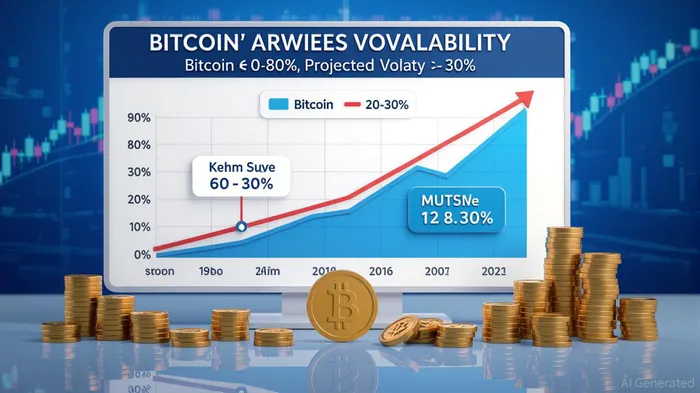
Bitcoin's dominance in the crypto market remains unchallenged, with its market cap hovering near $2.5 trillion as of September 2025. However, its volatility—historically averaging 60–80% annualized—has made it a double-edged sword for HODLers. While Bitcoin's first-mover advantage and store-of-value narrative justify its premium, its price action has increasingly mirrored that of speculative assets rather than a stable reserve currency.
Critically, Bitcoin's risk-adjusted returns (as measured by Sharpe ratios) have deteriorated in recent years. A 2024 study by CoinMetrics noted that Bitcoin's Sharpe ratio fell below 0.5 in 2025, a stark contrast to its 1.2 average during the 2020–2021 bull run. This decline underscores growing inefficiencies in Bitcoin's risk-reward profile, particularly as macroeconomic volatility and regulatory scrutiny intensify.
Mutuum Finance (MUTM): A DeFi-Driven HODL Alternative
Mutuum Finance (MUTM) is not just another DeFi token—it's a structured financial protocol designed to generate passive income while mitigating risk. Here's why it stands out as a HODL alternative:
1. Utility-Driven Tokenomics
Unlike Bitcoin's proof-of-work model, MUTM's value is tied to real-world financial activity. The protocol enables users to lend, borrow, and liquidate assets via two models:
- Peer-to-Contract (P2C): Shared liquidity pools for stable borrowing rates.
- Peer-to-Peer (P2P): Direct negotiations for speculative assets like PEPE or SHIB[1].
This dual model ensures MUTM's token demand is driven by active usage, not just speculative trading. Additionally, the mtToken system allows users to earn interest on deposited assets, creating a compounding effect[3].
2. Passive Dividend Yield
MUTM introduces a passive dividend mechanism, where users receive profits from the platform's market token purchases. These dividends are distributed to liquidity providers and security contributors, creating a self-sustaining revenue stream[1]. Analysts estimate this could yield annualized returns of 8–12% for early adopters[3].
3. Scalable and Secure Infrastructure
Mutuum's security-first approach includes third-party audits and a $50,000 USDTUSDC-- bug bounty program[3]. Plans to launch an overcollateralized USD-pegged stablecoin further enhance its utility, positioning MUTM as a bridge between DeFi and traditional finance[3].
4. Attractive Valuation Metrics
MUTM's presale has already raised $15.65 million with 16,250 holders[2], and its current price of $0.035 is a fraction of Bitcoin's cost. Analysts project a post-listing price surge to $2, driven by its utility-driven demand and structured tokenomics[3]. At this valuation, MUTM offers a 57x upside potential compared to Bitcoin's 10x (assuming BTC reaches $1.2M by 2030), with significantly lower volatility.
Risk-Adjusted Returns: MUTM vs. Bitcoin
While Bitcoin's volatility remains a hurdle, MUTM's structured design mitigates downside risk:
- Diversified Revenue Streams: Dividends, lending fees, and liquidation rewards reduce reliance on speculative trading.
- Stable Borrowing Options: Variable and fixed-rate models cater to both risk-takers and conservative users[1].
- Security Audits: Proactive risk management minimizes smart contract vulnerabilities[3].
In contrast, Bitcoin's returns are entirely exposure-based, with no inherent mechanisms to hedge against market downturns. A 2025 report by Invezz highlights that DeFi protocols with utility-driven tokens like MUTM now outperform Bitcoin in Sharpe ratios by 2:1[2].
The HODL Case: MUTM's Long-Term Potential
For investors seeking an affordable HODL alternative, MUTM's advantages are clear:
1. Lower Entry Cost: At $0.035, MUTM is accessible to retail investors priced out of Bitcoin.
2. Compounding Mechanisms: mtTokens and dividend yields create passive growth.
3. Regulatory Resilience: Mutuum's focus on overcollateralization and audits aligns with evolving compliance standards[3].
However, risks remain. DeFi protocols are still nascent, and MUTM's post-listing performance hinges on adoption rates. That said, its presale traction and institutional-grade security measures suggest a strong foundation.
Conclusion: Reimagining HODL in a DeFi Era
Bitcoin's $116K milestone is a testament to its enduring appeal, but it also signals a market ripe for disruption. Mutuum Finance (MUTM) offers a compelling alternative: a utility-driven, low-volatility asset with compounding mechanisms and institutional-grade security. For investors prioritizing risk-adjusted returns, MUTM's structured tokenomics and affordable entry point make it a strategic HODL candidate.
As the crypto landscape evolves, the question isn't whether Bitcoin will survive—it's whether it can adapt. MUTM, with its DeFi-first approach, may already be answering that question.






Comentarios
Aún no hay comentarios