
Bitcoin's $116,000 Correction: A Buying Opportunity or a Warning Sign for Crypto Investors?
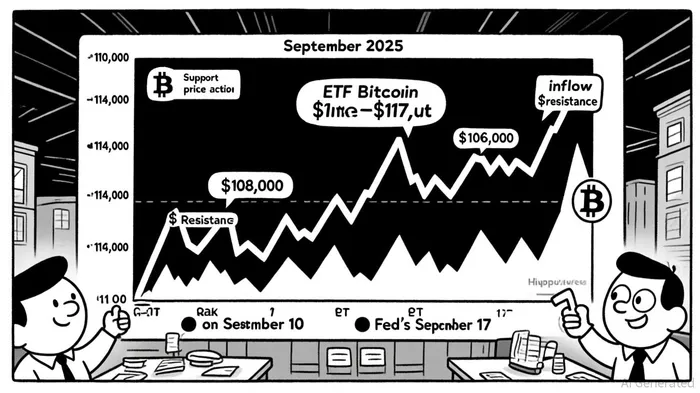
Bitcoin's recent pullback below $116,000 in September 2025 has sparked intense debate among investors. Is this a temporary correction in a long-term bullish trend, or a warning sign of deeper structural risks? To answer this, we must dissect the interplay of technical breakdowns, macroeconomic sentiment, and trader behavior.
Technical Breakdowns: Scarcity, Liquidity, and Key Levels
Bitcoin's price has been consolidating within a $110,000–$116,000 range, with critical support at $114,000 and $108,000[1]. On-chain metrics reveal a striking 74% of circulating coins are illiquid, and 75% have been dormant for over six months[5]. This hoarding behavior suggests limited selling pressure, reinforcing Bitcoin's scarcity-driven narrative. The Relative Strength Index (RSI) at 57 indicates balanced momentum, neither overbought nor oversold[1], while the Network Value to Metcalfe (NVM) Ratio has declined 7.5%, signaling alignment between market cap and network fundamentals[1].
However, the risk of a breakdown remains. A sustained drop below $108,000 could trigger over $10 billion in long liquidations[1], while a retest of $116,000–$117,000 could see a rally toward $150,000, supported by institutional inflows and a “golden cross” pattern[1]. Open interest has cooled to 720,000 BTCBTC-- contracts, reflecting reduced speculative leverage[1], but this also means the market is less resilient to sudden shocks.
Macroeconomic Sentiment: Fed Policy and the USD's Role
The U.S. Federal Reserve's September 17 rate cut of 25 basis points (bringing the target range to 4%–4.25%)[1] has been a pivotal event. While BitcoinBTC-- briefly crossed $117,000 post-announcement[6], the broader market absorbed $267 million in liquidations, with only $36 million tied directly to the Fed's decision[1]. This muted reaction suggests investors are pricing in the cut but remain cautious about future policy shifts.
Bitcoin's correlation with the Nasdaq 100 has strengthened to a two-year high[4], reflecting its growing integration into traditional asset paradigms. A weaker USD, driven by the Fed's dovish pivot, further bolsters Bitcoin's appeal as a hedge against inflation and devaluation[3]. However, analysts warn that a hawkish surprise—such as a delayed rate cut schedule—could push Bitcoin below $114,000[4].
Trader Behavior: ETF Inflows, Whale Accumulation, and Funding Rates
Institutional confidence is evident in U.S. spot Bitcoin ETF inflows, which hit $741.5 million on September 10[2], the largest single-day inflow since mid-July. This offset selling pressure from large holders (whales), who resumed offloading Bitcoin as prices slipped below $116,000[4]. Exchange data shows Kraken, Bitfinex, and CoinbaseCOIN-- Pro as top net inflow hubs, while Binance faced outflows[2], signaling a shift in capital toward regulated platforms.
Perpetual funding rates have cooled to 6% annualized[1], indicating reduced bullish leverage. Negative funding rates briefly emerged in late June 2025[3], hinting at bearish sentiment, but the average remains neutral. Open interest nearing “extreme fear” levels suggests a potential rebound if the $108,000 support holds[4].
Conclusion: A Cautious Buying Opportunity?
Bitcoin's correction below $116,000 is a mixed signal. On-chain scarcity and institutional inflows support a bullish case, particularly if the Fed sticks to its dovish trajectory. However, the risk of a short-term correction—triggered by a breakdown below $108,000 or a hawkish Fed—cannot be ignored.
For investors, the key is to balance optimism with caution. Accumulating Bitcoin during dips in the $110,000–$114,000 range could be prudent, but position sizing and stop-loss strategies are critical given the high leverage in the market. As the Fed's October and December decisions loom, Bitcoin's next move will likely hinge on whether macroeconomic optimism or volatility takes precedence.






Comentarios
Aún no hay comentarios