
Bitcoin's $111K Surge: A Cyclical Bull Market Reborn
Institutional Adoption: From Skepticism to Mainstream Embrace
The recent $90.6 million inflow into BitcoinBTC-- ETFs on October 24, per a TradingNews report, is more than a number-it's a signal. BlackRock's iShares Bitcoin Trust (IBIT) and ARKARK-- 21Shares Bitcoin ETF (ARKB) dominated the $477 million single-day inflow on October 21, according to the TradingNews piece, reversing a four-day losing streak. That piece also reported cumulative ETF assets now hit $151.58 billion, or 6.9% of Bitcoin's total market cap, and noted gold was down 5.9% in the same period. This isn't retail frenzy; it's institutional capital reallocating from gold to Bitcoin as a hedge.
JPMorgan's recent move to allow accredited clients to use Bitcoin and EthereumETH-- as loan collateral is covered in a Coinotag report, and is the next step in Wall Street's crypto integration. By the end of 2025, that analysis suggests this could help unlock $165,000 price projections for Bitcoin, as liquidity and use cases expand. Meanwhile, BlackRock's Q3 2025 crypto buying spree-$22 billion in Bitcoin and Ethereum-shows institutional conviction, according to a Finbold report. Even Ethereum ETFs, which saw $244 million in outflows per a Coindoo report, can't dampen the broader trend: Bitcoin is reclaiming its role as the default digital store of value.
On-Chain Metrics: A Cooler Bull Market
Bitcoin's on-chain activity tells a story of controlled growth. The NVT (Network Value to Transactions) ratio, a key valuation metric, is currently over 3x higher than Ethereum's, according to a Seeking Alpha article, but still below the peaks seen in 2017 and 2021. During the 2017 bull run, the NVT spiked as transaction volume lagged behind price, foreshadowing a 2018 crash, as highlighted in a NewHedge analysis. In 2021, the ratio was more balanced, reflecting broader adoption. Today's NVT suggests Bitcoin is in a mid-cycle phase-no overheating, but room to run.
Wallet growth and transaction volumes, however, tell a different story. While Ethereum outperforms Bitcoin in daily active users (DAAs), the Seeking Alpha piece notes Bitcoin's institutional wallet activity is surging. SpaceX's recent $133.7 million Bitcoin transfer-a reorganization of holdings, not a sale-is described in a CryptoFrontNews report, and highlights the stability of corporate reserves. Combined with Tesla's $2 billion Bitcoin stash, this signals long-term confidence.
Macroeconomic Tailwinds: Fed Policy and Capital Reallocation
The Federal Reserve's dovish pivot is Bitcoin's tailwind. With a 98.3% probability of a 25-basis-point rate cut in October 2025, inflation is trending toward the 2% target, making scarce assets like Bitcoin more attractive. As interest rates fall, the opportunity cost of holding cash rises-driving capital into Bitcoin as a hedge against currency devaluation.
This reallocation is already underway. A 0.2% shift of global assets ($46.9 trillion) into Bitcoin could inject $93.8 billion into the market, according to a Coinotag analysis, leveraging a 10x–12x liquidity multiplier. If Bitcoin captures just 3–5% of the $28.7 trillion gold market, its price could double. The math is simple: in a world of negative real returns, Bitcoin's scarcity becomes a competitive advantage.
Historical Parallels: A New Bull Market Blueprint
Comparing 2025 to past bull cycles reveals a unique setup. In 2017, the NVT ratio spiked before the crash; in 2021, it remained stable as adoption grew. Today's NVT is elevated but not extreme, suggesting a more mature market. Meanwhile, Bitcoin's realized price ($55,200) is still 100% below its current level, a point highlighted in a Coinotag post, indicating undervaluation relative to on-chain fundamentals.
The 2025 bull market isn't a replay of 2017-it's a new paradigm. Institutional adoption, macroeconomic shifts, and regulatory clarity are creating a flywheel effect. As Finbold reported, BlackRock's ETHA ETF captured 88% of Ethereum inflows on October 6, and the broader market is learning: Bitcoin isn't a speculative bet anymore. It's a core asset.
The Bottom Line: Why Now Is the Time
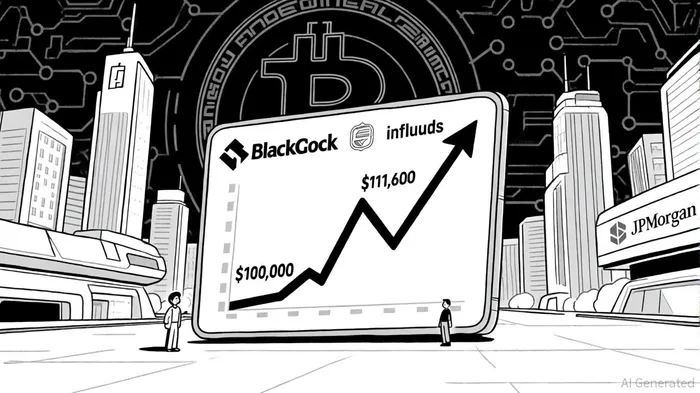
Bitcoin's $111,600 price tag isn't a bubble-it's a reflection of institutional confidence, macroeconomic tailwinds, and on-chain fundamentals. The recent ETF inflows, Fed rate cuts, and JPMorgan's collateral move are all pieces of a larger puzzle. For investors, this is a rare moment: a cyclical bull market with structural underpinnings.
As PlanB notes in the Coinotag post, Bitcoin's peak could still lie ahead. The question isn't whether the market will rally-it's whether you'll be positioned to ride the wave.





Comentarios
Aún no hay comentarios