
Bitcoin’s $111.3K Correction: Is a Sub-$100K Downtrend Imminent?
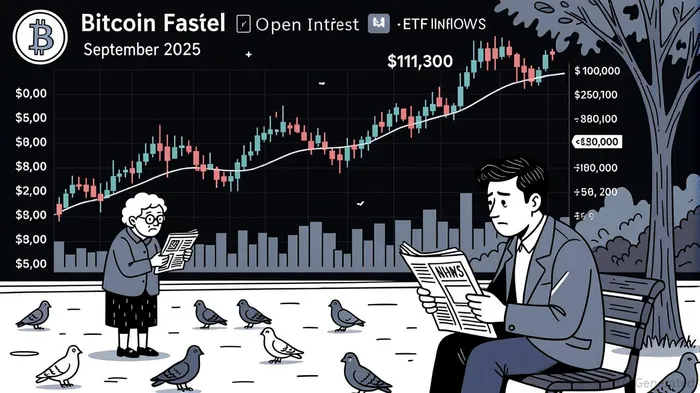
Bitcoin’s recent surge to an all-time high of $111,300 in September 2025 has been met with a sharp 10% correction, sparking debates about whether a sub-$100,000 downtrend is imminent. To assess this, we must dissect the interplay of on-chain behavior and institutional sentiment, which together paint a nuanced picture of a market transitioning from speculative fervor to cautious consolidation.
On-Chain Behavior: A Market in Transition
Bitcoin’s on-chain metrics reveal a maturing asset class, but one still vulnerable to liquidity shocks. Transaction volumes have weakened, with spot trading volumes declining nearly 9% to $7.7 billion, signaling reduced investor conviction [3]. Meanwhile, the MVRV (Market Value to Realized Value) ratio has dipped closer to loss territory, indicating shrinking unrealized profits and a more risk-averse market [4]. However, the Percent Supply in Profit remains stubbornly high at 90–95%, suggesting that capitulation—where holders sell en masse—has not yet occurred [2].
The MVRV Age Breakdown Composite, which measures the age of BitcoinBTC-- held by long-term and short-term holders, remains above its historical mean. This implies that long-term holders (LTHs) are still dominant, despite short-term holders (STHs) exerting increased influence as prices pull back from all-time highs [4]. The Realized Cap growth rate, a proxy for the absorption of new supply, has slowed to +2–3% per month—a stark contrast to previous cycles where this metric surged by double digits [2]. This slowdown underscores a shift in investor behavior: rather than aggressively chasing prices, participants are adopting a more defensive stance.
Futures open interest (OI) remains a critical wildcard. At $60–62 billion, it reflects robust speculative activity but also heightens sensitivity to volatility. A 5–8% correction could trigger large-scale liquidations, as seen in late 2025 when OI peaked at $67 billion before a $2.3 billion drop in a single session [2]. The market’s increasing reliance on derivatives—evidenced by Ethereum’s perpetual volume ratio hitting historical highs—further amplifies this risk [2].
Institutional Sentiment: ETFs and Funding Rates Signal Mixed Signals
Institutional flows have provided some stability. US spot ETFs, including the iShares Bitcoin Trust (IBIT) and Grayscale Bitcoin Trust (GBTC), recorded net inflows of 282.6 BTC on September 3, 2025, reversing a 10-day outflow trend [2]. Over the past month, these funds averaged ~97.6 BTC per day in inflows, suggesting continued institutional demand despite the pullback. However, the weak absorption of new supply—despite these inflows—highlights a disconnect between capital inflows and price action [3].
Perpetual funding rates, a gauge of leveraged bullish sentiment, have cooled to 6% in September 2025, down from double-digit levels earlier in the year [3]. This decline reflects reduced leverage demand and a more balanced market. Open interest in BTC-denominated contracts has also dropped to 720,000, a level consistent with profit-taking or cautious positioning [3]. Meanwhile, altcoin OI dominance has spiked to one of its highest levels since January 2023, indicating a capital shift toward smaller cryptocurrencies [1]. This divergence between Bitcoin and altcoins complicates the narrative of a unified bull market.
Red September and Technical Indicators: A Bearish Seasonality?
Historical patterns, such as the “Red September” phenomenon—where Bitcoin averages a -3.77% return since 2013—add to the bearish narrative [2]. Institutional selling, tax loss harvesting, and reduced summer liquidity have created a bearish technical setup, with key support levels now in play. However, technical indicators like a hidden bullish divergence in Bitcoin’s RSI suggest the market may not be as weak as price action implies [2]. Whale activity also tells a story of accumulation: addresses holding 100+ BTC reached a record 19,130, signaling sophisticated investors are buying the dip [2].
Is a Sub-$100K Downtrend Imminent?
The data points to a correction rather than a collapse. While a 10% pullback to $100,000 is plausible, it aligns with historical bull market patterns where drawdowns precede new rallies [1]. The record-high illiquid supply—72% of Bitcoin’s total supply held in cold storage or by LTHs—reinforces its role as a store of value, with macroeconomic factors like inflation and fiat devaluation further supporting its appeal [4].
That said, the risks are real. Elevated futures OI and a derivatives-heavy market structure make Bitcoin vulnerable to liquidity shocks. If open interest drops below $55 billion or funding rates turn negative again, a short squeeze could push prices toward $143,000 [3]. Conversely, a breakdown below $100,000 would test the resilience of LTHs and the strength of ETF inflows.
Conclusion: A Buying Opportunity or a Warning Sign?
Bitcoin’s $111.3K correction is a natural part of its bull market cycle, but it underscores the fragility of a market increasingly driven by leverage and derivatives. For investors, the key is to distinguish between a healthy consolidation and a deeper bearish trend. On-chain metrics suggest the former, with strong LTH accumulation and ETF inflows providing a floor. However, the risks of over-leveraged positions and seasonal headwinds cannot be ignored.
As the market navigates this inflection point, the coming weeks will hinge on two questions: Can institutional flows and LTHs absorb the downward pressure? And will macroeconomic catalysts—like the upcoming CPI data—provide the spark for a rebound? For now, the answer remains uncertain, but the data leans toward viewing this correction as a buying opportunity rather than a collapse.
**Source:[1] Crypto Market Positioning - September 2025 [https://www.coinbaseCOIN--.com/institutional/research-insights/research/trading-insights/crypto-positioning-2025-09?utm_source=tldrcrypto][2] On-chain analysis week 26/2025 x WHAT: Risks of shifting from spot to derivatives [https://medium.com/@whatexchange/on-chain-analysis-week-26-2025-x-what-risks-of-shifting-from-spot-to-derivatives-5c6ea16385b0][3] Bitcoin sees declining volume amid rising bearish market [https://www.mitrade.com/insights/crypto-analysis/bitcoin/fxstreet-BTCUSD-202509021602][4] Bitcoin Illiquid Supply Hits Record 14.3MMMM-- as Long-Term Holders Continue to Accumulate [https://www.xt.com/en/blog/community-news/2025-09-07T15:17:53.000Z]





Comentarios
Aún no hay comentarios