
Bitcoin's $106.7K Crossroads: Leverage-Driven Volatility and Short-Term Opportunities
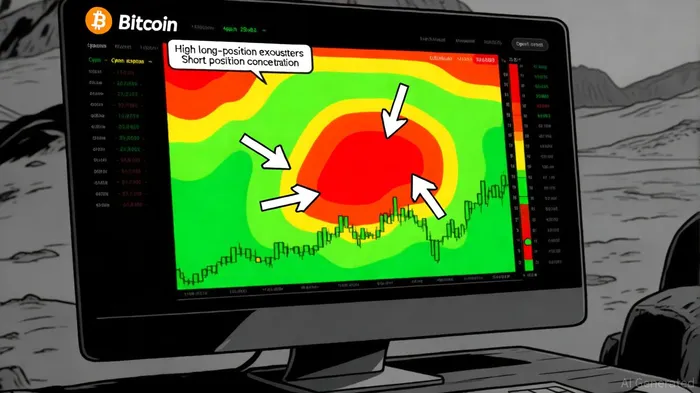
Bitcoin's price action in September 2025 has become a high-stakes chess match between leveraged bulls and bears. With open interest surging past $220 billion—a record high—the market is primed for explosive volatility as the price hovers near the critical $106.7K level[1]. This inflection point isn't just a number; it's a battleground where $10+ billion in leveraged long positions and $5.5 billion in short positions could be liquidated within hours, depending on the direction of the next move[1]. For short-term traders, this volatility isn't a risk—it's an opportunity.
The Leverage Overload
The derivatives market has become Bitcoin's shadow ecosystem. Perpetual futures trading volumes now dwarf spot volumes by 8–10x, a ratio that signals extreme speculative fervor[1]. Data from CoinGlass reveals that leveraged positions are densely packed around the $100K–$110K range, creating a “gravity well” effect where price corrections could trigger cascading liquidations[2]. The estimated leverage ratio (ELR) has hit a five-year high of +0.4, meaning even minor price swings could amplify systemic risks[4].
This leverage isn't evenly distributed. BTC-USDT futures, which dominate trading volume on exchanges like Binance and OKX, show leverage ratios nearing 2025 peaks[2]. Traders are effectively betting on a binary outcome: either a sharp rebound above $110K or a breakdown below $104.5K. The latter scenario could unleash $10 billion in long liquidations, while the former might trigger a short squeeze worth $5.5 billion[1].
Funding Rates as a Barometer
Funding rates for BTC-USDT perpetuals offer a real-time snapshot of market sentiment. When BitcoinBTC-- trades above its spot price (contango), longs pay shorts at a rate of ~0.005%[3]. But as the price approaches $106.7K, these rates have begun to fluctuate wildly. Negative funding rates observed in late June 2025—when Bitcoin briefly rallied from $100K to $108K—historically precede bullish reversals[5]. However, the current environment is more precarious: sellers dominate spot and futures markets, with weak buying volume suggesting a bearish bias[6].
Short-Term Opportunities in the Chaos
For traders willing to navigate the turbulence, three strategies emerge:
- Range Trading the $106.7K–$110K Corridor
The concentration of leveraged positions near $106.7K creates a self-fulfilling prophecy. If Bitcoin tests this level, the $10B in long liquidations could push prices back up, creating a short-term bounce. Conversely, a break below $104.5K might trigger a short-covering rally. Traders can use tight stop-loss orders to capitalize on these rebounds while avoiding deep drawdowns[1].
Hedging with Options
With open interest at record highs, options markets offer asymmetric protection. Buying put options below $104.5K or call options above $124K could hedge against liquidation-driven swings. The key is to balance premium costs with the likelihood of triggering these levels, which historical data suggests is high[1].Leveraging Macro Catalysts
The Federal Reserve's upcoming FOMC decisions are a wildcard. While the Fed's policy direction remains uncertain, its announcements are guaranteed to amplify volatility[1]. Traders who position themselves ahead of these events—using limit orders near key levels—can exploit the liquidity shocks that follow.
The Risks of a Late-Cycle Market
Bitcoin's current structure resembles a “late-cycle” phase, where aggressive selling pressure persists until fresh buying volume emerges[6]. The dominance of stablecoin-margined positions (post-FTX) has reduced the risk of a Black Thursday-style crash, but it hasn't eliminated the threat of sharp corrections[2]. Traders must also monitor the ELR metric: a sustained rise above +0.4 could signal an impending deleveraging spiral[4].
Conclusion
Bitcoin's $106.7K level isn't just a price—it's a fulcrum. For short-term investors, the leverage-driven volatility here is both a hazard and a catalyst. By understanding the distribution of liquidation clusters, funding rate dynamics, and macroeconomic triggers, traders can turn the chaos into an edge. The key is to act swiftly and decisively, because in a market where $10B can vanish in hours, hesitation is the most dangerous position of all.






Comentarios
Aún no hay comentarios