
Bitcoin's $103K Dip: A Catalyst for Altcoin Reallocation and the Rise of High-Utility Ecosystems
Bitcoin's recent retreat to $103,000 has reignited debates about its role as a macroeconomic bellwether and the broader implications for the crypto market. While some view the dip as a bearish signal, others see it as a structural opportunity for capital reallocation into high-utility altcoins. Historical patterns suggest that Bitcoin's corrections often act as catalysts for altcoin outperformance, particularly in projects with robust fundamentals and clear utility. This dynamic is especially evident in the case of BittensorTAO-- (TAO), a decentralized AI network poised to capitalize on the current market shift.
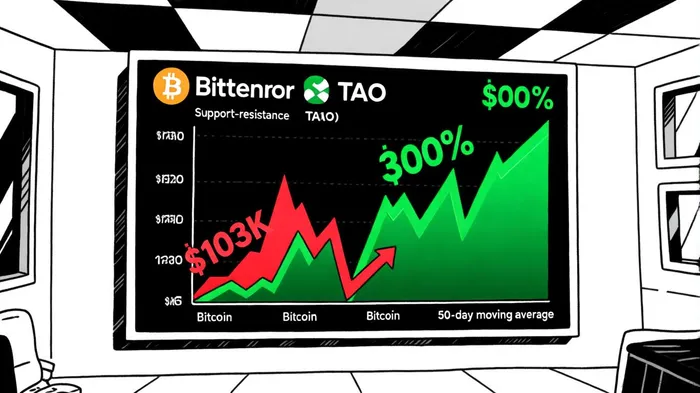
Bitcoin's Tug-of-War and the Case for Resilience
Bitcoin's price as of October 15, 2025, remains in a precarious equilibrium, trading between $111,880 and $113,078 amid a 1.91% decline, according to a CryptoDaily analysis. Analysts from Lekker Capital and 21Shares argue that the price action near critical support levels-despite macroeconomic headwinds like U.S.-China trade tensions-signals underlying strength, according to a Coindesk report. On-chain data reveals accumulation by smaller holders and a renewed conviction among mid-sized wallets, suggesting that the bearish narrative may be overstated, per a Coindoo analysis. However, the failure to breach the 50-day moving average highlights the fragility of Bitcoin's current rally, with fears of a further correction to $104,000 lingering, according to a CoinMarketCap forecast.
Capital Reallocation: Altcoins as Safe Havens in a Volatile Market
Historical data underscores a recurring pattern: Bitcoin's dips often trigger capital reallocation into altcoins, particularly those with strong utility-driven narratives, as reported by Coindesk. For instance, during the 2024 bear market, Ethereum's Dencun hard fork and staking yields attracted institutional flows, while DeFi and real-world asset tokenization projects outperformed BitcoinBTC--, according to a CryptoNews prediction. This trend has intensified in 2025, with Bitcoin's dominance dropping from 64% to 61%, as EthereumETH-- and altcoins gain traction, per Coindoo.
The current dip to $103K mirrors this dynamic. As Bitcoin consolidates, investors are increasingly shifting capital to projects like Bittensor (TAO), which offer tangible use cases in AI and decentralized infrastructure. This reallocation is further amplified by the rise of stablecoin pairs, which allow direct inflows into altcoins without first converting from Bitcoin, according to an InsideBitcoins analysis.
Bittensor (TAO): A Case Study in High-Utility Outperformance
Bittensor (TAO) has emerged as a standout performer in 2025, trading at $455 with a market cap of $4.64 billion, as noted by InsideBitcoins. Its 137.99% surge from the 30-day low underscores its appeal to both retail and institutional investors. Several factors drive this momentum:
Scarcity and Supply Dynamics: The first TAOTAO-- halving in December 2025 will cut daily emissions by 50%, mirroring Bitcoin's deflationary model, per CoinMarketCap. This scarcity mechanism, combined with institutional accumulation by entities like xTAO and TAO Synergies (which have locked up 1% of the circulating supply), creates upward pressure on the token's price.
Ecosystem Expansion: Bittensor's subnet count has surged to 128, covering applications from fraud detection to federated learning, as reported by Coindesk. A landmark partnership with Google Cloud in July 2025 further solidified its position as a decentralized AI infrastructure leader, according to CryptoNews. The Dynamic TAO (dTAO) upgrade, which decentralizes subnet value assessment, has also enhanced governance and community participation, per InsideBitcoins.
Technical Strength: TAO's price action above the Bollinger Bands midline and an RSI of 71 (indicating overbought conditions) suggest strong near-term momentum, as noted by InsideBitcoins. Key resistance levels at $475 and $500 could propel the token toward its previous peak, while support at $444 and $300 provides a safety net for long-term holders. However, historical backtests indicate that buying TAO when RSI exceeds 70 and holding for 30 days from 2022 to 2025 resulted in a -60.98% total return, with an average losing trade (-28.06%) outweighing average winners (21.28%).
Historical Precedents and the Path Forward
Bitcoin's historical corrections-such as the 50% drop in March 2020 and the 75% plunge in late 2022-have consistently been followed by altcoin rallies, per Coindoo. For example, during the 2024 dip, altcoins outperformed Bitcoin by leveraging Ethereum's Dencun upgrade and DeFi innovations, as noted by CryptoNews. The current environment mirrors this pattern, with TAO's 300% surge in Q3 2025 reflecting its ability to capitalize on AI-driven demand, according to CoinMarketCap.
Looking ahead, TAO's trajectory hinges on its ability to maintain utility-driven growth. The Google Cloud partnership and Dynamic TAO upgrade position it to benefit from the AI boom, while the halving event in December 2025 could trigger a parabolic price move. Analysts project an average price of $854.19 by 2030, with potential highs of $1,302.58, per CryptoNews, driven by AI adoption and regulatory clarity.
Conclusion: Positioning for the Next Bull Cycle
Bitcoin's $103K dip is notNOT-- a terminal bearish signal but a structural inflection point for the crypto market. As capital reallocates toward high-utility altcoins, projects like Bittensor (TAO) offer a compelling case for early positioning. With its scarcity model, ecosystem growth, and institutional backing, TAO is well-positioned to outperform in the next bull cycle. Investors who recognize the interplay between Bitcoin's volatility and altcoin innovation may find themselves at the forefront of the next wave of crypto-driven disruption.






Comentarios
Aún no hay comentarios