
The Biofuel Waiver Debate: A Tipping Point for U.S. Energy and Agricultural Markets
The Renewable Fuel Standard (RFS) reallocation debate has reached a critical juncture in 2025, with far-reaching implications for U.S. energy markets, agricultural supply chains, and investment strategies. As the Environmental Protection Agency (EPA) proposes record-high Renewable Volume Obligations (RVOs) for 2026 and 2027, stakeholders are grappling with the dual challenges of small refinery exemptions (SREs) and the geopolitical dynamics of biofuel trade. For investors, this debate represents both a high-stakes policy gamble and a potential inflection pointIPCX-- for domestic renewable energy infrastructure.
The RFS Reallocation Landscape: Policy Shifts and Market Signals
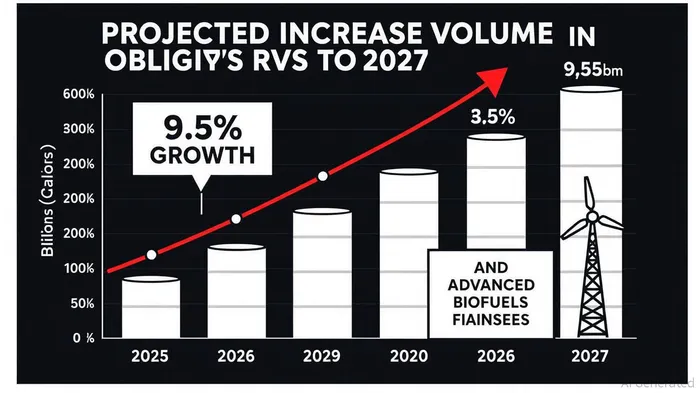
The EPA’s proposed RVOs for 2026 and 2027—24.02 billion gallons (bg) and 24.46 bg, respectively—mark a 9.5% increase from 2025 levels, with a clear tilt toward domestic production [1]. Notably, the agency has introduced a 50% devaluation of Renewable Identification Numbers (RINs) for imported biofuels and foreign-sourced feedstocks, a move explicitly designed to bolster U.S. corn ethanol and biomass-based diesel (BBD) producers [2]. This policy shift aligns with the Renewable Fuels Association’s (RFA) advocacy for “prioritizing domestic renewable fuels over imports,” which it argues will stabilize markets and support rural economies [3].
However, the reallocation of SREs remains a contentious wildcard. As of August 2025, the EPA has granted exemptions to 175 small refineries across multiple compliance years, with 13 petitions still pending [4]. While the agency has committed to reallocating these volumes to maintain RVO integrity, industry groups like the Iowa Renewable Fuels Association warn that delays or inconsistent enforcement could create a “2-billion-gallon uncertainty” in the market [5]. This uncertainty is already manifesting in RIN price volatility: D4 (BBD) credits recently traded between $0.84 and $0.89 per RIN, while D6 (conventional ethanol) credits hovered near $0.80–$0.82 [6].
Investment Opportunities: Domestic Biofuels and Agricultural Synergies
The EPA’s policy recalibration is creating clear tailwinds for U.S. biofuel producers and agricultural stakeholders. The proposed RVOs are expected to drive demand for corn and soybeans, with Darling IngredientsDAR-- noting that the devaluation of imported feedstocks could boost soybean oil demand by 1.5 billion gallons annually [7]. This has already spurred capital investment in soybean crush capacity, with five new plants operational in 2024 and more under construction [7].
The Inflation Reduction Act (IRA) further amplifies these opportunities. Section 45X tax credits for clean manufacturing have drawn $115 billion in U.S. clean energy investments since 2022, with biofuels and hydrogen production emerging as key beneficiaries [8]. For instance, biomass-based diesel producers stand to gain from the IRA’s 45V tax credit, which offers up to $1.29 per gallon for low-carbon fuels [9]. Similarly, the proposed 5.61 bg BBD mandate for 2026 could catalyze infrastructure upgrades at existing refineries, particularly in the Midwest [1].
Risks on the Horizon: SREs, Imports, and Market Fragmentation
Despite these opportunities, investors must navigate significant risks. The SRE backlog and reallocation process remain a source of regulatory ambiguity. Clean Fuels AllianceAENT-- America has warned that delayed RVO finalization could disrupt compliance planning for 2026, while the American Fuel and Petrochemical Manufacturers argue that reallocating exempted volumes risks “increasing imports and undermining U.S. energy dominance” [10].
Geopolitical tensions also loom large. Brazil’s recent trade barriers against U.S. ethanol exports—coupled with the EPA’s import devaluation policy—threaten to fragment global markets and reduce price competitiveness for U.S. biofuels [3]. Meanwhile, the elimination of eRINs (electricity from biogas) under the “Set 2” rule has shifted focus back to liquid biofuels, potentially slowing innovation in emerging sectors like sustainable aviation fuels (SAFs) [2].
Strategic Considerations for Investors
For investors, the RFS reallocation debate underscores the importance of hedging against policy volatility while capitalizing on structural trends. Key strategies include:
1. Diversifying Exposure: Balancing investments in conventional biofuels (e.g., corn ethanol) with advanced categories (e.g., BBD, cellulosic biofuels) to mitigate SRE-related risks.
2. Leveraging IRA Incentives: Targeting projects aligned with 45X and 45V tax credits, particularly in soybean oil processing and biomass-based diesel upscaling.
3. Monitoring RIN Markets: Closely tracking RIN price movements as a barometer of RVO enforcement and SRE reallocation progress.
Conclusion
The RFS reallocation debate is a microcosm of broader tensions in U.S. energy policy: the push-pull between domestic production and global trade, regulatory certainty and political expediency, and short-term compliance costs versus long-term decarbonization goals. For investors, the path forward lies in navigating these complexities with a dual focus on policy agility and market fundamentals. As the EPA moves toward finalizing its 2026–2027 RVOs by October 2025, the coming months will test whether the RFS can evolve into a stable, scalable framework—or remain a source of market fragmentation.
Source:
[1] EPA releases proposed rule to set 2026, 2027 RFS RVOs [https://biodieselmagazine.com/articles/epa-releases-proposed-rule-to-set-2026-2027-rfs-rvos-make-significant-changes-to-rfs-program]
[2] EPA Proposes New Renewable Fuel Standards [https://www.bdlaw.com/publications/epa-proposes-new-renewable-fuel-standards/]
[3] RFA: Proposed RVOs Provide 'Crucial Growth' [https://advancedbiofuelsusa.info/rfa-proposed-rvos-provide-crucial-growth-opportunities]
[4] August 2025 Decisions on Petitions for RFS Small Refinery Exemptions [https://advancedbiofuelsusa.info/august-2025-decisions-on-petitions-for-rfs-small-refinery-exemptions]
[5] Farm Groups Back EPA Refinery Exemption Move but Urge Full Reallocation [https://www.agriculture.com/farm-groups-back-epa-refinery-exemption-move-but-urge-full-reallocation-11796879]
[6] Oil, biofuel groups meet to align on RFS policy [https://www.argusmedia.com/en/news-and-insights/latest-market-news/2672529-oil-biofuel-groups-meet-to-align-on-rfs-policy]
[7] Policy changes to support US soybeans: Darling [https://www.argusmedia.com/en/news-and-insights/latest-market-news/2717591-policy-changes-to-support-us-soybeans-darling]
[8] The State of US Clean Energy Supply Chains in 2025 [https://www.cleaninvestmentmonitor.org/reports/us-clean-energy-supply-chains-2025]
[9] Top 5 Clean and Renewable Fuel Investments You Can't [https://www.dakotaridgecapital.com/insights/top-clean-renewable-fuel-investments-2025]
[10] EPA clears backlog of RFS small refinery exemptions [https://www.agri-pulse.com/articles/23372-epa-clears-backlog-of-rfs-small-refinery-exemptions]







Comentarios
Aún no hay comentarios