
Binance Yield Arena's 29% APR Offers and Their Impact on Crypto Passive Income Strategies
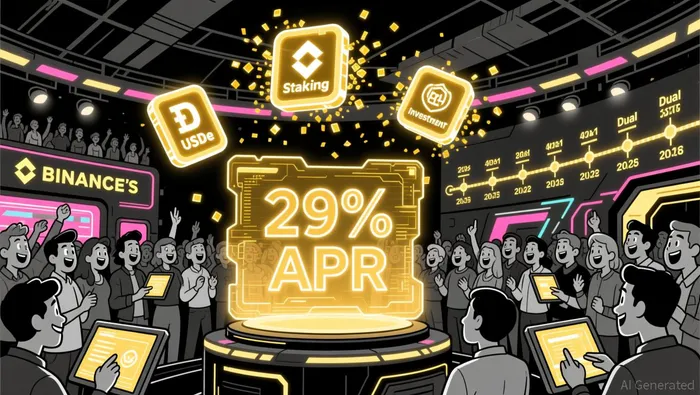
In the ever-evolving world of cryptocurrency, the allure of high annual percentage yields (APRs) continues to captivate investors seeking passive income. Binance's Yield Arena, offering up to 29% APRAT-- in late 2025, has become a focal point for users aiming to capitalize on volatile markets. However, the sustainability and strategic value of such high-yield products remain contentious, particularly in an environment where crypto assets are inherently prone to sharp price swings. This analysis evaluates Binance's 29% APR offers through the lens of risk management, collateralization, and broader market trends, while assessing their role in shaping modern crypto passive income strategies.
The Mechanics of Binance Yield Arena's 29% APR Offers
Binance's Yield Arena campaigns in late 2025 allowed users to earn up to 29% APR by holding as little as 0.01 USDeUSDe-- for 24 hours, with specific promotions running across multiple timeframes. These offers, part of Binance's broader "Earn" suite, included options like Simple Earn, ETH Staking, and Dual Investment, catering to both novice and experienced users. The platform's integration of yield-bearing assets like USDe further expanded accessibility, enabling users to earn rewards simply by holding synthetic dollar assets.
While the high APRs are enticing, Binance explicitly warns users of the risks associated with digital assets, including price volatility and potential losses as per platform disclosures. The platform's risk banners highlight the need for due diligence, emphasizing that these campaigns are not risk-free. This aligns with broader industry trends, as research shows platforms increasingly prioritize transparency to rebuild trust after the 2022 market collapses.
Risk Management and Collateralization in Volatile Markets
Despite the lack of detailed public documentation on Binance's collateralization strategies for the Yield Arena, the exchange has demonstrated a proactive approach to risk mitigation in other areas. For instance, Binance adjusted collateral ratios and leverage tiers in late 2025 to optimize trading conditions and reduce liquidation risks. These adjustments, while not directly tied to the Yield Arena, reflect a broader commitment to stabilizing user exposure during volatile periods.
General risk management advice for high-yield crypto products includes the "1–2% Rule," where traders limit exposure to 1–2% of their capital per trade, and the use of stop-loss orders to automate loss capping according to trading experts. Binance also encourages diversification across assets and strategies, such as combining spot trading, futures, and staking, to spread risk as recommended by financial advisors. For the Yield Arena specifically, users are advised to avoid overleveraging and to monitor campaigns closely, as limited-time offers may expire without notice.
Sustainability and Strategic Value in a Maturing Market
The sustainability of high-yield crypto products hinges on their ability to adapt to institutional-grade standards. As noted by Forbes, platforms like CoinDepo and Maple FinanceSYRUP-- have gained traction by offering yield opportunities backed by overcollateralized loans and institutional underwriting according to industry analysis. This shift toward transparency and verifiable lending spreads contrasts with the speculative models of the past, signaling a maturing market.
Binance's Yield Arena aligns with this trend by leveraging traditional financial (TradFi) practices, such as segregated custody and real-time reserve proofs as reported by industry analysts. Additionally, the integration of USDe as a yield-bearing collateral asset underscores Binance's effort to bridge DeFi and TradFi, enabling users to earn rewards while maintaining liquidity according to market reports. These innovations suggest that high-yield products can coexist with risk management frameworks, provided they prioritize user education and institutional compliance.
Strategically, high-yield crypto products are gaining traction as part of diversified portfolios. The approval of U.S. spot BitcoinBTC-- ETFs in late 2024, for example, catalyzed global crypto ETP assets under management to exceed $130–160 billion by 2025. This institutional adoption, coupled with regulatory clarity (e.g., the EU's MiCA regulations), has transformed crypto into a regulated asset class suitable for professional investors according to institutional reports. Binance's Yield Arena, with its recurring high-APR campaigns, positions itself as a tool for both retail and institutional players to generate passive income while navigating macroeconomic uncertainties like inflation and interest rate fluctuations as highlighted in market analysis.
Challenges and Considerations
Despite these advancements, the 29% APR offers are not without caveats. The limited-time nature of campaigns means users must act quickly, often without full visibility into underlying asset performance or collateralization ratios. Furthermore, the absence of detailed public documentation on Binance's risk management strategies for the Yield Arena raises questions about transparency. While the platform's general risk mitigation practices are robust, users must independently assess the alignment of these strategies with the specific risks of high-yield products.
Conclusion
Binance's Yield Arena represents a compelling intersection of innovation and risk in the crypto space. By offering up to 29% APR through limited-time campaigns, the platform taps into the growing demand for passive income strategies, particularly in volatile markets. However, the sustainability of these offers depends on Binance's ability to maintain transparency, adapt to regulatory shifts, and integrate robust risk management frameworks. For investors, the strategic value lies in balancing high-yield opportunities with disciplined risk mitigation- leveraging tools like stop-loss orders, diversification, and dollar-cost averaging to navigate the inherent uncertainties of crypto markets. As the industry matures, platforms that combine DeFi efficiency with TradFi safeguards will likely dominate, ensuring that high returns and user protection are not mutually exclusive.






Comentarios
Aún no hay comentarios