
Binance Wallet's BNB DeFi Carnival: A High-Yield Opportunity in a Zero-Fee Era
Zero-Fee Stablecoins: A Catalyst for Mass Adoption
BNB Chain's "0 Fee Carnival" initiative has eliminated gasGAS-- fees for stablecoin transactions involving USDTUSDT--, USD1, and USDCUSDC--, extending this benefit until November 30, 2025 according to the blog. This move has saved users over $4 million in gas costs by covering fees for withdrawals, transfers, and cross-chain bridging according to the blog. For instance, users can withdraw USD1 and USDC from centralized exchanges like Binance, Bitget, and MEXC without incurring fees, provided minimum thresholds are met according to the blog. The program's success is evident in BNB Chain's dominance in stablecoin transactions, with the chain ranking #1 in monthly active users (MAU) for both May and June 2025 according to the blog.
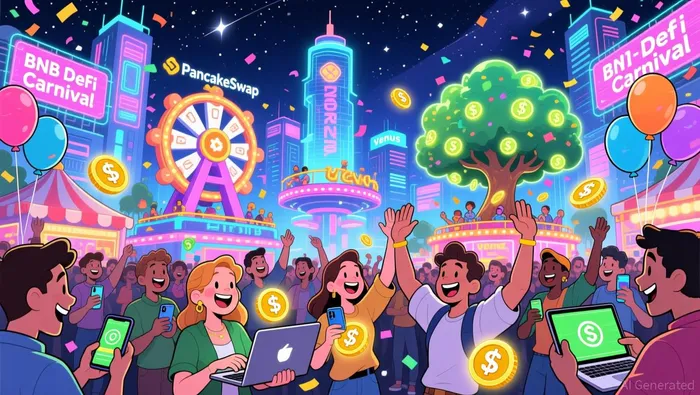 The zero-fee model reduces barriers to entry for DeFi participation, particularly for retail investors. By enabling frictionless asset movement, BNB Chain has incentivized users to deploy stablecoins into yield-generating protocols. Platforms like PancakeSwapCAKE-- and VenusXVS-- now offer competitive APYs on staked stablecoins, with some liquidity pools yielding up to 20% annually according to Cryptoslate. This synergy between zero-fee infrastructure and high-yield DeFi protocols creates a flywheel effect: lower transaction costs drive higher liquidity, which in turn enhances yield opportunities.
Referral Programs: Scaling User Acquisition with High-Value Incentives
Binance Wallet's referral ecosystem has become a cornerstone of user acquisition in 2025. The Referral Carnival, for example, offers a $430,000 prize pool, where participants earn points by inviting friends to engage in on-chain activities. Similarly, Binance's web referral program rewards users with up to 80% referral commissions, while invited users receive a 10% trading fee rebate. These structures not only incentivize organic growth but also align user behavior with platform objectives, such as increasing trading volume and TVL.
The effectiveness of referral programs is underscored by BNB Chain's Q3 2025 performance. During this period, the chain's TVL surged to $8.649 billion, supported by 3.09 million active addresses according to Alphanode. Strategic partnerships with protocols like AaveAAVE-- and UniswapUNI-- further amplified user acquisition by integrating BNB Chain's zero-fee infrastructure with cross-chain liquidity solutions according to MEXC. For investors, this means that referral-driven growth is not just a short-term tactic but a sustainable strategy to capitalize on BNB Chain's expanding ecosystem.
TVL Incentives and Passive Income Strategies
BNB Chain's TVL Incentive Program, which allocates $300,000 in rewards for projects increasing TVL, has become a critical tool for passive income generation. The program includes a $100,000 BNB Staking Challenge and a $200,000 TVL Challenge, with a focus on stablecoin and BNB staking according to Cryptoslate. For example, users staking USD1 on Venus can earn up to 5-7% APY, while liquidity providers on PancakeSwap's stablecoin pools have seen returns exceeding 15% according to Cryptoslate.
Cross-chain bridges like Celer cBridge and Meson.fi further enhance these opportunities by offering 100% rebates on bridging fees, enabling users to move assets from EthereumETH-- or SolanaSOL-- to BNB Chain at no cost according to BNB Chain's blog. This integration with multi-chain infrastructure ensures that users can access BNB Chain's high-yield protocols without sacrificing exposure to other ecosystems.
ROI Metrics and Strategic Frameworks
Expert analyses highlight the ROI potential of BNB Chain's incentives. For instance, B2B digital marketing benchmarks in 2025 indicate that email marketing delivers an ROI of $36–$40 per $1 spent, while SEO and content marketing often exceed 700% ROI according to Martal. These metrics suggest that projects leveraging BNB Chain's referral and TVL incentives can achieve cost-effective user acquisition.
Case studies from DeFi platforms, crypto casinos, and Web3 gaming further validate this. DeFi platforms, for example, have an average customer acquisition cost (CAC) of $85 and a 90-day active rate of 45% according to Blockchain Ads. In contrast, crypto casinos, which rely heavily on affiliate marketing, face a higher CAC of $125 but benefit from a player lifetime value (LTV) of $890 according to Blockchain Ads. These disparities underscore the importance of tailoring strategies to specific user segments.
Risks and Considerations
While the BNB DeFi Carnival presents compelling opportunities, risks such as market volatility and regulatory uncertainty persist. High-yield protocols like BNBCapital.org, which promises 17% daily returns, are backed by audits but remain speculative. Additionally, the sustainability of referral-driven growth depends on continuous user onboarding and capital inflows, which could be impacted by macroeconomic shifts.
Conclusion
Binance Wallet's BNB DeFi Carnival exemplifies how zero-fee infrastructure, referral incentives, and TVL-driven yield strategies can converge to create a high-yield environment. By leveraging these tools, investors can access passive income streams while contributing to BNB Chain's growth. However, success requires a nuanced understanding of risk management and strategic alignment with the ecosystem's evolving priorities. As BNB Chain continues to integrate with global DeFi networks, its carnival-like incentives may well redefine the future of decentralized finance.






Comentarios
Aún no hay comentarios