
Binance's Strategic Shift to USD1 and Its Implications for Stablecoin Dominance
The collapse of Binance's BUSD stablecoin in early 2023 marked a pivotal moment in the crypto industry, exposing the fragility of centralized stablecoins reliant on aggressive market tactics and opaque reserves. In the post-BUSD era, Binance has recalibrated its approach, embracing USD1-a Trump-linked stablecoin issued by World Liberty Financial-as a cornerstone of its stablecoin infrastructure. This strategic pivot reflects a calculated effort to navigate regulatory scrutiny, diversify risk, and reassert dominance in a fragmented stablecoin market.
The Post-BUSD Landscape: From Hegemony to Aggregation
Binance's earlier strategy with BUSD was characterized by hegemonic control. The exchange leveraged automatic conversion mechanisms to dominate liquidity pools, converting competing stablecoins like USDC and TUSD into BUSD to inflate trading volumes. However, this approach backfired when regulatory authorities, including the U.S. Department of Justice, intervened, leading to the collapse of BUSD and a reputational crisis for Binance.
Post-2023, Binance adopted a more defensive posture, diversifying its stablecoin reserves with alternatives like FDUSDFDUSD-- and BFUSDBFUSD--. By 2025, the exchange introduced $U, a meta-stablecoin backed by a basket of assets including USD1USD1--, USDT, and USDCUSDC--. This shift from hegemony to aggregation underscores Binance's recognition of the need for regulatory agility in a landscape where no single stablecoin can guarantee immunity from scrutiny.
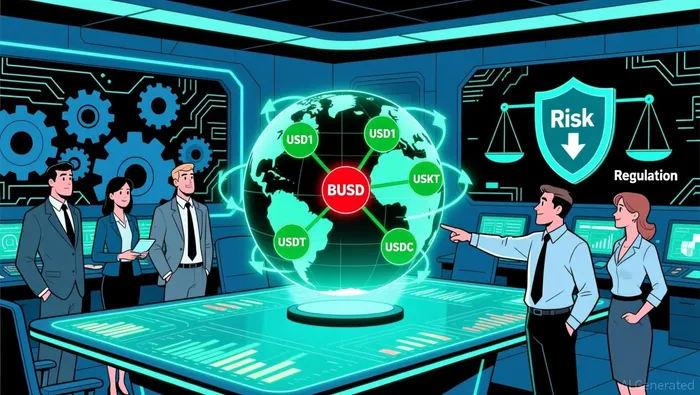
Strategic Integration of USD1: Political Capital and Operational Gains
Binance's partnership with World Liberty FinancialWLFI-- (WLF) to integrate USD1 into its ecosystem represents a bold alignment with political capital. USD1, backed by U.S. Treasuries and branded under the Trump family's influence, offers a unique value proposition: regulatory credibility bolstered by high-profile political connections. According to a report by Mexc News, Binance has introduced zero-fee trading pairs for USD1 with major cryptocurrencies like BTCBTC--, ETH, SOL, and BNBBNB--, directly enhancing liquidity and user adoption.
Operationally, USD1's integration into Binance's core systems-trading, margin, and liquidity-has been seamless. The exchange has converted all Binance-Peg BUSD (B-Token) collateral to USD1 at a 1:1 ratio, signaling a full commitment to the stablecoin. This move not only mitigates the risks of single-regulatory exposure but also positions USD1 as a hedge against potential de-pegging events in other stablecoins.
Competitive Advantages of USD1 in a Fragmented Market
USD1's competitive edge lies in three key areas:
1. Regulatory Resilience: Unlike BUSD, which relied on opaque reserves, USD1's U.S. Treasury backing provides a transparent collateral structure, aligning with evolving regulatory demands.
2. Political Leverage: The Trump family's ownership of WLF adds a layer of political capital, potentially shielding USD1 from adversarial regulatory actions.
3. Operational Efficiency: Zero-fee trading pairs and gas-free transfers for machine-to-machine microtransactions position USD1 as a scalable solution for the AI-driven economy.
Binance's strategic emphasis on USD1 also reflects a broader vision for the future of decentralized finance (DeFi). By prioritizing gas-free transfers and low-cost microtransactions, USD1 is tailored for AI-driven applications, where speed and cost-efficiency are paramount. This forward-looking design could cement USD1's role in next-generation financial infrastructure.
Implications for Stablecoin Dominance
Binance's shift to USD1 signals a paradigm shift in stablecoin dynamics. Rather than attempting to dominate a single stablecoin, the exchange is building a diversified stablecoin ecosystem. This aggregation strategy reduces dependency on any one issuer and mitigates the risks of regulatory overreach. As noted by , Binance's integration of USD1 into its trading and collateral systems represents a "strategic alignment with a Trump-linked project," leveraging political and financial synergies.
However, challenges remain. The Trump-WLF connection, while politically advantageous, could also attract scrutiny, particularly in jurisdictions wary of conflating financial instruments with partisan interests. Additionally, the success of USD1 hinges on sustained user adoption and the ability to maintain its peg to the U.S. dollar amid macroeconomic volatility.
Conclusion
Binance's strategic shift to USD1 exemplifies the evolving role of centralized stablecoins in a post-BUSD world. By combining regulatory compliance, political capital, and operational innovation, USD1 offers a compelling alternative to legacy stablecoins. For investors, this transition highlights the importance of adaptability in a market where regulatory and geopolitical factors can reshape competitive landscapes overnight. As Binance continues to refine its stablecoin strategy, USD1's trajectory will be a critical barometer for the future of centralized stablecoins in the AI-driven economy.






Comentarios
Aún no hay comentarios