
Binance's Strategic Move to Re-Enter South Korea via Gopax Acquisition: Regulatory Compliance and Regional Market Dominance in Crypto
The cryptocurrency landscape in South Korea has long been a battleground for global and local players, with regulatory scrutiny acting as both a barrier and a catalyst for innovation. Binance, the world's largest crypto exchange by trading volume, is now poised to re-enter this critical market through its acquisition of Gopax, a move that underscores the interplay between regulatory compliance and strategic market dominance.
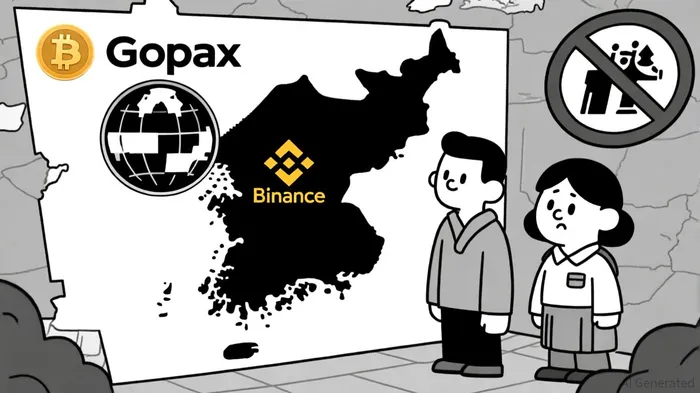
Regulatory Compliance: A Prerequisite for Re-Entry
Binance's acquisition of 67% of Gopax in February 2023 was initially driven by the need to stabilize the latter amid a liquidity crisis caused by frozen withdrawals linked to Genesis Global Capital, according to a CoinPedia report. However, the path to full integration was blocked by South Korean regulators, who paused the approval process in 2023 due to concerns over Binance's anti-money laundering (AML) practices and its opaque corporate governance, according to a CryptoTimes report. This regulatory standoff persisted until May 2025, when Binance resolved a $4.3 billion legal settlement with U.S. authorities, addressing longstanding AML and KYC deficiencies, according to a Crypto2Community report.
According to The Block, the Financial Intelligence Unit (FIU) has since resumed its review of Gopax's executive change report-a critical proxy for evaluating Binance's suitability as a controlling shareholder. This development signals a shift in South Korean regulators' stance, as the resolution of Binance's U.S. legal issues has alleviated concerns about its compliance capabilities. If the FIU grants final approval, Binance could fully re-enter the South Korean market by year-end 2025, as CoinPedia has suggested.
Regional Market Dynamics: Competition and Institutionalization
South Korea's crypto market has evolved into Asia's most dynamic, with a trading volume of $663 billion in 2025 and over 18 million retail investors, according to Stablecoin Insider. Local exchanges like Upbit and Bithumb have dominated the space, but the entry of a global giant like Binance could disrupt the status quo. The government's recent push for spot BitcoinBTC-- ETFs and won-backed stablecoins further underscores its ambition to institutionalize the market while balancing innovation with investor protection, as reported by The Crypto Basic.
Binance's re-entry aligns with these regulatory trends. By adhering to South Korea's stringent AML and KYC requirements, the exchange could position itself as a bridge between global liquidity and local compliance. As CoinPedia has argued, the approval of Binance's Gopax acquisition would likely accelerate the adoption of international standards in South Korea's crypto sector, fostering trust among institutional investors.
Strategic Implications: Market Dominance and Regulatory Alignment
Binance's acquisition of Gopax is not merely a financial maneuver but a calculated step to align with South Korea's regulatory roadmap. The country's Digital Asset Basic Act, which mandates reserve requirements for stablecoins and introduces a licensing framework for crypto firms, creates a fertile ground for compliant global players, as noted by Stablecoin Insider. By navigating these regulations, Binance could leverage Gopax's local infrastructure to capture market share while mitigating risks associated with regulatory arbitrage.
However, challenges remain. South Korean regulators have previously imposed temporary restrictions on exchanges like Upbit for AML violations, signaling a zero-tolerance approach to non-compliance, according to The Crypto Basic. Binance's success will hinge on its ability to integrate Gopax's operations seamlessly into its global compliance framework, ensuring transparency in user fund management and transaction monitoring.
Conclusion: A New Era for South Korea's Crypto Ecosystem
Binance's potential re-entry into South Korea represents a pivotal moment for the region's crypto market. By resolving its regulatory hurdles and aligning with the government's institutionalization agenda, the exchange could redefine competition in a market already primed for growth. For investors, this development highlights the importance of regulatory alignment in crypto's global expansion-a lesson that extends far beyond the Korean peninsula.






Comentarios
Aún no hay comentarios