
Binance's Strategic Listing of Hemi: A Catalyst for DeFi Innovation and Retail Investor Access
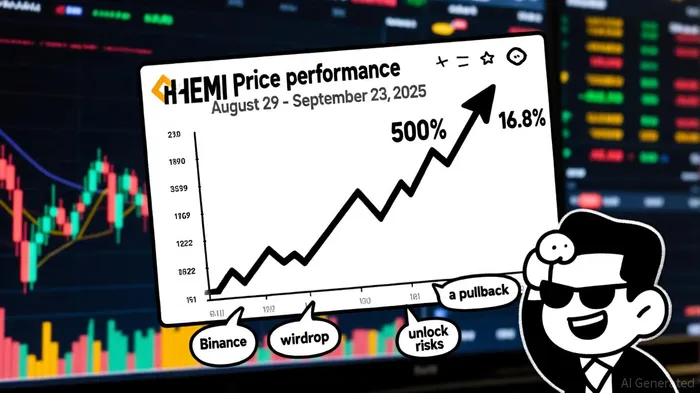
Binance's decision to list HemiHEMI-- (HEMI) on August 29, 2025, marks a pivotal moment in the evolution of decentralized finance (DeFi). By integrating Hemi—a BitcoinBTC-- layer-2 protocol designed to merge Bitcoin's security with Ethereum's programmability—into its ecosystem, Binance is notNOT-- only expanding its own infrastructure but also accelerating Bitcoin's transition from a store of value to a foundational asset for DeFi applications. This move, coupled with strategic product integrations like airdrops, leveraged trading, and cross-chain bridges, positions Hemi as a compelling long-term investment in a rapidly maturing market.
Hemi's Technological Differentiation: Bridging Bitcoin and Ethereum
Hemi's core innovation lies in its Hemi Virtual Machine (hVM), which embeds a full Bitcoin node within an EthereumETH-- Virtual Machine (EVM). This architecture allows developers to build applications that interact with both Bitcoin and Ethereum natively, enabling use cases like trustless lending, BTC-backed stablecoins, and cross-chain derivatives without custodial intermediaries [2]. Unlike traditional wrapped BTCBTC-- solutions or Bitcoin layer-2 projects that rely on centralized sequencers, Hemi's design ensures trust-minimized interoperability, reducing counterparty risk while preserving Bitcoin's security guarantees [3].
The protocol's Proof-of-Proof (PoP) consensus mechanism further distinguishes it. By anchoring its state to the Bitcoin blockchain, Hemi inherits Bitcoin's finality and security, achieving “superfinality” where network reorganization is nearly impossible without a 51% attack on Bitcoin itself . This contrasts with alternatives like Stacks or the Lightning Network, which either lack Ethereum compatibility or are limited to microtransactions [1]. As of September 2025, Hemi has achieved $1.2 billion in total value locked (TVL), making it the second-largest Bitcoin DeFi sidechain after CORE, with 90+ deployed protocols and partnerships with SushiSUSHI--, LayerZeroZRO--, and MetaMask [2].
Binance's Role in Scaling DeFi Infrastructure
Binance's strategic partnership with Hemi is part of a broader initiative to scale DeFi infrastructure. The exchange has invested in 46 projects across DeFi, AI, and ZK technologies in 2025, emphasizing a chain-agnostic approach that includes SolanaSOL--, Ethereum, and Layer 2 solutions [3]. Hemi's listing on Binance Alpha and Binance Smart Chain (BSC) is complemented by exclusive campaigns such as the Binance Wallet Booster, which allocated 2% of HEMI's total supply to users for on-chain activity, and 50x leverage trading, which amplified liquidity inflows [5]. These initiatives align with Binance's 2025 mid-year report, which highlights a 550% year-over-year increase in TVL for Bitcoin-based DeFi (BTCFi), a trend Hemi is poised to accelerate [4].
Beyond Hemi, Binance's infrastructure investments—such as its collaboration with Franklin Templeton to develop institutional-grade digital asset solutions and BSC's role in supporting fast, low-cost transactions—underscore its commitment to bridging decentralized and traditional finance [4]. By providing Hemi with access to its 180+ million users and institutional-grade tools, Binance is effectively lowering barriers to entry for retail investors while fostering ecosystem growth.
Market Performance, Risks, and Competitive Positioning
Since its listing, HEMI has experienced a 500% price surge, driven by Binance's marketing, a 100 million token airdrop to BNBBNB-- holders, and speculative inflows from Yzi Labs-backed tokens like Aster (ASTER) [2]. However, the token's tokenomics—featuring a 10 billion total supply with only 9.8% currently circulating—pose risks of sell pressure as early investor unlocks approach [5]. Historical patterns suggest that low-float tokens often face corrections during these periods, though Hemi's 32% community allocation and growing TVL may mitigate this risk [2].
Competitively, Hemi faces challenges from projects like CORE and Stacks but maintains a unique edge through its dual-chain integration and institutional backing. A $15 million funding round led by YZi Labs (formerly Binance Labs) and Republic Digital has bolstered confidence in its vision, while its incentivized testnet attracted 200,000 PoP miners and 88% cross-chain traffic on Ethereum's Sepolia testnet [2]. Analysts remain cautious about execution risks, particularly in developer adoption and scalability, but the project's technical maturity and Binance's support suggest a strong foundation for long-term growth [5].
Investment Thesis: A High-Conviction Play on Bitcoin's DeFi Future
Hemi's strategic alignment with Binance's infrastructure expansion, combined with its technological differentiation and growing TVL, makes it a high-conviction play for investors seeking exposure to Bitcoin's DeFi revolution. While short-term volatility is inevitable, the protocol's focus on interoperability, security, and institutional partnerships positions it to capture a significant share of the BTCFi market. For Binance, Hemi represents a critical step in its mission to democratize access to DeFi, offering retail investors a gateway to Bitcoin-based applications while reinforcing its dominance in the exchange space.






Comentarios
Aún no hay comentarios