
Binance's Strategic Expansion with ASTER and TRADOOR Perpetual Futures Listings: Assessing the Impact on Liquidity, Market Volatility, and Trader Sentiment
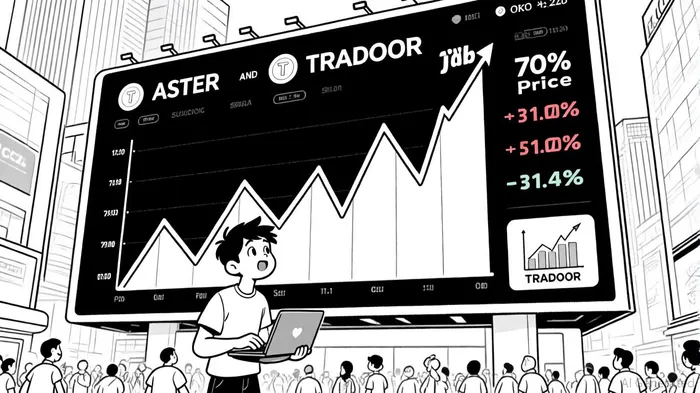
Binance's recent addition of ASTER/USDT and TRADOOR/USDT perpetual futures on September 19, 2025, marks a pivotal moment in the exchange's strategy to dominate the crypto derivatives market. By offering up to 50x leverage, Binance has amplified trading opportunities for these tokens, triggering immediate liquidity surges and volatility spikes. This analysis evaluates the market impact through three lenses: liquidity dynamics, price volatility, and trader sentiment, drawing on real-world data and strategic context.
Liquidity Surge and Market Depth
The ASTER/USDT perpetual contract, launched at 3:00 PM UTC, catalyzed a 1,650% price surge in the ASTER token within 24 hours, generating $345 million in trading volume and attracting 330,000 new wallets[1]. Open interest for ASTER/USDT reached $255.3 million, reflecting robust liquidity and institutional-grade participation[1]. Similarly, TRADOOR/USDT's 70% price jump post-listing at 3:30 PM UTC underscored strong demand, though specific liquidity metrics for TRADOOR remain less detailed[2]. Binance's 50x leverage offering likely amplified position sizes, enabling traders to capitalize on short-term price movements while deepening order books[3].
The introduction of these contracts aligns with Binance's broader strategy to diversify derivatives offerings. By expanding access to altcoin futures, the exchange not only attracts retail traders but also institutional players seeking arbitrage and hedging opportunities[4]. This liquidity injection is critical for projects like Aster, a CZ-backed decentralized exchange platform, which now boasts 1.848 million total users and 617,379 new users added in the last seven days[1].
Market Volatility and Funding Rate Dynamics
Perpetual futures inherently influence volatility through leverage and funding rates. For ASTER/USDT, the 400% surge since its airdrop on September 18, 2025, highlights the token's sensitivity to leveraged trading[5]. While specific funding rate data for the pair is not publicly available post-launch, general principles apply: positive funding rates (longs paying shorts) indicate bullish sentiment, while negative rates signal bearish pressure[6]. The ASTER/USDT contract's hourly funding rate settlements—unlike the standard 8-hour cycle—suggest a design to mitigate price divergence and stabilize volatility[7].
TRADOOR/USDT's 70% price jump, though impressive, raises questions about sustainability. High leverage can exacerbate short-term swings, particularly in less-established tokens. However, Binance's deep liquidity infrastructure and the token's prior presence on Binance Alpha Market likely provided a buffer against extreme volatility[2].
Trader Sentiment and Positioning
Sentiment analysis reveals a bullish bias in ASTER/USDT trading. As of the latest data, long positions account for 56.24% of open interest, while shorts hold 43.76%[8]. This imbalance suggests traders anticipate further price appreciation, possibly driven by CZ's public endorsement and Aster's growing user base[5]. Social media trends, though not quantified in the sources, likely amplified this sentiment, with platforms like Twitter and Telegram serving as amplifiers for retail FOMO.
For TRADOOR/USDT, the absence of granular sentiment metrics is notable. However, the token's 70% price surge post-listing implies strong retail participation, potentially driven by speculative positioning[2]. Binance's real-time funding rate tools and long/short ratio dashboards likely played a role in shaping trader behavior, though institutional sentiment remains harder to gauge without top-trader data[9].
Strategic Implications for Binance and the Market
Binance's move reinforces its leadership in the derivatives space, where it now competes with platforms like ByBit and OKX. By introducing niche tokens like ASTER and TRADOOR, the exchange diversifies its product suite and captures market share from smaller exchanges. The 50x leverage offering also appeals to experienced traders, aligning with Binance's focus on advanced derivatives products[3].
However, the rapid price surges raise concerns about speculative bubbles. For ASTER, the 1,650% gain in 24 hours—while extraordinary—may not be sustainable without fundamental adoption. Similarly, TRADOOR's 70% jump could face profit-taking pressure if funding rates normalize or sentiment shifts.
Conclusion
Binance's ASTER and TRADOOR perpetual futures listings have delivered a liquidity boost and volatility spike, driven by high leverage and strategic timing. While ASTER's performance highlights the potential for leveraged trading to drive token adoption, the sustainability of these gains depends on underlying project fundamentals. Trader sentiment, skewed bullish for ASTER, suggests continued momentum, but caution is warranted for tokens with less-established use cases like TRADOOR. As Binance expands its derivatives ecosystem, the interplay between leverage, liquidity, and sentiment will remain central to its market influence.







Comentarios
Aún no hay comentarios