
Binance's Strategic Delistings and Implications for Crypto Market Structure: Shifting Risk Profiles and User Behavior in Leveraged Trading
Binance's 2025 delistings of trading pairs and leveraged products represent a pivotal shift in the exchange's approach to risk management and market quality. These actions, driven by declining liquidity, regulatory pressures, and systemic volatility, signal a broader transformation in how crypto platforms address user behavior and structural risks in leveraged trading. By analyzing these delistings and their consequences, we uncover critical insights into the evolving dynamics of the crypto derivatives market.
Strategic Delistings: A Risk Mitigation Imperative
Binance's decision to delist 23 spot trading pairs in January 2025-including 1000SATS/FDUSD and AEVO/BTC-was explicitly tied to low liquidity and trading volume. The exchange reiterated this rationale in December 2025, removing 15+ margin trading pairs involving FDUSDFDUSD--, such as DOT/FDUSD and ENA/FDUSD, to optimize platform efficiency. These moves reflect a strategic pivot toward maintaining "sustainable markets" and aligning with user demand for high-quality, liquid assets.
The delistings also underscore Binance's heightened focus on mitigating risks in leveraged trading. For instance, the removal of margin pairs like FLOW/BTC was prompted by "wider bid-ask spreads and slippage", which exacerbate liquidation risks for leveraged positions. Similarly, the delisting of leveraged tokens (e.g., EIGEN/FDUSD and ARB/FDUSD) on December 30, 2025, aimed to prevent cascading failures, particularly after the October 2025 flash crash, where $19 billion in leveraged positions were liquidated due to distorted price feeds.
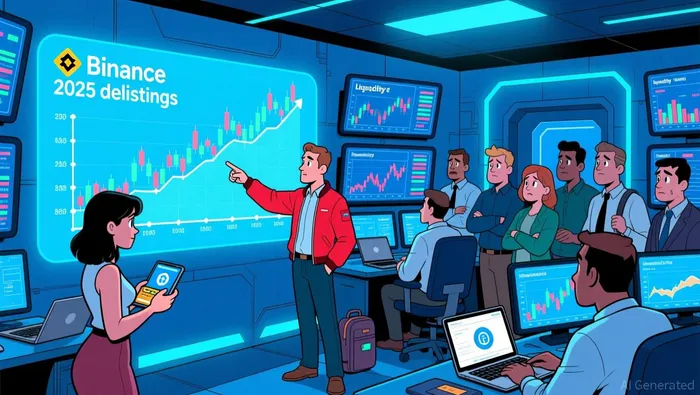
User Behavior Shifts: Position Closures and Liquidity Migration
The delistings have forced traders to reevaluate their exposure to leveraged products. By the end of 2025, forced liquidations reached $150 billion, reflecting heightened volatility and structural instability. Traders were compelled to close positions in delisted pairs or migrate to alternatives like perpetual swaps or higher-liquidity pairs. This migration was further amplified by Binance's increased KYC requirements and regulatory scrutiny, pushing users toward platforms like Bybit and KuCoin, which offer zero-fee promotions and unified account structures.
Quantitative trends reinforce this shift. Leverage positions declined by 24% in September 2024 and 29% in April 2025, indicating a broader market deleveraging. Meanwhile, Binance's total trading volume in 2025 hit $34 trillion, underscoring its role as a liquidity hub despite delistings. However, liquidity migration to competing exchanges has accelerated, with stablecoins like USDTUSDT-- and USDCUSDC-- gaining dominance as investors "hold cash equivalents rather than deploy capital", a bearish signal for BitcoinBTC--.
Market Structure Implications: Risk Management and Product Substitution
Binance's delistings highlight a maturing market structure, where risk management and institutionalization are prioritized. The exchange has adjusted leverage and collateral ratios for assets like WLDWLD-- and BIOBIO--, increasing collateral requirements from 50% to 60% to reduce systemic exposure. These adjustments align with broader industry trends, including the adoption of AI-driven tools for predictive analytics and crisis simulation.
Product substitution is also reshaping the landscape. Traders previously reliant on delisted margin pairs are now favoring perpetual futures and cross-margin structures, which offer greater flexibility. This shift is mirrored in institutional participation, as crypto derivatives volume reached $85.70 trillion in 2025, with Bitcoin and EthereumETH-- derivatives rivaling traditional futures markets.
Conclusion: A New Era of Risk-Aware Trading
Binance's 2025 delistings are not merely operational adjustments but strategic responses to a market grappling with volatility, regulatory scrutiny, and user risk tolerance. By prioritizing liquidity, reducing leveraged exposure, and fostering product innovation, the exchange is setting a precedent for how platforms can balance growth with stability. For investors, these developments signal a transition toward a more institutionalized, risk-aware crypto ecosystem-one where delistings are not just a cost of doing business but a catalyst for structural resilience.






Comentarios
Aún no hay comentarios