
Binance's Strategic Delistings and Their Impact on Altcoin Valuation Dynamics
Strategic Delistings: A Routine but Impactful Practice
Binance Futures announced the delisting of the three altcoin pairs on November 21, 2025, citing routine product optimization and risk management as primary drivers. The exchange emphasized that such decisions are informed by factors like low liquidity, declining trading volumes, and shifting user demand. For instance, XCN, FLMFLM--, and PERP-tokens with historically volatile price trajectories-were likely removed due to their inability to sustain consistent trading activity, a critical metric for futures markets where liquidity directly impacts slippage and price discovery.
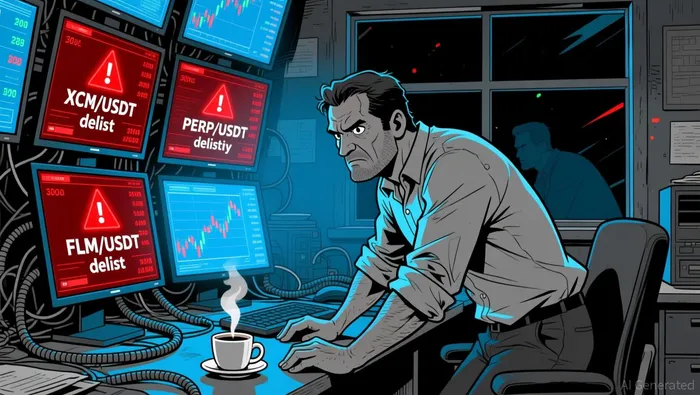 This approach aligns with Binance's broader strategy to maintain platform efficiency. By pruning underperforming pairs, the exchange aims to reduce operational complexity and focus on assets that better serve its global user base. However, the delistings also underscore a growing trend: centralized exchanges increasingly act as gatekeepers of market relevance, with their listings and delistings serving as implicit endorsements or rejections of projects.
Risk Management Implications for Futures Traders
For traders, the delistings introduce immediate operational risks. Binance's policy of automatically closing open positions at 12:00 UTC on the delisting date forces traders to either manually exit their positions beforehand or risk liquidation. This creates a dual challenge:
1. Price Volatility: As traders rush to close positions, sudden shifts in demand can exacerbate price swings. For example, a wave of sell orders to unwind long positions in PERPPERP-- could temporarily depress its spot price, compounding losses for leveraged traders.
2. Slippage Risks: Low-liquidity tokens like XCN and FLM are particularly vulnerable to slippage during forced liquidations, where large orders execute at unfavorable prices.
These risks are amplified by the lack of transparency in pre-delisting price action. While Binance provides advance notice, the absence of granular open interest data for these altcoins makes it difficult for traders to gauge market depth or anticipate liquidity crunches. For instance, data from June 2025 showed a $2.1 billion drop in Bitcoin's open interest amid geopolitical tensions, illustrating how macro events can destabilize even major assets. Smaller tokens like XCN and FLM, with inherently thinner order books, face even greater uncertainty.
Market Sentiment and the "Binance Effect"
Binance's delistings also act as a barometer for market sentiment. The removal of futures contracts often signals waning institutional or retail confidence in a project. For XCN, FLM, and PERP, the delistings may trigger a self-fulfilling prophecy: reduced futures availability limits leverage opportunities, which in turn deters speculative inflows and further depresses price action.
This dynamic is evident in historical precedents. When Binance delisted other low-volume tokens in 2024, their spot prices often declined by 10–30% within weeks, as traders shifted capital to more liquid alternatives. While spot trading for XCN, FLM, and PERP may continue, the absence of futures markets could erode their perceived utility as hedging or speculative tools, accelerating their marginalization.
Moreover, the delistings may indirectly influence broader market sentiment metrics. For example, a surge in risk-off behavior-reflected in fear/greed indices-could coincide with Binance's June 2025 delistings, as traders exited leveraged positions amid geopolitical tensions. While no direct data exists for XCN, FLM, or PERP, the correlation between exchange actions and macro sentiment underscores the interconnectedness of crypto markets.
Strategic Lessons for Traders and Investors
The XCN/FLM/PERP delistings offer critical insights for risk management in 2025:
1. Diversification and Liquidity Awareness: Traders should avoid overexposure to tokens with thin futures markets, as liquidity crises can erase gains rapidly.
2. Proactive Position Management: Monitoring exchange announcements and closing positions ahead of delistings is essential to avoid forced liquidations.
3. Sentiment-Driven Hedging: Given the volatility of altcoin futures, traders might consider hedging with options or stablecoin pairs to mitigate downside risks.
Binance's actions also highlight the importance of aligning with projects that demonstrate robust fundamentals and community engagement. Tokens delisted for low demand often lack the innovation or adoption to justify speculative bets, a reality that becomes starkly apparent when derivatives markets withdraw support.
Conclusion
Binance's strategic delistings of XCN, FLM, and PERP reflect a broader recalibration of risk and liquidity in crypto futures trading. While these moves are framed as routine optimizations, their implications for traders and market sentiment are profound. By forcing liquidity outflows and signaling waning confidence, Binance's decisions act as both a warning and a catalyst for market evolution. For investors, the lesson is clear: in an ecosystem where exchange policies can redefine asset valuations overnight, adaptability and vigilance are not just advantages-they are necessities.






Comentarios
Aún no hay comentarios