
Binance's Strategic Delistings and Their Impact on Altcoin Liquidity and Investor Risk
Binance's aggressive delisting strategy in 2025 has reshaped the altcoin market, signaling a shift toward liquidity-driven governance and regulatory alignment. By systematically removing underperforming assets, the exchange has recalibrated its platform to prioritize projects with robust fundamentals, active development, and compliance with evolving global standards. This analysis examines the patterns in delisted assets, user behavior shifts, and price volatility dynamics to underscore the growing importance of liquidity-first strategies for investors in high-risk crypto markets.
Patterns in Delistings: Sectors and Criteria
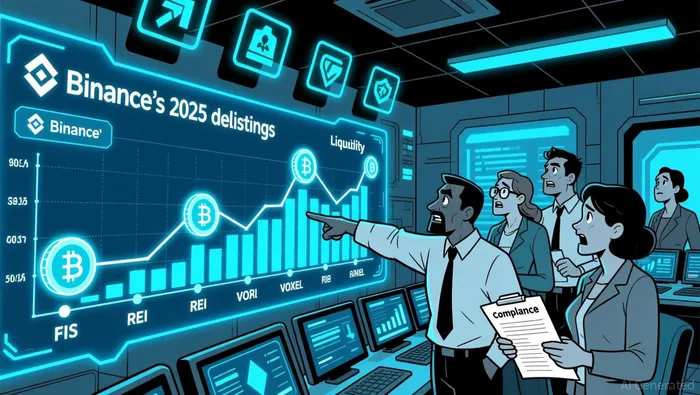
Binance's 2025 delistings reveal a clear focus on liquidity thresholds and sector-specific risks. Over the year, the exchange removed 23 spot trading pairs, including tokens like FISFIS--, REIREI--, and VOXELVOXEL--, which were primarily tied to decentralized finance (DeFi) and gaming sectors according to Binance's announcements. These delistings were driven by consistent failures to meet Binance's criteria for trading volume, project team commitment, and network stability. For instance, the December 2025 delisting of StaFiFIS-- (FIS), REI NetworkREI-- (REI), and VoxiesVOXEL-- (VOXEL) highlighted the exchange's intolerance for low-liquidity assets, even in high-growth sectors like blockchain gaming.
Stablecoins also faced scrutiny. In March 2025, Binance delisted trading pairs for non-compliant stablecoins under the EU's Markets in Crypto-Assets (MiCA) regulation, including USDTUSDT--, DAI, and AEUR. This move underscored the exchange's alignment with regulatory frameworks, further narrowing the scope for privacy coins and stablecoins lacking institutional-grade compliance.
User Behavior and Liquidity Reallocation
The delistings triggered immediate shifts in user behavior. Traders often migrated positions to alternative pairs, such as AI/USDT or AI/BTC, following the removal of AI/BNB in Q1 2025. This reallocation temporarily inflated volatility in the remaining pairs while reducing liquidity in the delisted assets. For example, the delisting of 1000SATS/FDUSD in 2025 redirected trading activity to more stablecoin-backed pairs, reflecting Binance's broader strategy to concentrate liquidity in high-volume markets.
However, such migrations are not without risks. The delisting of privacy coins like BAKEBAKE-- and HIFIHIFI-- in September 2025 demonstrated how regulatory pressures can force traders into less familiar or more volatile alternatives, amplifying short-term price swings. This pattern suggests that investors must remain vigilant about sector-specific liquidity risks, particularly in niche markets like DeFi or gaming.
Price Volatility and Investor Risk
Binance's delistings have had mixed effects on price stability. While the removal of low-liquidity pairs can stabilize prices for remaining assets, it also heightens risks for investors in delisted tokens. For example, the delisting of 23 spot trading pairs-including 1000SATS/FDUSD-was framed as a "routine market maintenance" effort to improve trade execution. Yet, this process often leads to abrupt liquidity contractions, increasing the likelihood of slippage and price volatility for affected assets.
Investors in delisted tokens face compounded risks. The removal of FIS, REI, and VOXEL in December 2025 not only reduced market access but also signaled a loss of institutional confidence, potentially devaluing these assets. Such outcomes highlight the importance of monitoring Binance's delisting announcements, as they often act as early indicators of broader market sentiment shifts.
A Liquidity-First Approach for 2026
Given these trends, a liquidity-first strategy is critical for managing risk in 2026. Investors should prioritize assets with:
1. High trading volumes and active on-chain activity, as these are key metrics in Binance's delisting criteria.
2. Regulatory alignment, particularly in sectors like stablecoins and DeFi, where compliance is increasingly non-negotiable.
3. Strong project fundamentals, including active development and transparent governance, to avoid exposure to "Monitoring Zone" tokens according to Binance's announcements.
Binance's introduction of tools like the "Vote to Delist" feature and its emphasis on liquidity concentration further reinforce the need for investors to focus on assets with proven utility and market demand.
Conclusion
Binance's 2025 delistings mark a pivotal moment in the evolution of altcoin markets. By tightening liquidity standards and aligning with regulatory expectations, the exchange has created a more selective but potentially more stable environment for traders. However, the risks associated with delisted assets-particularly their susceptibility to liquidity shocks and valuation declines-demand a cautious, liquidity-first approach. As 2026 unfolds, investors who prioritize assets with robust fundamentals and active trading volumes will be better positioned to navigate the evolving crypto landscape.






Comentarios
Aún no hay comentarios