
Binance's Q3 2025 Surge: A Catalyst for BNB's Growth and Ecosystem Dominance
Binance's Q3 2025 Dominance: A Structural Shift in Crypto Capital Flow
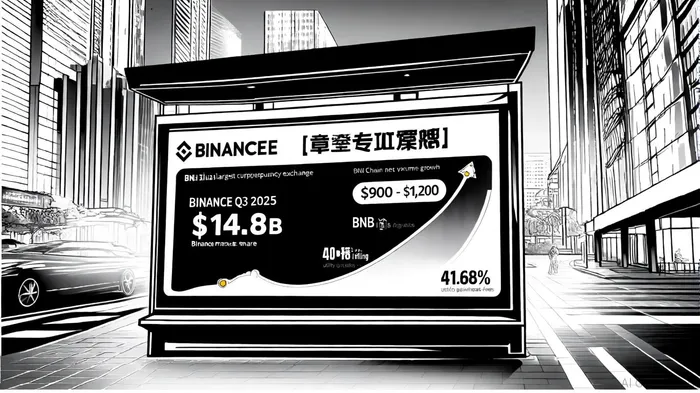
Binance's Q3 2025 performance underscores its role as the de facto gateway for global crypto capital. According to a Binance report, the exchange recorded $14.8 billion in net inflows, dwarfing the combined $94 million from the next ten largest centralized exchanges. This 158x gap highlights Binance's unparalleled ability to attract liquidity, driven by its 290 million users, $31 billion in stablecoin reserves, and robust compliance infrastructure, according to BZNS Media. Such inflows directly correlate with BNB's price action, as the token surged to $1,200 amid heightened futures market interest, per The Currency Analytics.
Network Usage: BNBBNB-- Chain's Efficiency and Scalability
The BNB Smart Chain (BSC) and its Layer 2 solution, opBNB, demonstrated exceptional scalability in Q3 2025. Daily active users reached 2.27 million on BSC and 1.79 million on opBNB, while total transactions hit 10.1 billion, according to a BNB Chain update. This growth was amplified by a 214.5% year-over-year increase in daily transactions (11.44 million as of September 2025), according to YCharts. Critical to this success was the reduction of gasGAS-- fees to 0.05 Gwei ($0.005 per transaction), making BNB Chain one of the most cost-efficient blockchains, according to a Binance post.
Fee revenue for the BNB Chain nearly doubled to $357.3 million in Q3 2025, driven by applications like PancakeSwapCAKE-- and VenusXVS--, according to Dropstab. This revenue model-where transaction demand directly supports BNB's utility-creates a flywheel effect: lower fees attract more users, which in turn increases BNB's on-chain activity and price.
Token Utility Expansion: From Gas to Governance
BNB's utility has expanded beyond its traditional role as a gas token. Binance's Q3 inflows and BNB Chain's fee revenue have reinforced BNB's value proposition in three key areas:
1. Gas and Staking: The 0.05 Gwei minimum gas price ensures BNB remains the primary medium for on-chain activity, according to Social Capital Markets.
2. Rewards and Incentives: Binance's BNB-based reward programs, including Binance Alpha and staking yields, have driven token demand, per Business of Apps.
3. Governance and Compliance: Binance's Proof-of-Reserve (POR) system and $1 billion SAFU fund enhance trust, indirectly boosting BNB's institutional adoption.
Analysts project BNB could reach $1,300 as these utilities converge with macroeconomic tailwinds, per CoinGape.
Exchange Dominance: Binance's Structural Advantages
Binance's 41.68% share of global CEX volume, according to CoinLaw, is underpinned by its regulatory compliance (22 licenses, 1,280+ compliance staff) and product innovation (e.g., Binance Pay, which processed $110 million in fees in 2025). This dominance creates a self-reinforcing cycle: higher volume attracts more traders, which increases BNB's utility, further solidifying Binance's market position.
Future Outlook: Challenges and Opportunities
While Binance's Q3 performance is impressive, risks persist. Regulatory scrutiny in key markets and competition from Ethereum's Layer 2 solutions could temper growth. However, Binance's focus on opBNB, cross-chain bridges, and institutional partnerships positions it to maintain its lead.
For investors, BNB's trajectory hinges on three metrics:
1. Network Activity: Sustained growth in transactions and active wallets.
2. Fee Revenue: Continued expansion of BNB Chain's GDP.
3. Exchange Inflows: Binance's ability to retain its $14.8 billion Q3 inflow momentum.
Conclusion
Binance's Q3 2025 results illustrate a platform at the peak of its influence. With BNB's price, utility, and ecosystem growth aligned, the token is well-positioned to challenge Ethereum's dominance in the near term. However, investors must monitor regulatory developments and competitive dynamics to fully capitalize on this momentum.






Comentarios
Aún no hay comentarios