
Binance Overtakes CME in Bitcoin Futures: A Retail-Led Shift in Crypto Market Dynamics
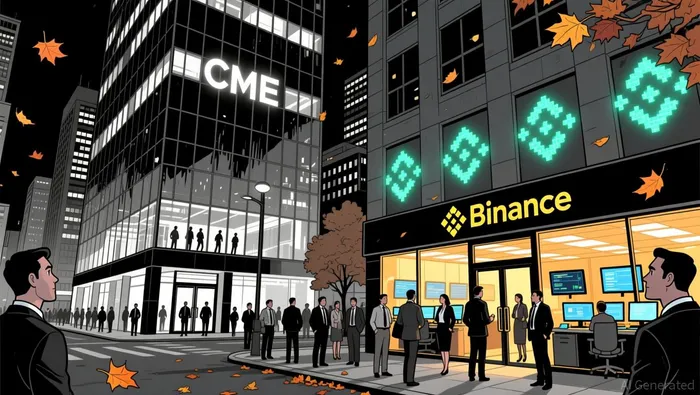
The global crypto derivatives market is undergoing a seismic shift. By late 2025, Binance had surpassed the CME GroupCME-- in BitcoinBTC-- futures open interest, a milestone signaling a broader realignment of market dynamics. This transition, driven by declining institutional basis trading and surging retail participation, is reshaping risk profiles and unlocking new opportunities for traders and investors.
Market Dynamics: Binance's Rise and CME's Retreat
Binance's dominance in the derivatives space has solidified, with the exchange capturing 29.3% of global crypto derivatives volume in 2025-equivalent to $25.09 trillion in trading activity according to CoinGlass. Meanwhile, the CME's Bitcoin futures open interest, which peaked at 175,000 BTC in early 2025, declined to 123,000 BTC ($11 billion) by year-end. Binance, in contrast, maintained steady open interest of 125,000 BTC, reflecting its appeal to retail traders seeking directional exposure. This divergence underscores a structural shift: while institutions are retreating from basis trading, retail-driven volatility is amplifying Binance's role as a liquidity hub.
Institutional Retreat: Basis Trading's Decline and Strategic Reallocation
Institutional participation in crypto derivatives has not wained overall but has shifted focus. The CME's basis rate-a measure of the premium paid for futures over spot prices-compressed to 5% by late 2025, eroding returns for traditional basis trading strategies. As profitability diminished, institutions pivoted toward regulated products like ETFs and options, with corporate holdings of crypto assets exceeding $185 billion in Q4 2025. This reallocation reflects a maturation of institutional strategies, prioritizing risk management and yield generation (e.g., staking, lending) over speculative arbitrage.
However, this retreat from basis trading has left a void. The CME's open interest decline-driven by year-end deleveraging and position closures-highlights a loss of institutional liquidity. Binance, meanwhile, has capitalized on this gap, becoming the preferred venue for retail-driven directional bets.
Retail Surge: Volatility as a New Asset Class
Retail traders now dominate Bitcoin futures trading on Binance, accounting for a significant portion of its $30 billion daily open interest. This shift has amplified market volatility, as retail participation tends to be more speculative and less hedged. For instance, Binance's stable open interest throughout 2025 contrasts with CME's steady decline, illustrating how retail demand for leveraged exposure creates asymmetric price swings.
This volatility, while traditionally viewed as a risk, is emerging as a new asset class. Traders can now profit from retail-driven momentum through strategies like:
1. Short-term options trading on platforms offering Bitcoin options with high implied volatility.
2. Inverse ETFs or leveraged tokens to capitalize on rapid price corrections.
3. Stablecoin arbitrage as retail-driven liquidity imbalances create temporary dislocations between spot and derivatives markets according to market insights.
Opportunities in the New Paradigm
The institutional-retail divide presents actionable opportunities:
- For Institutional Investors: The decline in basis trading profitability has pushed institutions toward structured products (e.g., Bitcoin yield strategies via staking or call overwriting). These tools allow for income generation without direct exposure to volatile price swings according to market analysis.
- For Retail Traders: Binance's retail-friendly infrastructure-low fees, high leverage, and a diverse product suite-enables participation in Bitcoin's price action. However, retail traders must hedge against liquidity risks, as sudden deleveraging events can exacerbate volatility.
- For Market Makers: The gap between institutional and retail activity creates arbitrage opportunities. For example, discrepancies in open interest between Binance and CMECME-- can be exploited through cross-exchange basis trades.
Conclusion: A Market Reimagined
The overtaking of CME by Binance in Bitcoin futures is not merely a market share shift-it is a redefinition of crypto's risk landscape. As institutions pivot toward regulated yield strategies and retail traders drive volatility, the market is bifurcating into two distinct ecosystems. For investors, this duality demands a nuanced approach: leveraging retail-driven momentum while hedging against institutional liquidity shifts.
In this new era, the winners will be those who adapt to the duality of crypto's institutionalization and democratization-capitalizing on volatility as both a challenge and an opportunity.







Comentarios
Aún no hay comentarios