
Binance's Oracle Vulnerabilities and Systemic Risks in Leveraged Crypto Trading
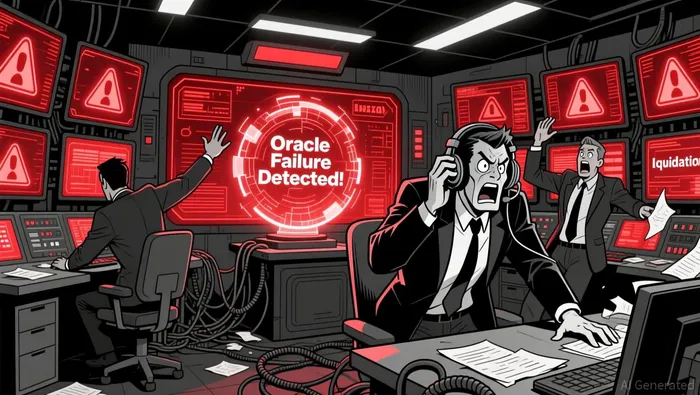
The October 2025 oracle failure on Binance exposed a critical vulnerability in centralized exchange (CEX) collateral models and their reliance on centralized data feeds. This event, which saw assets like Ethena's USDeUSDe-- stablecoin, Wrapped Beacon ETHWBETH-- (wBETH), and Binance Staked SOLBNSOL-- (BnSOL) plummet to fractions of their value within days, triggered a cascading liquidation crisis. The incident underscores the systemic risks inherent in leveraged crypto trading when oracle systems-responsible for price feeds and collateral valuation-fail or are manipulated. For investors, this raises urgent questions about the structural integrity of both CEX and DeFi ecosystems.
The October 2025 Oracle Failure: A Case Study in Systemic Risk
On October 10, 2025, Binance's oracle system began updating its pricing methodology, coinciding with a sharp and unexplained drop in key asset prices. USDe fell to 65 cents, wBETH to 20 cents, and BnSOLBNSOL-- to 13 cents within an eight-day window according to research. This collapse activated a self-reinforcing liquidation loop, overwhelming the exchange's Auto-Deleveraging (ADL) mechanisms designed to manage highly leveraged positions according to analysis. ADL, intended to preserve solvency, instead accelerated the downward spiral by forcing mass liquidations, further depressing prices.
The root cause was attributed to operational security lapses during oracle updates, though speculation of a coordinated attack persists according to Binance. Binance responded with a $100 million liquidity program for market makers and compensation for affected users according to analysis. However, the event highlighted a fundamental flaw: centralized oracles act as single points of failure, capable of destabilizing entire markets.
Structural Risks in CEX Collateral Models
CEX collateral models rely on institutional oversight and regulatory compliance to manage risks, typically requiring overcollateralization to buffer against asset depreciation or liquidity shocks according to research. In contrast, DeFi protocols often demand even higher collateralization ratios due to crypto's volatility. Yet both systems share a critical dependency on oracles for price feeds and collateral valuation.
The "Oracle Problem" in DeFi-where smart contracts cannot natively access external data-creates vulnerabilities if oracles are compromised or provide inaccurate information according to analysis. CEX models, while benefiting from human oversight, are not immune. Binance's 2025 incident demonstrated how a centralized oracle's failure can trigger systemic risks, particularly in leveraged trading environments where automated liquidations amplify market stress.
DeFi's Oracle Challenges and Systemic Risks
DeFi's permissionless architecture exposes it to unique risks. For instance, the dYdX flash loan attack exploited oracle manipulation to drain funds within seconds according to case study. Similarly, the 2023 GDS Chain and Mycelium Perpetual Swaps hacks revealed flaws in settlement logic and access controls, exacerbated by reliance on unstable third-party price feeds according to analysis. These breaches underscore the dangers of inadequate smart contract audits and poor governance.
Cross-chain vulnerabilities further complicate the landscape. The 2025 Cetus DEX incident exploited slippage and liquidity calculation flaws, while the 2021 Poly Network hack highlighted weaknesses in economic models according to case study. These events reinforce the need for diversified oracle feeds, real-time monitoring, and rigorous audits to mitigate risks.
Comparative Analysis: CEX vs. DeFi Risk Management
While CEX models leverage institutional redundancies to mitigate technological risks, they face regulatory and compliance challenges. DeFi, conversely, prioritizes algorithmic governance but struggles with smart contract exploits and oracle manipulation. A 2023–2025 risk comparison shows DeFi protocols are more susceptible to flash loan attacks due to their permissionless nature according to research. CEX, though less prone to such exploits, remains vulnerable to centralized oracle failures, as seen in Binance's 2025 crisis.
Implications for Investors
For investors, the October 2025 incident and broader DeFi breaches signal the need for caution. Key lessons include:
1. Diversified Oracle Feeds: Protocols and exchanges must adopt multi-source oracles to reduce single-point-of-failure risks.
2. Robust Risk Management: Automated liquidation mechanisms should be stress-tested to avoid exacerbating market downturns.
3. Smart Contract Audits: Regular, third-party audits are critical to identifying vulnerabilities in settlement logic and access controls.
4. Regulatory Scrutiny: CEX operators must balance innovation with compliance to avoid systemic shocks.
Conclusion
Binance's oracle failure and the broader DeFi security landscape reveal a shared vulnerability: overreliance on centralized oracles. While CEX models offer institutional safeguards, they remain exposed to operational risks. DeFi's algorithmic approach, though innovative, demands rigorous security measures to prevent exploitation. For investors, the path forward lies in advocating for decentralized, multi-source oracle systems and robust risk management frameworks-both on-chain and off-chain.







Comentarios
Aún no hay comentarios