
Binance's November 2025 Delistings and Their Implications for Crypto Derivatives Trading
Direct Impact on Derivatives: Position Closure and Liquidity Risks
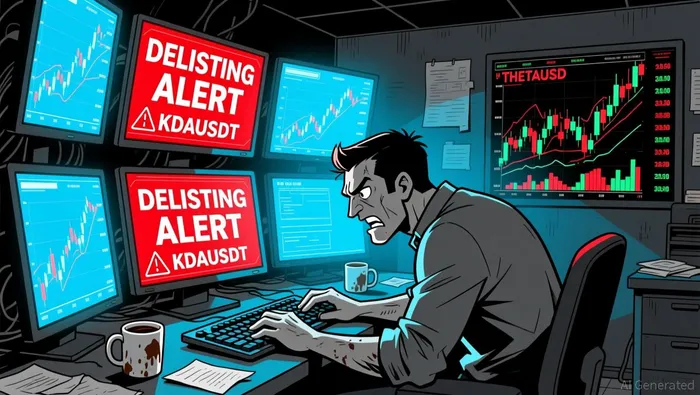
Binance's delistings extend beyond spot trading pairs to include perpetual futures contracts. For instance, the exchange has announced the removal of USDⓈ-M KDAUSDTKDA--, COIN-M AXSUSD, and THETAUSD perpetual contracts on November 6–7, 2025, with automatic position closures and settlements for unmanaged exposure. These actions reflect a broader strategy to phase out low-liquidity assets, as seen in the 25% quarterly decline in trading volume for KDAUSDT.
Traders must act swiftly to avoid forced liquidations. According to Binance's guidelines, open positions in delisted contracts must be closed manually before deadlines, as automatic settlements could result in unfavorable pricing. This creates a window of heightened volatility, as last-minute trading activity may distort price discovery. For example, KadenaKDA-- (KDA) and FlamingoFLM-- (FLM) tokens face delistings on November 12, with deposits and withdrawals ceasing shortly thereafter. Derivatives traders holding these tokens should prioritize hedging or closing positions well before the cutoff to mitigate slippage risks.
Broader Market Implications: Volatility and Institutional Alternatives
The delistings coincide with a pivotal development in the derivatives market: the launch of institutional-grade crypto perpetual futures by SGX Derivatives on November 24, 2025. These products, benchmarked against the iEdge CoinDesk Crypto Indices, offer a regulated alternative to offshore platforms and could absorb liquidity displaced by Binance's delistings. With perpetual futures already accounting for over $187 billion in daily trading volume globally, the SGX initiative signals a shift toward institutional-grade infrastructure that may reduce systemic volatility.
However, the transition period remains precarious. Tokens like DOGEDOGE-- and NILNIL--, which are being delisted from Binance's spot markets, could experience sharp price corrections as liquidity dries up. Historical precedents suggest that delistings often trigger short-term sell-offs, particularly for lower-cap assets. Derivatives traders should monitor open interest and funding rate data for these tokens to anticipate directional moves.
Strategic Position Closure: Actionable Steps for Traders
To navigate these risks, traders should adopt a multi-pronged approach:
1. Proactive Monitoring: Track Binance's official announcements and exchange-specific alerts for delisting schedules. Automated tools can flag position closures days in advance.
2. Liquidity Arbitrage: Use cross-exchange arbitrage to hedge exposure. For example, tokens delisted on Binance may retain liquidity on platforms like Bybit or Kraken.
3. Derivatives Hedging: Utilize options or futures on regulated exchanges (e.g., SGX) to offset directional risks in delisted assets.
4. Risk Diversification: Reduce concentration in tokens with weak fundamentals, as delistings often reflect underlying market sentiment.
Conclusion
Binance's November 2025 delistings are a double-edged sword: they aim to cleanse the market of underperforming assets but also create friction for derivatives traders. By combining proactive position management with institutional-grade alternatives like SGX's perpetual futures, traders can mitigate liquidity risks and capitalize on emerging opportunities. As the crypto market evolves, adaptability-rather than resistance to change-will define successful strategies in 2025 and beyond.






Comentarios
Aún no hay comentarios